
Compound Interest Calculator
Future value:
Total deposits:
Interest earned:
Monthly deposits are assumed to be made at the end of each month. Results are estimates and do not include taxes or fees.
A compound interest calculator shows how much your money grows when the interest you earn is added to your balance and then earns interest itself. Enter your starting principal, annual interest rate, compounding frequency, and time horizon, plus any monthly deposit, and it estimates your future value, total deposits, and total interest earned.
How the Compound Interest Calculator Works
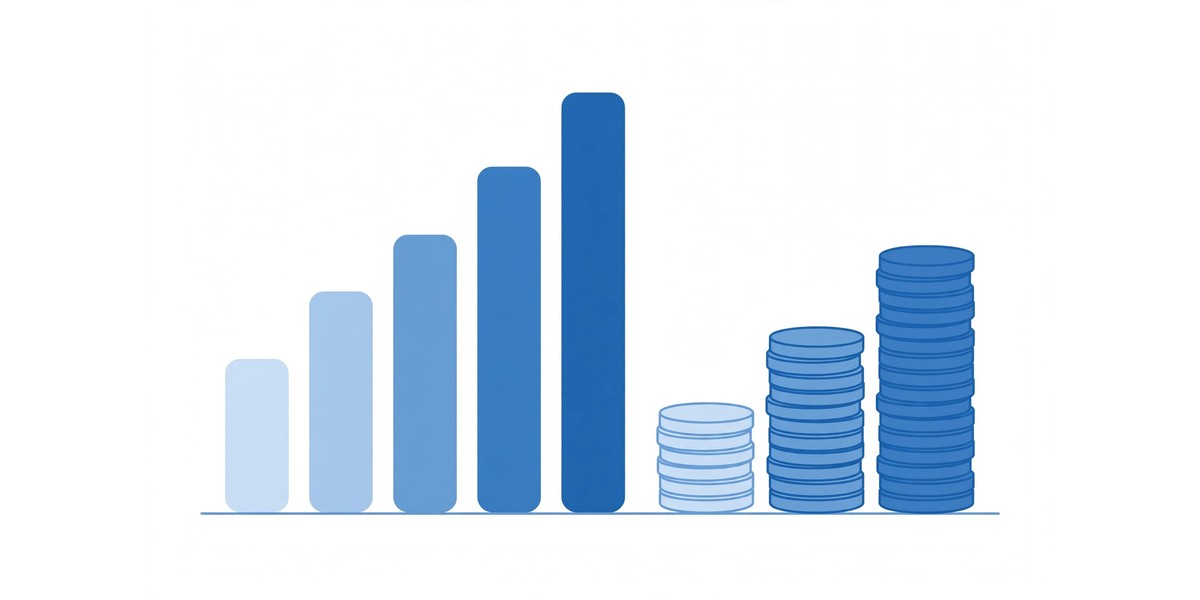
Compound interest is interest earned on both your original deposit and on interest that has already been added to your account. That snowball effect is why money left invested for decades can grow far beyond the sum of the deposits you made. By contrast, simple interest only pays on your original principal, so it grows in a straight line instead of an accelerating curve.
The calculator uses the standard compound interest formula, A = P(1 + r/n)^(nt), where P is your starting principal, r is the annual interest rate as a decimal, n is the number of compounding periods per year, and t is the number of years. When you add a monthly deposit, each deposit compounds from the month it is made until the end of the period, so regular contributions can add up to more than the interest on your starting balance alone.
The compound interest formula, explained
The exponent nt is the total number of compounding periods, and the base (1 + r/n) is the growth factor for each period. Raising that factor to the power of nt shows how repeated, period-by-period growth multiplies your money. This is also why starting early matters so much: every extra year adds another round of compounding on an ever-larger balance.
How to Use This Compound Interest Calculator
- Enter your starting principal, the lump sum you are starting with today.
- Enter the annual interest rate you expect to earn, as a percentage.
- Choose how often interest compounds: yearly, quarterly, monthly, or daily.
- Enter the number of years you plan to leave the money invested.
- If you plan to add money regularly, enter your monthly deposit. Leave it at 0 if you will not add anything.
- Click Calculate to see your future value, total deposits, and interest earned.
Compound Interest Calculator Examples
These worked examples show how the calculator handles different rates, time horizons, and monthly deposits. You can reproduce each one by entering the same inputs above and comparing your result with the table.
| Starting amount | Rate and compounding | Time and monthly deposit | Future value | Interest earned |
|---|---|---|---|---|
| $10,000 | 5%, monthly | 10 years, $0 | $16,470.09 | $6,470.09 |
| $5,000 | 4%, yearly | 5 years, $0 | $6,083.26 | $1,083.26 |
| $1,000 | 6%, monthly | 5 years, $100 | $8,325.85 | $1,325.85 |
Notice the third example: the saver deposited $7,000 in total ($1,000 at the start plus $100 a month for 5 years) yet ended with $8,325.85. The extra $1,325.85 is pure interest, earned mostly on the steady monthly deposits rather than on the small starting balance.
Why Compounding Frequency Matters
More frequent compounding means interest is added to your balance sooner, so it starts earning its own interest earlier. The difference between yearly and monthly compounding is modest at low rates, but at higher rates or over longer periods it becomes noticeable. Daily compounding gives the highest return for a given nominal rate, though the gap between daily and monthly compounding is usually small.
What matters far more than frequency is time and consistency. A saver who starts ten years earlier, or who keeps up a regular monthly deposit, will usually beat a saver chasing a slightly higher rate. If you are building a safety net, setting a savings goal first helps you pick a monthly deposit you can actually sustain. And if high-interest debt is eating your cash flow, paying off debt sooner often beats investing, because the interest you avoid is a guaranteed return.
- Start early: time in the market beats timing the market.
- Deposit regularly: even small monthly amounts compound into large sums.
- Reinvest earnings: withdrawing interest breaks the compounding chain.
- Compare after-tax returns: taxes can shrink the rate you actually keep.
Compound Interest Calculator FAQs
What is compound interest?
Compound interest is interest calculated on your original principal plus all interest previously earned. Each compounding period, the interest is added to your balance, so the next period earns interest on a larger amount.
How is compound interest different from simple interest?
Simple interest is calculated only on the original principal, so it grows by the same dollar amount each period. Compound interest grows faster over time because each period earns interest on an ever-larger balance.
What is a good interest rate to use in the calculator?
It depends on where your money sits. A high-yield savings account might pay around 4 to 5 percent, while long-term stock market returns have historically averaged about 7 to 10 percent before inflation. Use a conservative rate for planning, and run a second calculation at a lower rate to see a cautious scenario.
Does the calculator include taxes or inflation?
No. The results are before taxes and before inflation, so your real purchasing power will be lower than the headline future value. Treat the figure as a planning estimate, not a guaranteed outcome.
How much should I deposit each month?
A common guideline is to save 15 to 20 percent of your income, including any employer retirement match. The right amount depends on your budget, so start with a figure you can maintain every month without fail, then raise it when your income grows.
Can compound interest work against me?
Yes. The same math applies to loans and credit card balances: unpaid interest compounds, so a debt can grow quickly if you only make minimum payments. That is why clearing expensive debt is often the best first use of spare cash.
Learn More
Explore related calculators to plan the rest of your finances: