Biweekly Mortgage Calculator
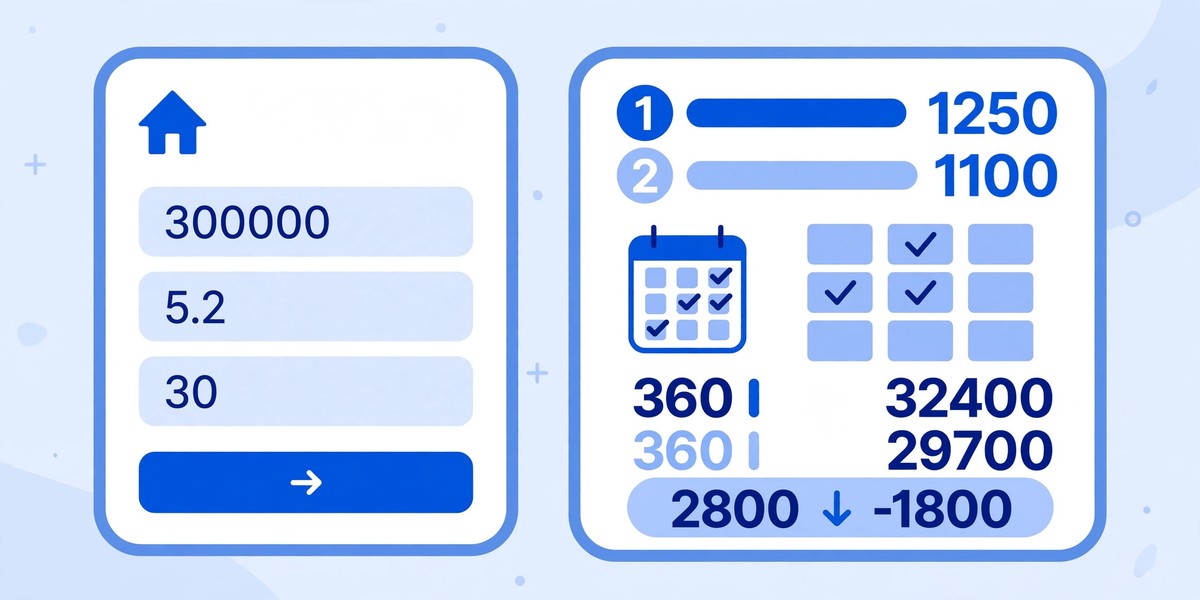
See how paying half your mortgage every two weeks shortens your loan and cuts interest.
Your results
Results assume monthly compounding converted to an equivalent biweekly rate, with no fees or escrow changes. For planning estimates only.
A biweekly mortgage calculator shows how paying half of your monthly mortgage payment every two weeks can shorten your loan and cut your total interest. Because there are 26 biweekly periods in a year, you end up making the equivalent of 13 monthly payments instead of 12. That extra payment goes straight toward your principal, which shrinks your balance faster and can save tens of thousands of dollars over the life of the loan.
How Biweekly Mortgage Payments Work
With a standard monthly plan, you make 12 full payments per year. With a biweekly plan, your lender (or your own autopay schedule) drafts half of your monthly payment every two weeks. That adds up to 26 half-payments per year, which equals 13 full monthly payments. The extra monthly payment is applied entirely to principal, not interest, so each year you knock roughly one extra month off your loan schedule.
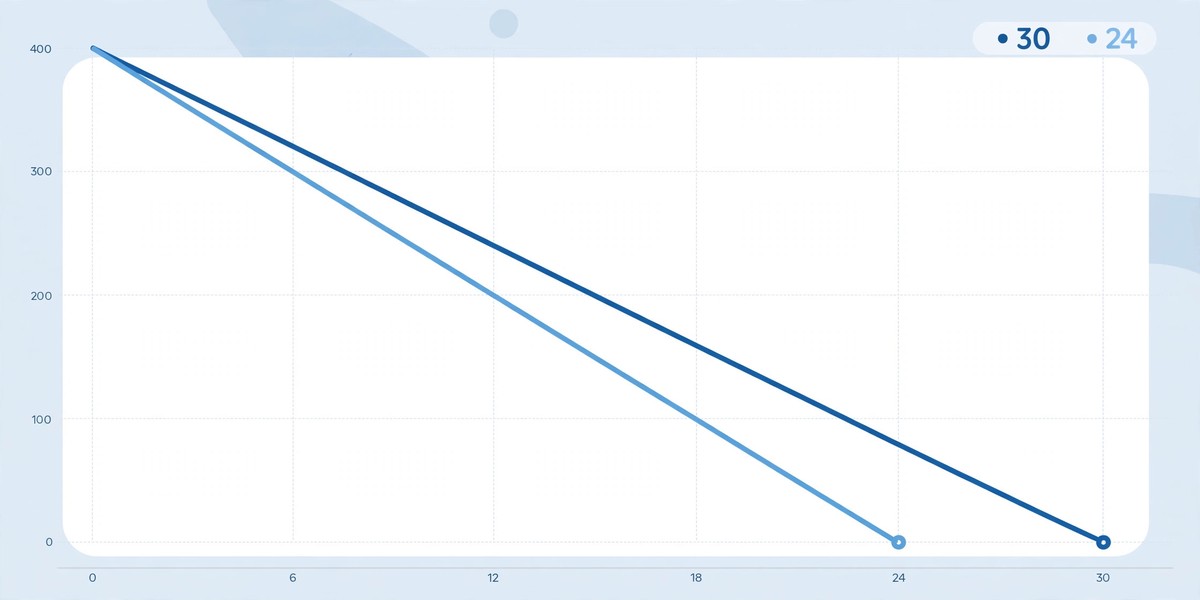
There is a second, smaller benefit. Because part of your payment arrives sooner, slightly less interest accrues between payments. The combination of faster principal reduction and earlier payments is what shortens a 30-year loan to about 23 to 24 years for most borrowers.
How to Use This Biweekly Mortgage Calculator
- Enter your loan amount. Type your original mortgage balance in dollars, for example 300000. Do not include commas or a dollar sign.
- Enter your annual interest rate. Use your note rate, the percentage printed on your mortgage documents. In the current US market, most 2026 fixed rates fall between 6 and 7 percent.
- Choose your loan term. Pick 30, 20, 15, or 10 years from the dropdown. This is the original length of your loan, not the time you have left.
- Add extra principal (optional). If you plan to pay additional principal with each biweekly payment, enter that amount. The default is zero.
- Click Calculate Savings. The calculator builds a full biweekly amortization schedule and compares it against the standard monthly schedule.
- Read your results. You will see both payment amounts, the payoff date under each plan, the total interest under each plan, the interest saved, and the extra principal you pay each year.
If you make a typing mistake, the calculator shows a friendly message explaining what to fix. It accepts loan amounts up to 20,000,000 and rates from 0.1 to 25 percent.
Biweekly Mortgage Savings Examples
The table below shows three common US loan scenarios at 2026 rates. All figures were computed with a period-by-period amortization schedule using monthly compounding converted to an equivalent biweekly rate.
| Loan scenario | Monthly payment | Biweekly payment | Biweekly payoff time | Interest saved |
|---|---|---|---|---|
| $250,000 at 6.5%, 30 years | $1,580.17 | $790.09 | 24 years, 1 month | $74,454 |
| $300,000 at 7.0%, 30 years | $1,995.91 | $997.95 | 23 years, 8 months | $104,888 |
| $400,000 at 6.0%, 30 years | $2,398.20 | $1,199.10 | 24 years, 6 months | $100,556 |
Notice the pattern. On a $300,000 loan at 7 percent, biweekly payments shave more than 6 years off the loan and save over $100,000 in interest, because each year you effectively pay an extra $1,995.91 toward principal. Higher rates magnify the savings, since more of your monthly payment would otherwise go to interest.
Frequently Asked Questions
Do biweekly mortgage payments really save money?
Yes. You make 26 half-payments per year, which equals 13 full monthly payments. The extra payment goes entirely to principal, so your balance drops faster and less interest accrues. On a typical 30-year loan at current rates, borrowers save tens of thousands of dollars and finish paying 6 to 7 years early.
How much faster do you pay off a 30-year mortgage with biweekly payments?
Most 30-year mortgages pay off in about 23 to 24 years with biweekly payments and no extra principal. For example, a $300,000 loan at 7 percent pays off in 23 years and 8 months, which is 6 years and 4 months early. Adding even $100 of extra principal per biweekly payment can cut the payoff to 19 years.
Is biweekly the same as paying twice a month?
No, and the difference matters. Twice a month (semimonthly) means 24 half-payments per year, which equals exactly 12 monthly payments, so there is no savings benefit. Biweekly means 26 half-payments, which equals 13 monthly payments. Only the biweekly schedule produces the extra annual payment.
Do lenders charge a fee for biweekly mortgage plans?
Some lenders and third-party services charge a setup fee, a per-payment fee, or both. Before signing up, ask about all fees and do the math. You can get the same result for free by dividing your monthly payment by 12 and adding that amount to each monthly payment as extra principal.
Can I switch back to monthly payments later?
In most cases, yes. Biweekly plans are usually voluntary and can be canceled by contacting your servicer. If you use the do-it-yourself method of adding one-twelfth of your payment each month, you can simply stop adding the extra amount whenever you want.
Are biweekly payments worth it if my rate is already low?
They still shorten your loan term, but the dollar savings are smaller at low rates because less interest accrues in the first place. At a 3 percent rate, the same $300,000 loan saves roughly $21,000 rather than $100,000. If your rate is low and you have higher-interest debt or better investment options, those may be a better use of the extra cash.