
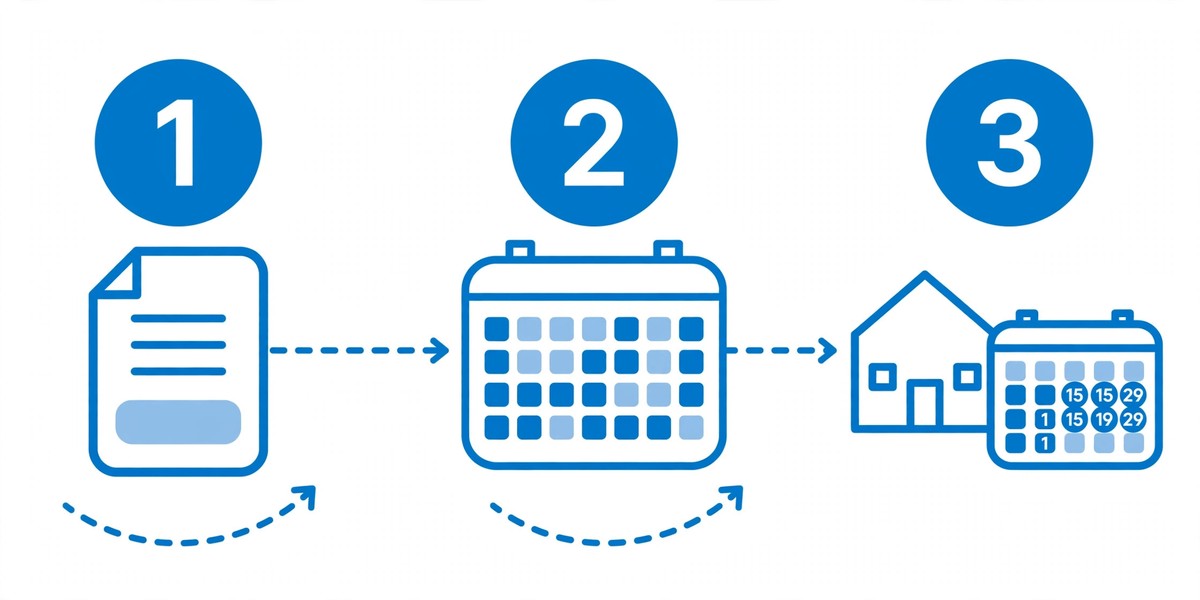
Setting up biweekly mortgage payments takes five steps: confirm there is no prepayment penalty, choose between your servicer’s program or a free do-it-yourself method, add one-twelfth of your monthly payment as extra principal each month, mark it principal-only, and verify it on your statements. The DIY method avoids the $200 to $400 fees many servicers charge.
There are two ways to get the biweekly benefit: enroll in a servicer-run program, or replicate it yourself for free. Both produce the same result, 13 monthly payments per year instead of 12. This guide covers both paths so you can pick the one that fits.
What do you need before you start?
Gather these items before you set anything up:
- Your current monthly payment amount. Find the principal-and-interest portion on your mortgage statement. For the DIY math below, a $300,000 loan at 7% has a monthly payment of about $1,996.
- Your servicer’s contact information. You will find it on your monthly statement or in your online loan account.
- Your loan documents or online account access. You need these to check for a prepayment penalty and to confirm how extra payments are applied.
- A small emergency cushion. Make sure you can comfortably cover the extra amount each month without raiding savings meant for emergencies.
- A decision on method. Servicer program or DIY? Step 2 below compares them side by side.
Step 1: Confirm there is no prepayment penalty
Before accelerating any mortgage, check that your loan allows extra principal payments without a fee. The good news: the vast majority of US residential mortgages originated after 2014 carry no prepayment penalty, because federal rules sharply restricted them. Still, verify rather than assume.
Check your closing documents for a “prepayment penalty” section, or simply call your servicer and ask. In most cases the answer is no penalty, and you can move on to step 2.
Step 2: Choose your setup method
You have two options, and the math works out the same either way:
| Servicer biweekly program | DIY extra-principal method | |
|---|---|---|
| How it works | Servicer drafts half your payment every two weeks | You add 1/12 of your payment to each monthly payment |
| Cost | Often $200 to $400 to enroll | Free |
| Setup effort | Phone call or online enrollment | One bank transfer setup |
| Flexibility | May require formal cancellation | Stop or change anytime |
| Best for | People paid biweekly who want full automation | Almost everyone else |
Before you decide, it helps to see the payoff. Use our biweekly mortgage calculator to preview how much interest you would save and how many years you would shave off your own loan.
Step 3: Set up the free DIY method
The DIY method, recommended by consumer advocate Clark Howard, reproduces the biweekly effect with zero fees. The logic is simple: one-twelfth of your monthly payment, added every month, equals one full extra payment per year. Follow these steps:
- Do the division. Take your monthly principal-and-interest payment and divide by 12. For a $1,995.91 payment: $1,995.91 / 12 = $166.33. That is your monthly extra amount. Verify: $166.33 x 12 = $1,995.96, which is one extra payment per year (off by four cents from rounding).
- Log in to your bank’s bill pay or your servicer’s website. Find your existing recurring mortgage payment.
- Add a separate recurring monthly transfer for the extra amount. Schedule it for the same day as your regular payment. Keeping it as a separate transfer makes it easy to label and track.
- Label it “principal only.” This is the critical step. Most servicers let you designate extra funds as principal-only online; if yours does not, call and ask how to ensure the extra is applied to principal rather than held as a future payment.
- Confirm the first application. After your first extra payment posts, check your statement to make sure the principal balance dropped by the expected amount and the funds were not parked in a suspense account.
That is the entire setup. You are now making the equivalent of 13 payments per year, capturing the full biweekly savings with no enrollment fee.
Step 4: Or enroll through your servicer
If you prefer the servicer to handle everything, call the number on your mortgage statement and ask about biweekly payment options. Before you agree to anything, protect yourself with these checks:
- Ask for all fees in writing. Enrollment fees of $200 to $400 are common, plus possible per-transaction charges.
- Confirm the extra goes to principal, and ask when half-payments are credited. Some servicers hold partial payments, which slightly reduces savings.
- Ask how to cancel, and whether returning to monthly payments triggers a fee or waiting period.
- Get the enrollment confirmation in writing, showing your start date, draft amounts, and fee total.
Step 5: Verify the extra payments are working
Setup is not complete until you confirm the money is landing where it should. Do these checks:
- Review your first three statements. Each should show the extra applied to principal, not parked in a suspense account.
- Watch the principal balance. It should fall faster than your original amortization schedule projected.
- Recheck once a year. Servicers occasionally change payment processing after system updates.
- Keep records of your extra payments in case a dispute arises about how funds were applied.
What mistakes should you avoid?
- Skipping the “principal only” label. Unlabeled extra money may be applied to future payments instead of principal.
- Paying enrollment fees needlessly. The free DIY method delivers the same savings math.
- Assuming half-payments credit instantly. Some programs hold funds, which trims the savings.
- Stretching your budget. The extra 8.3% per year should come from genuine surplus, not emergency savings.
- Creating autopay conflicts. If you have autopay for the base payment, schedule the extra transfer for the same day and confirm the first cycle.
Frequently asked questions
Can I set up biweekly payments without my servicer?
Yes. The DIY method needs no servicer enrollment: just add one-twelfth of your monthly payment as extra principal each month. On a $1,995.91 payment, that is $166.33 extra per month, which totals one extra payment per year and produces the same savings as a formal biweekly program.
How long does it take to set up?
The DIY method takes about 15 minutes: one division problem, one recurring transfer, and one principal-only confirmation. Servicer enrollment takes one call plus a few business days, plus time to review fee disclosures.
Will my servicer charge a fee for biweekly payments?
Possibly. Servicer-run and third-party biweekly programs commonly charge $200 to $400 to enroll, sometimes with ongoing transaction fees. The DIY approach of adding extra principal yourself carries no fee at all, which is why consumer advocates recommend it.
What if I am paid monthly instead of biweekly?
The DIY method suits monthly paychecks perfectly: one monthly payment plus a fixed extra amount. The savings come from the extra annual payment, not from matching your pay schedule.
Can I stop biweekly payments later?
With the DIY method, yes, immediately: just cancel or pause the extra transfer. With a servicer program, you typically must request cancellation, and some programs impose a fee or notice period. This flexibility gap is another reason the DIY method is popular.
Does the extra money automatically go toward principal?
Not always. Some servicers apply unlabeled extra funds to future payments or hold them in suspense. Always designate extra payments as principal-only in your servicer’s portal or by phone, and verify on your next statement that the principal balance dropped accordingly.