Quick answer: Biweekly payments save more than monthly payments in almost every case. On a $300,000, 30-year loan at 7%, biweekly payments finish the loan in about 24 years and save roughly $103,000 in interest versus standard monthly payments. Monthly payments only win when a biweekly plan charges fees or you need maximum budget flexibility.
The Short Answer in Numbers
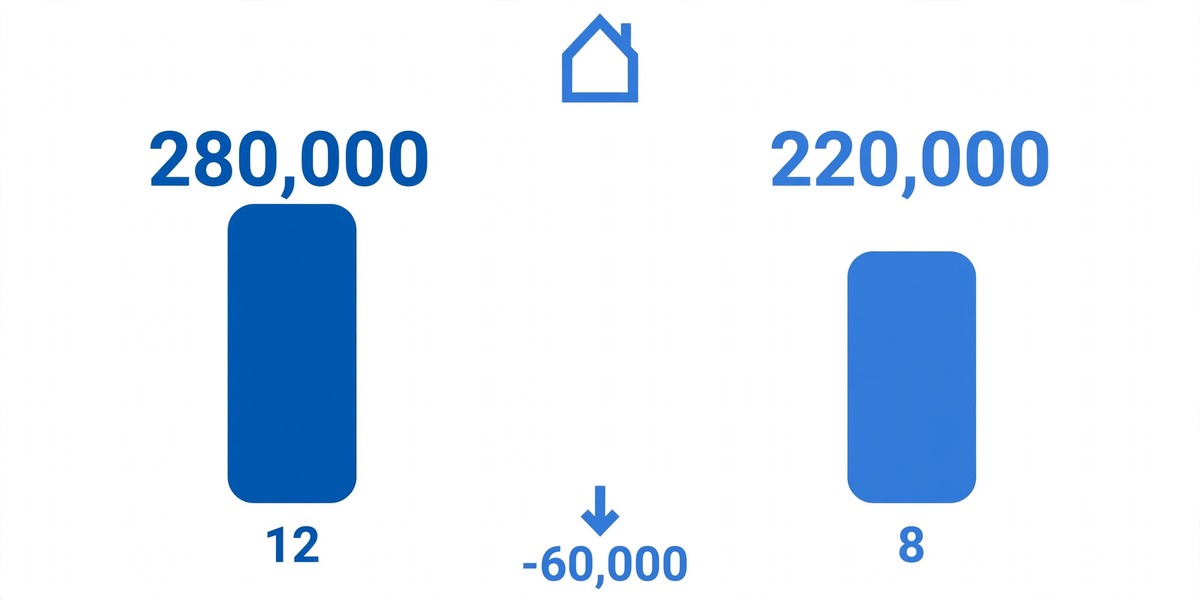
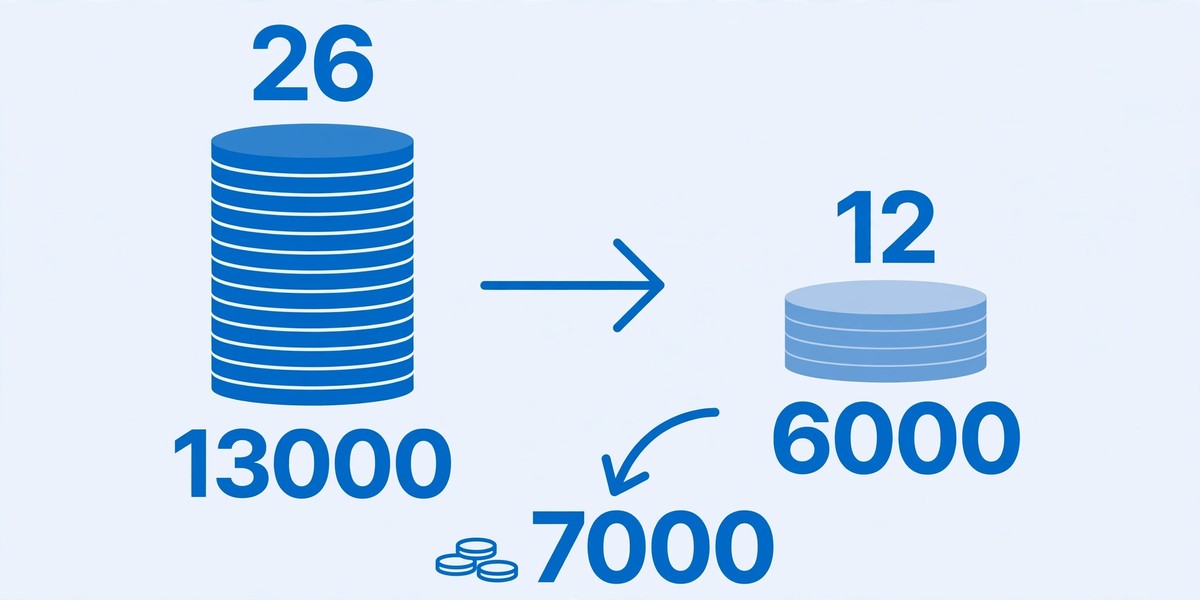
The comparison is not close. A biweekly schedule makes 26 half-payments a year, equal to 13 full monthly payments, while a monthly schedule makes only 12. That one extra payment per year goes straight to principal and compounds over the life of the loan.
Here is the head-to-head result for a $300,000, 30-year mortgage at 7%, with every figure verified:
| Monthly payments | Biweekly payments | |
|---|---|---|
| Payment amount | $1,995.91 per month | $997.95 every two weeks |
| Payments per year | 12 | 26 (13 monthly equivalents) |
| Total paid per year | $23,950.92 | $25,946.70 |
| Payoff time | 30 years | About 23.7 years |
| Total interest | $418,527 | $315,139 |
| Interest saved | – | $103,388 |
The biweekly borrower pays about $1,996 more per year, roughly $166 per month on average, and in exchange wipes out more than six years of payments and over $100,000 in interest. Run your own loan through our biweekly mortgage calculator to see your own numbers.
Does the Winner Change at Different Loan Sizes?
No. Biweekly wins by a similar margin across loan sizes and rates. Verified results for a second scenario, a $350,000, 30-year loan at 6.5%:
| Monthly payments | Biweekly payments | |
|---|---|---|
| Payment amount | $2,212.24 per month | $1,106.12 every two weeks |
| Total paid per year | $26,546.88 | $28,759.12 |
| Payoff time | 30 years | About 24.2 years |
| Total interest | $446,406 | $343,597 |
| Interest saved | – | $102,809 |
The pattern holds: about six years shaved off, about $100,000 kept. Larger loans and higher rates widen the dollar gap even further, while smaller loans narrow it, but the direction never flips.
Why Does Biweekly Win by So Much?
Three mechanics combine to produce the large savings:
- One extra payment per year. Thirteen monthly equivalents instead of twelve means 8.3% more money attacks the loan each year.
- The extra goes to principal. Regular payments mostly cover interest in the early years. On the $300,000 example, the first year of monthly payments sends $20,903 to interest and only $3,047 to principal. The extra biweekly payment skips the interest line almost entirely.
- Compounding in your favor. Every dollar of extra principal shrinks the balance that future interest is calculated on. That snowball is why a modest 8.3% annual overpayment cuts the loan term by more than 20%.
What About DIY Biweekly vs Formal Biweekly?
You do not need a lender program to get biweekly-style savings. Adding one-twelfth of your monthly payment to each monthly check, $166.33 extra on the $300,000 example, produces nearly identical results:
- DIY extra payment: $2,162.24 per month, payoff in 285 payments (23.75 years), total interest about $316,100, savings of $102,425 versus standard monthly.
- True biweekly: $997.95 every two weeks, payoff in 617 payments (23.7 years), total interest $315,139, savings of $103,388.
The difference between DIY and formal biweekly is under $1,000 over the life of the loan. The DIY method costs nothing to set up and you control it completely.
When Do Monthly Payments Win?
Monthly payments are the better choice in a few specific situations:
- The biweekly plan charges fees. A setup fee of several hundred dollars plus a few dollars per payment eats directly into your savings. The DIY method avoids this entirely.
- Your budget has no slack. Biweekly costs about 8% more per year on average. If that strains your emergency fund or forces high-interest debt elsewhere, stick with monthly and build savings first.
- You can earn more than your mortgage rate. At 7%, paying down the mortgage beats most safe investments. At 3%, investing the extra $166 a month in a retirement account often wins over decades.
- You plan to sell soon. If you will move within a few years, the savings are small in absolute dollars, though the slightly lower balance still helps.
- Your servicer holds partial payments. Some servicers collect the first half-payment and wait for the second before crediting your account, which blunts the benefit. DIY monthly extras avoid this problem.
The Bottom Line
For a borrower who plans to stay in the home, has room in the budget, and pays no junk fees, biweekly beats monthly on every measure that matters: years saved, interest saved, and equity built. The DIY one-twelfth method captures nearly all of the benefit with none of the enrollment hassle, which makes it the smartest default for most homeowners.
Frequently Asked Questions
Which saves more, biweekly or monthly mortgage payments?
Biweekly saves more in nearly every scenario. On a $300,000, 30-year loan at 7%, biweekly saves about $103,000 in interest and cuts about 6 years off the loan compared with monthly payments.
How much extra do I pay per month with biweekly payments?
About 8% more on average. On a $1,995.91 monthly payment, the biweekly schedule averages about $2,162 per month over the year, or roughly $166 extra per month.
Is it better to pay biweekly or add extra to principal monthly?
They are nearly identical. Adding one-twelfth of your payment each month saves $102,425 on the $300,000 example, versus $103,388 for true biweekly, a difference of under $1,000 over the life of the loan.
Do biweekly payments make sense on a 15-year mortgage?
The benefit is much smaller. On a $300,000, 15-year loan at 7%, biweekly saves about $27,000 and cuts the term to about 13 years, because a 15-year loan carries far less total interest to attack.
Can biweekly payments hurt me financially?
Only in edge cases: lender fees that exceed the savings, a budget too tight for the extra 8% per year, or carrying high-interest debt that should be paid first. For most stable budgets, biweekly is strictly beneficial.
Should I refinance instead of switching to biweekly?
They solve different problems. Refinancing lowers your rate, while biweekly attacks principal at your current rate. If rates have dropped meaningfully since you bought, refinance first, then run the new loan on a biweekly-style schedule for maximum savings.