

Semester GPA Calculator
| Course | Grade | Credits | Quality Points |
|---|
Cumulative GPA (Optional)
Add your prior cumulative GPA and credit hours to combine with this semester.
Answer: A GPA calculator divides your total quality points by your total credit hours. Enter each course’s letter grade and credit hours, multiply each grade’s point value by its credits, add the results, and divide by total credits. The widget above does this instantly for both semester and cumulative GPA.
How the GPA Formula Works
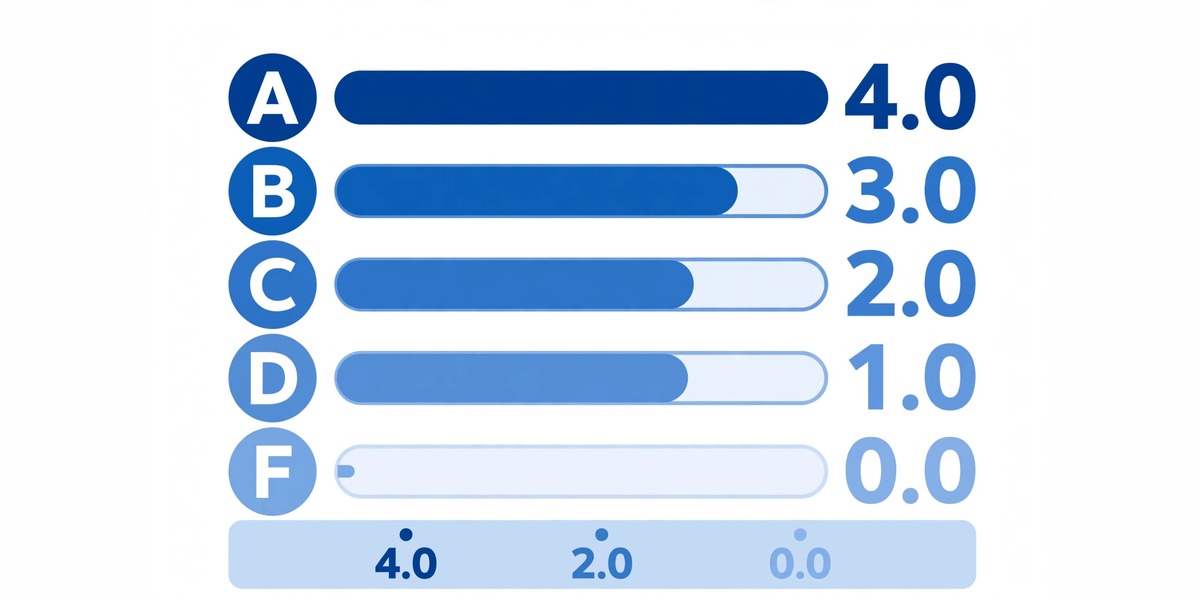
Every letter grade converts to a point value on the standard 4.0 scale: A = 4.0, A- = 3.7, B+ = 3.3, B = 3.0, B- = 2.7, C+ = 2.3, C = 2.0, C- = 1.7, D+ = 1.3, D = 1.0, D- = 0.7, and F = 0.0. Multiply each point value by the course’s credit hours to get that course’s quality points. Add all quality points, then divide by the total credit hours. The result is your GPA, usually shown to two decimal places.
Credit hours weight each course. A 4-credit class counts more than a 1-credit lab, so a B in a 4-credit course affects your GPA more than an A in a 1-credit seminar. That is why the formula uses quality points rather than a simple average of grades.
How to Use This GPA Calculator
- List your courses. Add one row per course using the Add Course button. The course name is optional, but filling it in makes the breakdown table easier to read.
- Pick each grade. Choose the letter grade you earned (or expect) from the dropdown. The calculator uses the standard 4.0 scale shown above.
- Enter credit hours. Type the credit value for each course, from 0 to 9. Most lectures are 3 credits; labs and seminars are often 1 or 2.
- Click Calculate GPA. You get your semester GPA, total credit hours, total quality points, and a per-course breakdown table.
- Add prior terms (optional). To get your combined cumulative GPA, enter your previous cumulative GPA and previous total credit hours. The calculator blends them with this semester automatically.
Worked Example: Semester GPA
Take a student with five courses: English 101 (3 credits, A), Biology 201 (4 credits, B+), US History 150 (3 credits, B), College Algebra 110 (4 credits, C+), and Intro to Art 105 (2 credits, F). Here is the full calculation:
| Course | Grade | Points | Credits | Quality Points |
|---|---|---|---|---|
| English 101 | A | 4.0 | 3 | 12.0 |
| Biology 201 | B+ | 3.3 | 4 | 13.2 |
| US History 150 | B | 3.0 | 3 | 9.0 |
| College Algebra 110 | C+ | 2.3 | 4 | 9.2 |
| Intro to Art 105 | F | 0.0 | 2 | 0.0 |
| Totals | 16 | 43.4 |
Semester GPA = 43.4 / 16 = 2.7125, which rounds to 2.71. Notice how the F in a 2-credit course drags the average down even though three of the grades are B or better. This is the same math the calculator runs in one click.
Worked Example: Cumulative GPA
Cumulative GPA blends every term you have ever completed. The formula is the same, just extended: add this semester’s quality points to your prior total quality points, then divide by combined credit hours.
Continuing the example: suppose the student had a prior cumulative GPA of 3.20 across 45 credit hours. That is 3.20 x 45 = 144.0 prior quality points. Add this semester’s 43.4 quality points and 16 credits:
Combined quality points = 144.0 + 43.4 = 187.4. Combined credits = 45 + 16 = 61. Cumulative GPA = 187.4 / 61 = 3.0721, which rounds to 3.07.
Why Cumulative GPA Moves Slowly
Each new semester is a smaller slice of a growing total. With 45 prior credits, a 16-credit semester makes up only about 26 percent of the new total, so one rough term drops the cumulative average by just 0.13, from 3.20 to 3.07. The more credits you have banked, the harder it becomes to move the needle in either direction.
Common GPA Scale Questions
Most US colleges use the unweighted 4.0 scale in this calculator. High schools often add weight for AP and honors classes, which can push weighted GPAs above 4.0. If your school uses a different scale (for example, a 5.0 weighted scale), convert your grades to the 4.0 equivalents first, or check whether your school publishes its own conversion chart.
Pass/fail courses usually do not count toward GPA at all, so leave them out of the calculator. Transfer credits typically carry hours but not grades at your new school, which means they do not change your institutional GPA.
Frequently Asked Questions
How do I calculate my GPA by hand?
Convert each letter grade to its 4.0-scale point value, multiply by the course’s credit hours, add all the quality points, and divide by total credit hours. For example, an A (4.0) in a 3-credit course gives 12.0 quality points. The calculator above automates every step.
What is a good GPA in college?
A 3.0 is the widely used benchmark for good academic standing and many scholarships. A 3.5 or higher qualifies for dean’s list at most schools and opens doors to competitive internships and graduate programs. Averages vary by major, so compare yourself to your program’s norms, not just the national average.
Do plus and minus grades change my GPA?
Yes, at most schools. An A- is worth 3.7 instead of 4.0, and a B+ is worth 3.3 instead of 3.0. Over several courses, plus and minus grades can shift a GPA by a tenth of a point or more, so use the exact grades your transcript shows.
How is cumulative GPA different from semester GPA?
Semester GPA covers one term only. Cumulative GPA covers every graded course you have completed, weighted by all credit hours earned. Graduate schools and employers that ask for your GPA almost always mean the cumulative figure.
Can I raise my GPA after a bad semester?
Yes, but the math gets tougher as you earn more credits. Retaking a failed course helps at schools with grade replacement, and loading future terms with strong grades steadily pulls the average up. Our guide to raising your GPA walks through the exact numbers.
Does an F hurt more than a withdrawal?
Almost always. An F earns 0.0 quality points while still counting its credit hours, which drags the average down. A withdrawal (W) typically removes the course from the GPA calculation entirely, though too many withdrawals can raise questions on a transcript.