
Answer: Unweighted GPA caps at 4.0 and treats every course equally, so an A is always 4.0. Weighted GPA adds bonus points, usually 0.5 for honors and 1.0 for AP or IB courses, so an A in AP Chemistry can be worth 5.0. Colleges often recalculate applicants on an unweighted scale.
What Is Unweighted GPA?
Unweighted GPA uses the standard 4.0 scale for every course, no matter how difficult the class. An A in regular English 101 and an A in AP Physics both earn 4.0. The highest possible unweighted GPA is a perfect 4.0, which requires straight As.
This is the scale nearly all colleges use for enrolled students, and it is the scale our GPA calculator uses. Because it ignores course difficulty, unweighted GPA is the cleanest measure of the grades themselves.
What Is Weighted GPA?
Weighted GPA rewards students who take harder courses. Schools add bonus points to grades earned in honors, AP, IB, or dual-enrollment classes. The most common system adds 0.5 points for honors and 1.0 point for AP/IB, creating a 5.0 scale where an A in an AP class is worth 5.0.
Because of the bonus, weighted GPAs can climb above 4.0. A student with straight As in AP classes could hold a 5.0 weighted GPA while their unweighted GPA is 4.0. High schools introduced weighting so students would not avoid challenging courses just to protect a perfect average.
How Does the Weighting Math Work?
Take two students, each with four 3-credit courses. Ana takes all regular classes and earns A, A-, B+, B. Ben takes two AP classes and earns the same letter grades: A in AP Calculus, A- in regular English, B+ in AP Biology, B in regular History.
Ana (unweighted): (4.0 + 3.7 + 3.3 + 3.0) x 3 credits = 42.0 quality points / 12 credits = 3.50.
Ben (weighted, +1.0 for AP): AP Calculus A becomes 5.0, AP Biology B+ becomes 4.3. Quality points = (5.0 + 3.7 + 4.3 + 3.0) x 3 = 48.0 / 12 = 4.00. Same letter grades, but Ben’s weighted GPA is half a point higher because two courses carried AP weight.
Ben’s unweighted GPA, meanwhile, is identical to Ana’s: 3.50. Weighting changes the number, not the underlying grades.
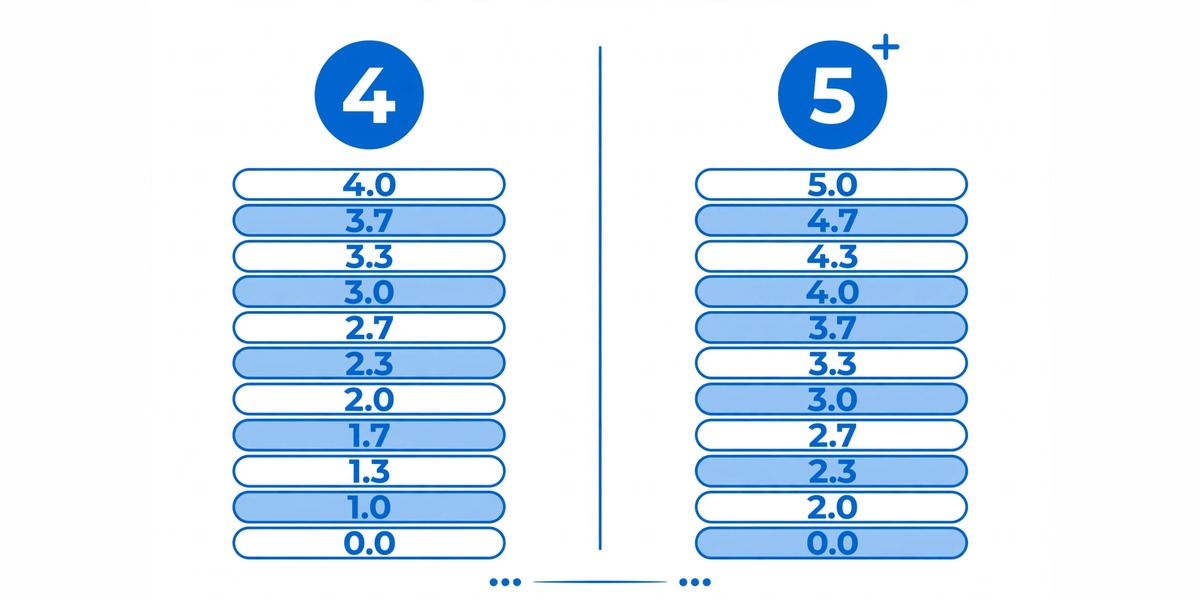
Weighted vs Unweighted GPA: Side-by-Side Comparison
| Feature | Unweighted GPA | Weighted GPA |
|---|---|---|
| Maximum value | 4.0 | 4.5 to 5.0 (varies by school) |
| Honors bonus | None | Usually +0.5 points |
| AP/IB bonus | None | Usually +1.0 point |
| Rewards course rigor | No | Yes |
| Used by colleges for enrolled students | Yes, almost always | Rarely |
| Comparable across schools | Mostly yes | No, scales differ |
Why Do Schools Use Different Weighting Systems?
There is no national standard for weighted GPA, which is the system’s biggest weakness. One school adds 1.0 for AP, another adds 0.5, a third weights only AP exam scores of 4 or 5. Some schools weight honors and AP identically; others do not weight honors at all.
This inconsistency is exactly why colleges recalculate. An admissions office cannot fairly compare a 4.6 from a school with generous weighting against a 4.1 from a strict one, so most selective colleges strip the weight away and evaluate everyone on an unweighted 4.0 scale, then consider course rigor separately.
Which GPA Do Colleges Look At?
For admissions, colleges look at both, but in different ways. They recalculate your unweighted GPA to compare you fairly with applicants from other schools, then they examine your transcript for rigor: how many AP, IB, honors, or dual-enrollment courses you took relative to what your school offered.
In other words, a 3.7 unweighted GPA with six AP courses usually beats a 4.0 unweighted GPA with zero advanced courses at a selective school. The weighted number itself matters less than the story behind it.
Once you are enrolled, the question disappears: colleges compute your college GPA on the unweighted 4.0 scale, and graduate schools and employers use that figure.
How Do I Convert Weighted GPA to Unweighted?
Subtract the bonus points your school added, then recompute. If your school adds 1.0 per AP course and you took 4 AP courses out of 24 total semester courses, remove 4.0 total bonus points from your quality-point sum and divide by total credits again.
Example: a weighted GPA of 4.25 across 72 credits means 306.0 weighted quality points. If 12 of those credits were AP courses carrying a 1.0 bonus each, subtract 12.0 bonus points: (306.0 – 12.0) / 72 = 294.0 / 72 = 4.08 unweighted. The exact adjustment depends on your school’s specific weighting rules.
Frequently Asked Questions
Is a 4.2 GPA good?
It depends on the scale. A 4.2 weighted GPA is strong but common among students taking AP courses. A 4.2 unweighted GPA is impossible on a 4.0 scale, so always check which scale a number refers to before comparing.
Do colleges prefer weighted or unweighted GPA?
Neither directly. Admissions offices recalculate an unweighted GPA for fair comparison and separately evaluate how challenging your coursework was. Taking harder classes and earning slightly lower grades usually looks better than an easy perfect record.
Can my weighted GPA go down if I take regular classes?
Yes. An A in a regular class earns 4.0 while your weighted average might sit at 4.4, so each regular-course A pulls the weighted average down slightly. This is a quirk of the math, not a reason to avoid classes you need.
What is a good weighted GPA for Ivy League schools?
Admitted students at highly selective schools typically present weighted GPAs between 4.0 and 4.5, but these schools recalculate on their own scales. Course rigor, class rank, and test scores matter as much as the headline number.
Does my high school weighting follow me to college?
No. Your college transcript starts fresh on the unweighted 4.0 scale. AP credits may transfer as course credit, but the bonus points do not transfer into your college GPA.
Should I take AP classes just to boost my weighted GPA?
Take them for the learning and the rigor signal, not the number alone. A B in AP Chemistry (often weighted to 4.0) equals an A in a regular class numerically, but admissions officers notice the ambition. Do not overload to the point that grades collapse.