Answer: To calculate your GPA, convert each letter grade to its point value on the 4.0 scale, multiply by the course’s credit hours to get quality points, add all quality points, and divide by total credit hours. For example, 37.3 quality points divided by 12 credits gives a 3.11 GPA.
What Is the GPA Formula?
GPA stands for grade point average, and the formula is a weighted average, not a simple one:
GPA = Total Quality Points / Total Credit Hours
Quality points are what give the formula its weight. Each course contributes its grade’s point value times its credit hours, so a 4-credit course counts four times as much as a 1-credit course. If you prefer the hands-off route, our GPA calculator runs the whole formula instantly from your grades and credits.
What Are Quality Points?
Quality points turn letter grades into numbers you can do math with. On the standard US 4.0 scale, the values are: A = 4.0, A- = 3.7, B+ = 3.3, B = 3.0, B- = 2.7, C+ = 2.3, C = 2.0, C- = 1.7, D+ = 1.3, D = 1.0, D- = 0.7, and F = 0.0.
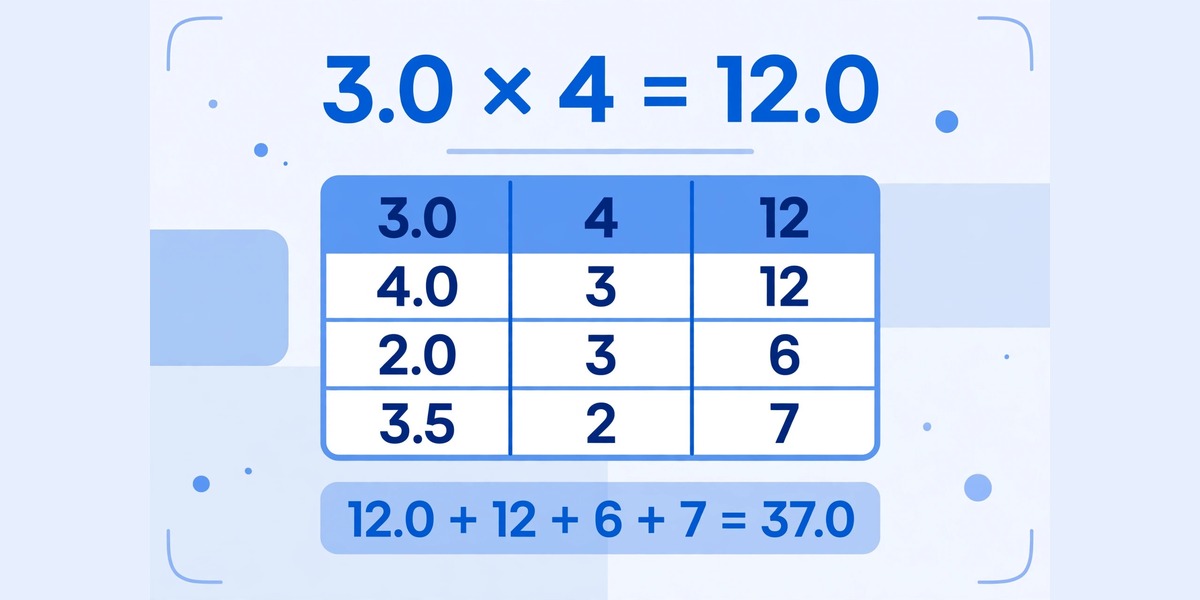
Multiply each value by the course’s credit hours. An A in a 3-credit course earns 4.0 x 3 = 12.0 quality points. A B in a 4-credit course earns 3.0 x 4 = 12.0 quality points. Same points, different paths. That is the weighting in action.
How to Calculate GPA Step by Step
- List every graded course for the term, with its letter grade and credit hours. Leave out pass/fail courses, since they do not affect GPA at most schools.
- Convert each grade to points using the 4.0 scale above. Double-check plus and minus grades; a B+ (3.3) is not a B (3.0).
- Multiply points by credit hours for each course. This gives each course’s quality points.
- Add up all quality points and separately add up all credit hours.
- Divide quality points by credit hours. Round the result to two decimal places. That is your GPA.
Worked Example: Calculating a Semester GPA
Consider a student, Maria, with four courses this semester: Psychology 101 (3 credits, A), English Composition (3 credits, B+), Calculus I (4 credits, C), and Spanish Lab (2 credits, A-).
| Course | Grade | Points | Credits | Quality Points |
|---|---|---|---|---|
| Psychology 101 | A | 4.0 | 3 | 12.0 |
| English Composition | B+ | 3.3 | 3 | 9.9 |
| Calculus I | C | 2.0 | 4 | 8.0 |
| Spanish Lab | A- | 3.7 | 2 | 7.4 |
| Totals | 12 | 37.3 |
GPA = 37.3 / 12 = 3.1083, which rounds to 3.11. Notice that the C in 4-credit Calculus pulls harder than the A- in the 2-credit lab pushes. Credit hours decide each grade’s influence.
How Do Credit Hours Change the Result?
Imagine Maria retook the numbers with a simple average of point values: (4.0 + 3.3 + 2.0 + 3.7) / 4 = 13.0 / 4 = 3.25. The real GPA is 3.11, a full 0.14 lower, because her weakest grade sat in her heaviest course. Whenever your hardest classes carry the most credits, the weighted formula is less forgiving than a straight average.
This is also why a single 1-credit A barely moves a GPA. Adding a 1-credit A (4.0 quality points) to Maria’s record would give (37.3 + 4.0) / (12 + 1) = 41.3 / 13 = 3.18, only 0.07 higher. Small courses make small ripples.
What Mistakes Do Students Make When Calculating GPA?
- Ignoring plus/minus grades. Treating a B+ as a B understates your points by 0.3 per credit.
- Averaging the letters directly. Adding A + B + C and dividing by 3 ignores credit weighting entirely.
- Including pass/fail courses. A “Pass” carries no point value and should be excluded.
- Using the wrong scale. Some high schools weight AP courses to 5.0. College transcripts almost always use 4.0.
- Rounding too early. Round only the final result, not each course’s quality points, or the error compounds.
How Is Semester GPA Different from Cumulative GPA?
Semester GPA covers one term. Cumulative GPA covers your entire academic history, using the same formula over every graded course you have ever taken. If Maria’s 37.3 quality points and 12 credits joined a prior record of 2.90 across 30 credits (87.0 quality points), her cumulative GPA would be (87.0 + 37.3) / (30 + 12) = 124.3 / 42 = 2.9595, or 2.96. New terms blend into the old average; they never replace it.
Frequently Asked Questions
What is the easiest way to calculate GPA?
Use the quality points formula: multiply each grade’s 4.0-scale value by its credit hours, add the totals, and divide quality points by credit hours. An online calculator does this in seconds and removes arithmetic errors.
How do I calculate my GPA if my school uses percentages?
First convert each percentage to a letter grade using your school’s scale (commonly 90-100 = A, 80-89 = B, 70-79 = C, 60-69 = D, below 60 = F), then apply the 4.0 point values and the standard formula.
Do I include failed courses in my GPA?
Yes. An F earns 0.0 quality points but its credit hours still count in the denominator, which is why a single F can drop a GPA sharply. Only a formal withdrawal (W) removes a course from the calculation.
How do I calculate GPA with plus and minus grades?
Use the exact values: A- = 3.7, B+ = 3.3, B- = 2.7, C+ = 2.3, C- = 1.7, D+ = 1.3, D- = 0.7. Multiply each by its credit hours exactly as you would for whole-letter grades.
What GPA do I need to keep my scholarship?
Most merit scholarships require a 3.0 cumulative GPA, though some demand 3.25 or 3.5. Check your award letter, because falling below the threshold for even one term can trigger probation or loss of funding.
Can a 4.0 GPA ever go higher?
On the unweighted 4.0 scale, no. On weighted high school scales, AP and honors courses can earn up to 5.0, so weighted GPAs above 4.0 are possible. Colleges usually recalculate applicants on an unweighted 4.0 scale anyway.