
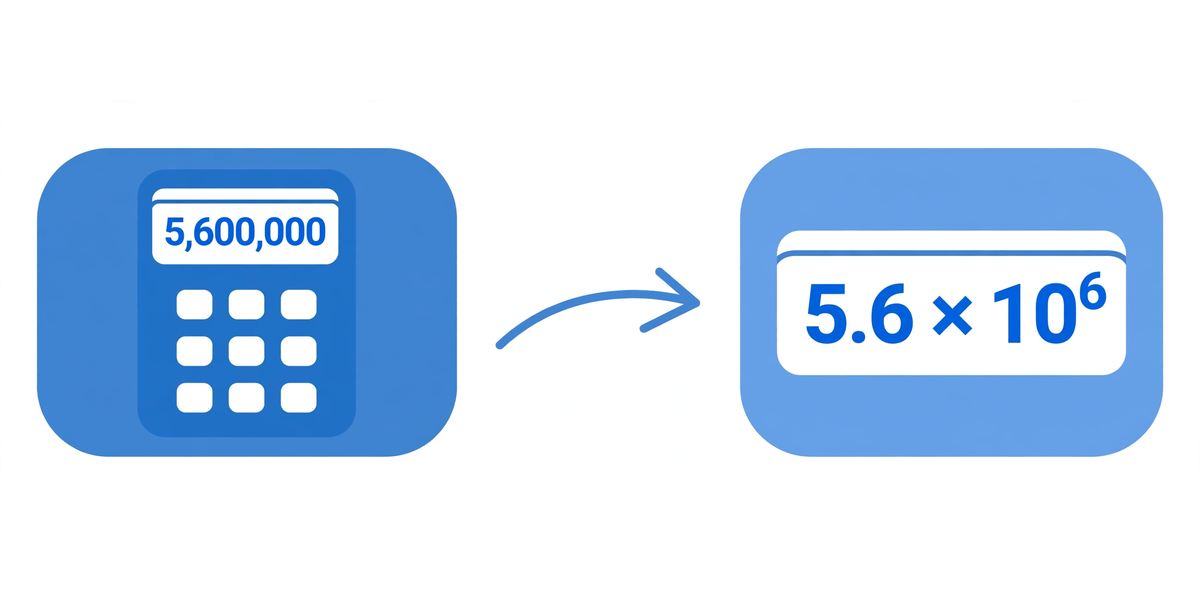
Accepts decimals (5,600,000 or 0.00034), e-notation (6.022e23), or power form (3*10^8).
Step-by-step
A scientific notation calculator converts any decimal number into scientific notation instantly, or converts scientific notation back to standard form. It shows the coefficient, the power of 10, e-notation, and a step-by-step breakdown, so you can solve problems in science, math, and engineering classes with full confidence.
What Is Scientific Notation?
Scientific notation is a compact way to write very large or very small numbers. Every number is expressed as a coefficient between 1 and 10 (but not including 10) multiplied by a power of 10. For example, the distance from Earth to the Sun is 149,600,000 kilometers, which becomes 1.496 x 10^8 km in scientific notation.
This format is used everywhere in the United States science curriculum, from Common Core standard 8.EE in middle school math to high school physics and chemistry. NASA engineers, astronomers, and chemists rely on it daily because it keeps huge and tiny quantities readable and comparable at a glance.
How to Use This Calculator
- Enter your value. Type a decimal number like 5600000 or 0.00034, or enter a value already in scientific notation like 5.6 x 10^6.
- Press convert. The calculator processes your input instantly, no extra settings needed.
- Read the scientific notation result. You will see the standard form a x 10^n, for example 5.6 x 10^6.
- Check the e-notation. Many calculators and spreadsheets write the same value as 5.6e6, which is also shown for you.
- Review the coefficient and exponent separately. The coefficient is 5.6 and the exponent is 6 in the example above.
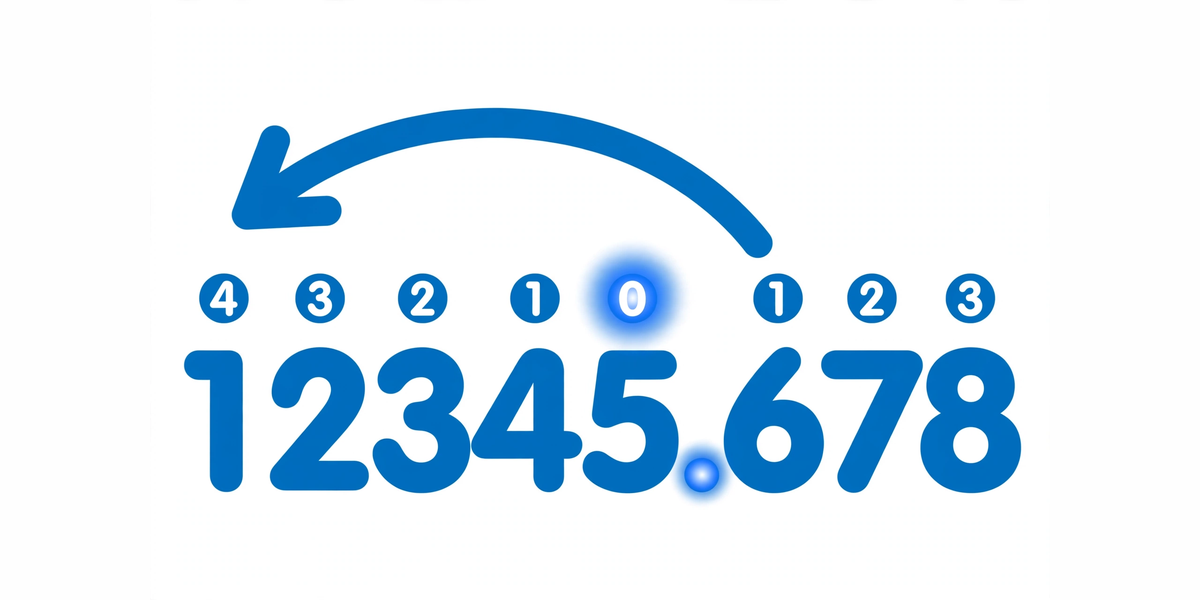
- See the step-by-step breakdown. Each move of the decimal point is listed, so you understand exactly how the conversion works.
- Copy or reuse the result. Use the converted value in your homework, lab report, or the practice steps below.
Verified Examples Table
These real-world numbers show scientific notation in action. Each conversion is verified:
| Real-world value | Standard form | Scientific notation |
|---|---|---|
| Speed of light | 299,792,458 m/s | 2.99792458 x 10^8 m/s |
| Mass of Earth | 5,972,000,000,000,000,000,000,000 kg | 5.972 x 10^24 kg |
| Avogadro's number | 602,200,000,000,000,000,000,000 | 6.022 x 10^23 |
| Mass of an electron | 0.0000000000000000000000000000009109 kg | 9.109 x 10^-31 kg |
| US federal budget (approx. $7 trillion) | $7,000,000,000,000 | 7 x 10^12 |
| Thickness of a human hair (approx. 0.0001 m) | 0.0001 m | 1 x 10^-4 m |
When Scientists and Students Use Scientific Notation
In the US, students first meet scientific notation in 8th grade under Common Core standard 8.EE.4, where they learn to write numbers like 3.4 x 10^5 and to estimate products and quotients with them. It then becomes essential in high school chemistry (moles and atomic mass), physics (astronomy distances, light speed), and biology (cell counts, DNA base pairs).
Beyond school, NASA mission planners use it for orbital distances, finance analysts use it for national debt figures, and engineers use it for tolerances measured in thousandths of an inch. Any time a number has too many zeros to count comfortably, scientific notation is the standard solution.
How Scientific Notation Appears on Calculators and Spreadsheets
Most handheld calculators and spreadsheet apps cannot print superscripts, so they use e-notation instead. The value 5.6 x 10^6 shows as 5.6E6 or 5.6e6 on a TI-84 or in Google Sheets. The letter E stands for "exponent of 10" and means exactly the same thing as the x 10^ part.
This matters because homework and tests mix formats. A physics problem may state the distance as 1.496e8 km while the textbook writes 1.496 x 10^8 km. Recognizing both forms prevents errors when copying numbers into the calculator above, so always check which format your input uses before converting.
Frequently Asked Questions
What does a scientific notation calculator do?
It converts a decimal number to scientific notation, converts scientific notation back to standard form, and displays helpful extras such as e-notation, the coefficient, the exponent, and the step-by-step decimal moves used in the conversion.
Why must the coefficient be between 1 and 10?
Keeping the coefficient in the range from 1 to less than 10 guarantees one unique representation for every number. That makes values easy to compare: a larger exponent always means a larger number, and the coefficients can be compared directly.
What is the difference between scientific notation and e-notation?
They are the same idea written differently. Scientific notation writes 5.6 x 10^6, while e-notation writes 5.6e6. Calculators and spreadsheets like Google Sheets use e-notation because they cannot display superscripts, so this tool shows you both.
How do I write a small number in scientific notation?
Move the decimal point right until one non-zero digit remains to its left, then use a negative exponent equal to the number of places moved. For example, 0.00034 becomes 3.4 x 10^-4 because the decimal moved 4 places right.
Can this calculator handle negative exponents?
Yes. Positive exponents expand the number larger (10^6 = 1,000,000) and negative exponents shrink it (10^-4 = 0.0001). Enter any value, large or small, and the tool computes the correct exponent automatically.
Is scientific notation on standardized US tests?
Yes. The SAT, ACT, AP Chemistry, and AP Physics exams all expect students to read and compute with scientific notation. Practicing conversions here builds the speed these tests require.