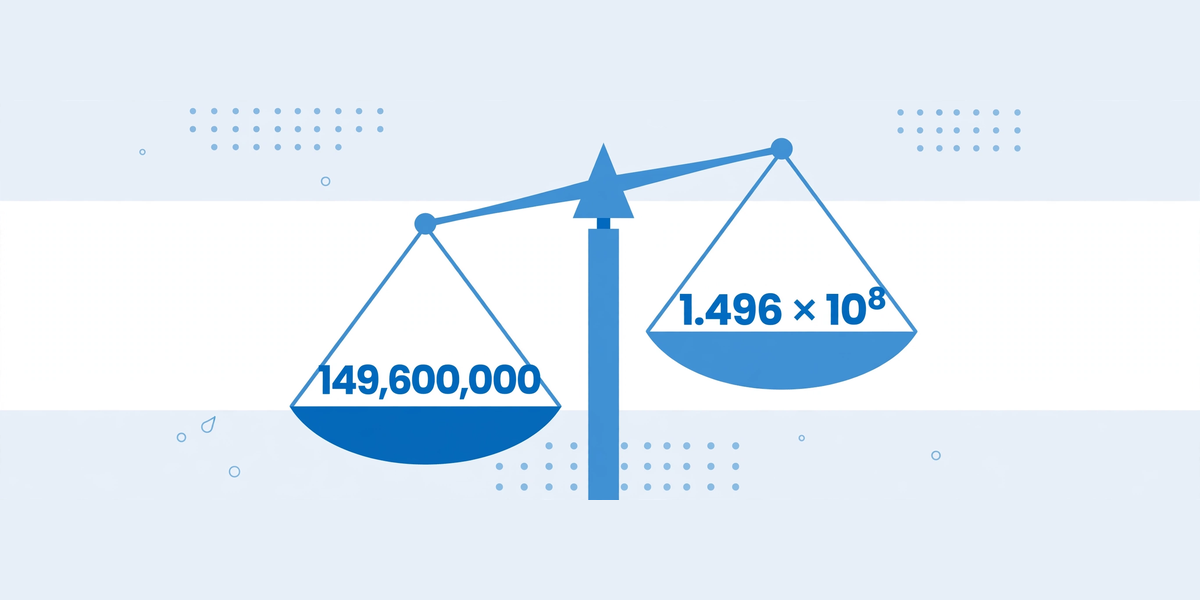
Scientific notation writes a number as a coefficient between 1 and 10 times a power of 10, such as 5.6 x 10^6, while standard form writes the number out fully, such as 5,600,000. Use scientific notation for very large or very small numbers where zeros get in the way, and use standard form for everyday quantities that people need to read at a glance.
What Is Scientific Notation?
Scientific notation compresses a number into two parts: a coefficient (a number from 1 up to but not including 10) and a power of 10. The speed of light, 299,792,458 meters per second, becomes 2.99792458 x 10^8 m/s. The exponent tells you the scale: positive for huge values, negative for tiny ones.
It is the working language of science in the US. NASA flight computers, chemistry textbooks, and physics labs all use it because it keeps extreme values short, comparable, and safe from dropped-zero errors.
What Is Standard Form?
Standard form is the ordinary way of writing a number with all its digits and place values visible: 340,000, 0.00034, 7,000,000,000. It is what you see on price tags, census reports, and bank statements.
Its strength is readability for familiar magnitudes. A news article reporting a $7 trillion federal budget writes it as $7,000,000,000,000 rather than 7 x 10^12, because readers picture dollars, not exponents. Its weakness is that extreme values become long strings of zeros that are easy to miscount.
How Do the Two Forms Compare?
| Feature | Scientific notation | Standard form |
|---|---|---|
| Example | 5.6 x 10^6 | 5,600,000 |
| Best for | Very large or very small numbers | Everyday quantities |
| Length | Short and consistent | Grows with the number of zeros |
| Comparing scale | Easy: compare exponents | Hard: count the digits |
| Readability | Requires math literacy | Instant for most readers |
| Calculation | Simple exponent rules | Longhand arithmetic |
| Common users | Scientists, engineers, students | General public, journalists |
When Should You Use Scientific Notation?
- Astronomy and space: NASA lists the Earth-Sun distance as 1.496 x 10^8 km, not 149,600,000 km, in mission documents.
- Chemistry: Avogadro’s number is written 6.022 x 10^23, never with all 24 digits.
- Physics: the electron mass is 9.109 x 10^-31 kg; expanding it means writing 31 decimal places.
- Computing significant figures: scientific notation makes precision explicit, since every digit shown is significant.
When Should You Use Standard Form?
- Money: a $25,000 salary reads naturally; 2.5 x 10^4 dollars would confuse a pay stub.
- Populations and statistics: the US population of about 340,000,000 is clearer than 3.4 x 10^8 in a news headline.
- School grades and scores: a test score of 92 out of 100 needs no conversion.
- Final answers for non-technical audiences: lab reports for a general audience often convert back so readers grasp the scale.
How Do You Convert Between the Two Forms?
Converting either direction follows the decimal-shift rule. If you want a tool to handle it, a Scientific Notation Calculator converts both ways and displays the step-by-step decimal moves.
Standard form to scientific notation
- Move the decimal left for numbers over 10, right for numbers under 1, until one non-zero digit remains on the left.
- The number of places moved is the exponent, positive for left moves, negative for right moves.
- Example: 72,000 becomes 7.2 x 10^4. Example: 0.00034 becomes 3.4 x 10^-4.
Scientific notation to standard form
- Move the decimal right for positive exponents, left for negative exponents, by the exponent’s value.
- Fill empty places with zeros.
- Example: 3.4 x 10^5 becomes 340,000. Example: 3.4 x 10^-4 becomes 0.00034.
Why Do US Schools Teach Both Forms?
Common Core standard 8.EE introduces scientific notation in 8th grade precisely because students need both: scientific notation to compute with extreme values, and standard form to report answers people can read. The SAT, ACT, and AP science exams test both directions, and real careers from NASA engineering to financial analysis switch between them depending on the audience.
Think of it as two dialects of the same language. Scientists speak scientific notation among themselves for precision and speed, then translate to standard form when explaining results to the public.
What Are the Most Common Mix-Ups?
- Calling any big number “scientific notation.” The number 56,000,000 is standard form, not scientific notation, until it is rewritten as 5.6 x 10^7.
- Confusing standard form with expanded form. Standard form is 340,000; expanded form is 300,000 + 40,000. They are different US math vocabulary terms.
- Assuming scientific notation is always shorter. For a number like 250, the standard form is actually shorter than 2.5 x 10^2. Use scientific notation where it earns its keep: extreme magnitudes.
- Forgetting the exponent sign. A positive exponent grows the number; a negative one shrinks it. Reading 3.4 x 10^-4 as 34,000 instead of 0.00034 is a factor-of-a-hundred-million error.
Quick Self-Check Quiz
- Which form is 6.022 x 10^23? Scientific notation.
- Convert 5,600,000 to scientific notation. 5.6 x 10^6.
- Expand 1 x 10^-4 to standard form. 0.0001.
- A NASA report lists a distance as 1.496 x 10^8 km. Write it in standard form. 149,600,000 km.
Frequently Asked Questions
Which is correct: scientific notation or standard form?
Both are correct; they are different representations of the same value. 5.6 x 10^6 and 5,600,000 are the same number, so choose the form that fits your audience and the size of the number.
Is standard form the same as expanded form?
No. Standard form is the compact ordinary number, like 340,000. Expanded form breaks it into place values, like 300,000 + 40,000. In US classrooms, “standard form” sometimes causes confusion because British usage means something different.
Why does NASA use scientific notation?
Space distances and masses span dozens of orders of magnitude, from 9.109 x 10^-31 kg electrons to 1.989 x 10^30 kg stars. Scientific notation prevents catastrophic zero-counting errors in mission-critical math.
When is standard form better than scientific notation?
For numbers people already understand intuitively, like money, populations, and test scores. Writing $25,000 as 2.5 x 10^4 adds confusion without benefit.
How do you know which form a test wants?
Science classes usually want scientific notation for extreme values and standard form for final readable answers. When in doubt, give the scientific notation answer and include the standard form in parentheses.
What is e-notation and where does it fit?
E-notation is scientific notation for devices that cannot show superscripts: 3.4e5 means 3.4 x 10^5. Calculators, spreadsheets, and programming languages use it, so treat it as a third way to write the same value.