To divide scientific notation, divide the coefficients and subtract the exponents, then renormalize so the coefficient sits between 1 and 10. For example, (7.8 x 10^5) divided by (1.3 x 10^2) equals 6 x 10^3, because 7.8 divided by 1.3 is 6 and 5 minus 2 is 3.
What Is the Rule for Dividing Scientific Notation?
- Divide the coefficients: a / b.
- Subtract the exponents: 10^m / 10^n = 10^(m-n). Subtract the bottom exponent from the top one.
- Renormalize: adjust the decimal and exponent so the coefficient falls between 1 and 10.
The key difference from multiplication: exponents get subtracted, not added. Mixing those up is the number one error students make. A Scientific Notation Calculator is a fast way to verify your quotient before turning in an assignment.
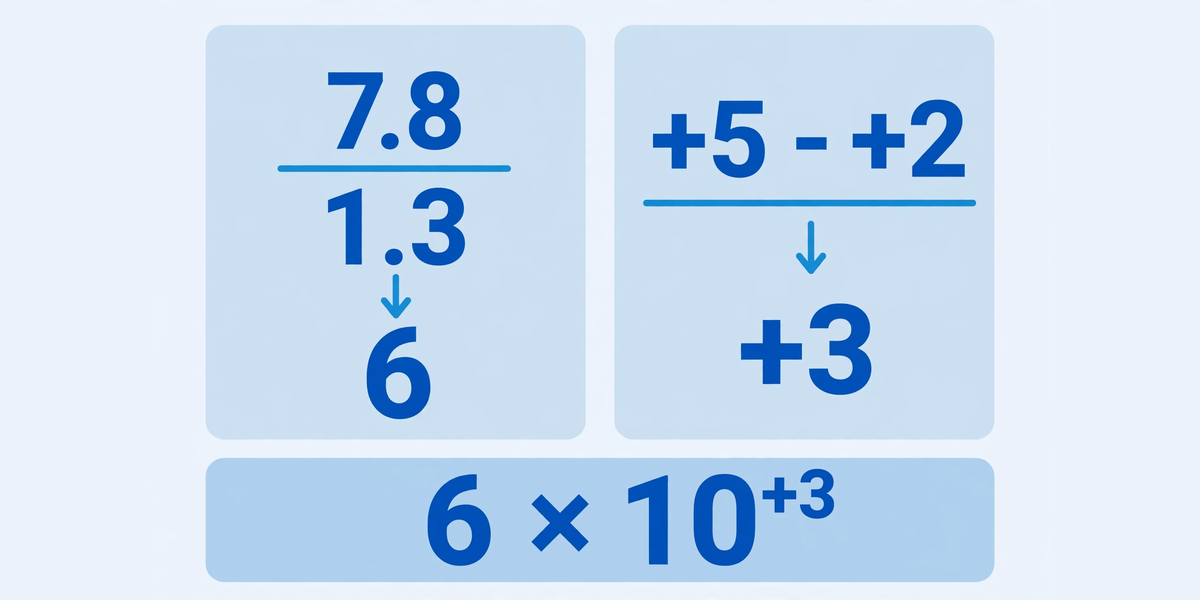
Worked Example: (7.8 x 10^5) / (1.3 x 10^2)
- Divide coefficients: 7.8 / 1.3 = 6.
- Subtract exponents: 5 – 2 = 3.
- Combine: 6 x 10^3, which equals 6,000.
- Renormalization check: 6 is between 1 and 10, so this is final.
Check by expanding: 780,000 / 130 = 6,000. Correct. In real terms, that is like splitting 780,000 doses of a vaccine evenly across 130 clinics: 6,000 doses each.
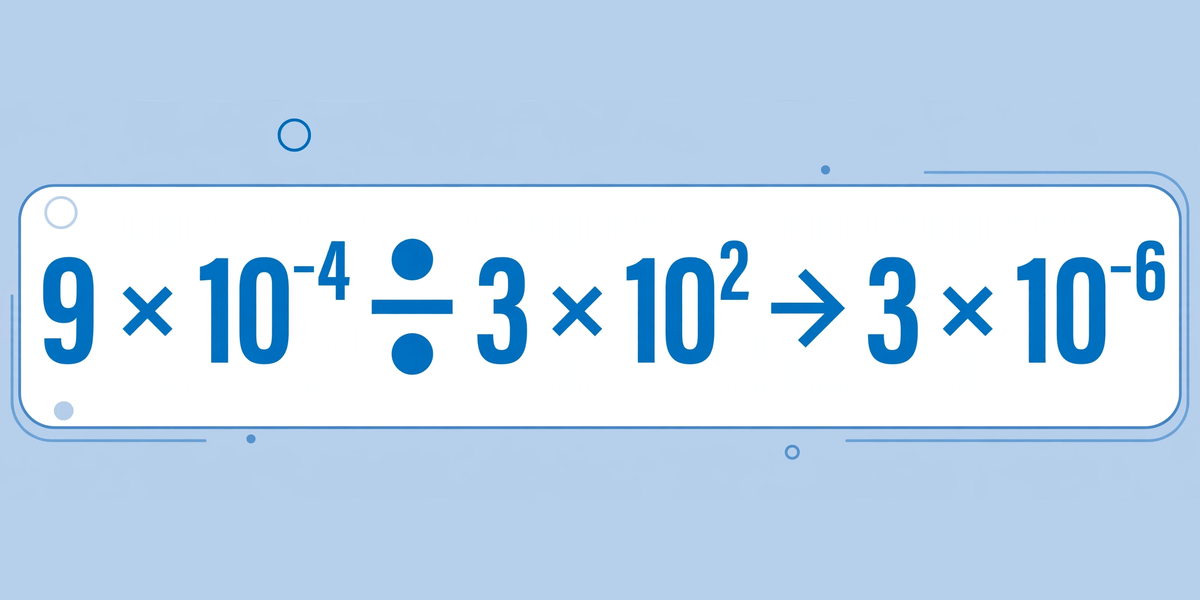
Worked Example: (9 x 10^-4) / (3 x 10^2)
Dividing by a large number shrinks the result, so the exponent drops further negative:
- Divide coefficients: 9 / 3 = 3.
- Subtract exponents: -4 – 2 = -6.
- Combine: 3 x 10^-6, which equals 0.000003.
Check by expanding: 0.0009 / 300 = 0.000003. Correct. Watch the double negative trap: subtracting a positive 2 from -4 moves you left on the number line to -6.
Worked Example: (5 x 10^7) / (2 x 10^3)
- Divide coefficients: 5 / 2 = 2.5.
- Subtract exponents: 7 – 3 = 4.
- Combine: 2.5 x 10^4, which equals 25,000.
Check by expanding: 50,000,000 / 2,000 = 25,000. Correct. A finance version: a $50 million budget split among 2,000 employees is $25,000 per employee.
Worked Example: (4 x 10^3) / (8 x 10^5)
When the top coefficient is smaller than the bottom one, the result needs renormalization:
- Divide coefficients: 4 / 8 = 0.5.
- Subtract exponents: 3 – 5 = -2.
- Combine: 0.5 x 10^-2.
- Renormalize: 0.5 is below 1, so shift the decimal right one place and subtract 1 from the exponent: 5 x 10^-3, which equals 0.005.
Check by expanding: 4,000 / 800,000 = 0.005. Correct.
How Do You Renormalize After Dividing?
| Coefficient result | Action | Example |
|---|---|---|
| Between 1 and 10 | None, already correct | 6 x 10^3 |
| 10 or greater | Shift decimal left, add 1 to exponent | 24 x 10^2 becomes 2.4 x 10^3 |
| Less than 1 | Shift decimal right, subtract 1 from exponent | 0.5 x 10^-2 becomes 5 x 10^-3 |
Renormalization keeps every answer in true scientific notation form, which is what US math and science teachers expect.
Where Is Scientific Notation Division Used?
- Astronomy: dividing a galaxy’s total mass by its star count to find the average stellar mass.
- Medicine: computing drug concentration per milliliter from a total dose dissolved in a solution.
- Demographics: the US population of about 3.4 x 10^8 divided by 50 states gives 6.8 x 10^6 people per state on average. Check: 340,000,000 / 50 = 6,800,000. Correct.
- Physics: finding density by dividing mass by volume when both are extreme values.
Worked Example: (8 x 10^-3) / (2 x 10^-6)
Dividing two small numbers can yield a large result, because subtracting a more negative exponent adds:
- Divide coefficients: 8 / 2 = 4.
- Subtract exponents: -3 – (-6) = 3.
- Combine: 4 x 10^3, which equals 4,000.
Check by expanding: 0.008 / 0.000002 = 4,000. Correct. The step -3 – (-6) = 3 trips up many students: subtracting a negative is the same as adding, so write it out in full.
Practice Problems With Answers
- (6 x 10^8) / (3 x 10^2) = 2 x 10^6. Check: 600,000,000 / 300 = 2,000,000. Correct.
- (5 x 10^-5) / (5 x 10^2) = 1 x 10^-7. Check: 0.00005 / 500 = 0.0000001. Correct.
- (9.6 x 10^4) / (3.2 x 10^1) = 3 x 10^3 = 3,000. Check: 96,000 / 32 = 3,000. Correct.
What If Both Numbers Are in Standard Form?
When a problem gives standard-form numbers like 96,000 and 32, you have two options. You can divide directly (96,000 / 32 = 3,000), or convert first and then divide: 9.6 x 10^4 divided by 3.2 x 10^1 gives 3 x 10^3, which is 3,000. Both paths agree.
Converting first pays off when the numbers are extreme. Dividing 0.008 by 0.000002 in decimal form is easy to misplace, but (8 x 10^-3) / (2 x 10^-6) = 4 x 10^3 is nearly mechanical. Choose the representation that minimizes your chance of a zero-counting error.
Frequently Asked Questions
Do you add or subtract exponents when dividing?
Subtract the bottom exponent from the top one: 10^m / 10^n = 10^(m-n). For (7.8 x 10^5) / (1.3 x 10^2), the exponent is 5 – 2 = 3, giving 6 x 10^3.
What happens when the denominator’s exponent is bigger?
The result gets a negative exponent. (4 x 10^3) / (8 x 10^5) = 5 x 10^-3, because 3 – 5 = -2 and 0.5 renormalizes to 5.
How do you divide when the coefficients do not divide evenly?
Use a decimal quotient. (5 x 10^7) / (2 x 10^3) = 2.5 x 10^4, which is fine because 2.5 sits between 1 and 10.
What if the quotient coefficient is less than 1?
Renormalize by moving the decimal right one place and decreasing the exponent by 1: 0.5 x 10^-2 becomes 5 x 10^-3.
Can you divide three numbers in scientific notation?
Yes. Divide the first two coefficients and subtract the first two exponents, then repeat with the third number, renormalizing once at the end.
Is division of scientific notation tested in the US?
Yes. It appears in Common Core 8th grade standards, on the SAT and ACT, and in AP Chemistry and AP Physics free-response sections.