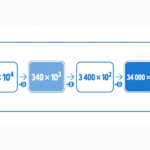

To multiply scientific notation, multiply the coefficients together, add the exponents together, then renormalize so the coefficient sits between 1 and 10. For example, (4 x 10^4) times (2 x 10^6) equals 8 x 10^10, because 4 times 2 is 8 and 4 plus 6 is 10.
What Is the Rule for Multiplying Scientific Notation?
Multiplication follows one clean pattern:
- Multiply the coefficients: a x b.
- Add the exponents: 10^m x 10^n = 10^(m+n).
- Renormalize: if the new coefficient is 10 or more, move the decimal one place left and add 1 to the exponent.
This works because 10^m x 10^n = 10^(m+n) by the laws of exponents taught in US algebra courses. If the arithmetic feels tedious, a Scientific Notation Calculator can double-check each product before you submit your homework.
Worked Example: (4 x 10^4) x (2 x 10^6)
- Multiply coefficients: 4 x 2 = 8.
- Add exponents: 4 + 6 = 10.
- Combine: 8 x 10^10.
- Renormalization check: 8 is between 1 and 10, so the answer is already in proper form.
Real-world check: imagine a city of 4 x 10^4 people where each household spends $2 x 10^6 on a bond measure total. The total is 8 x 10^10, or $80,000,000,000 (80 billion).
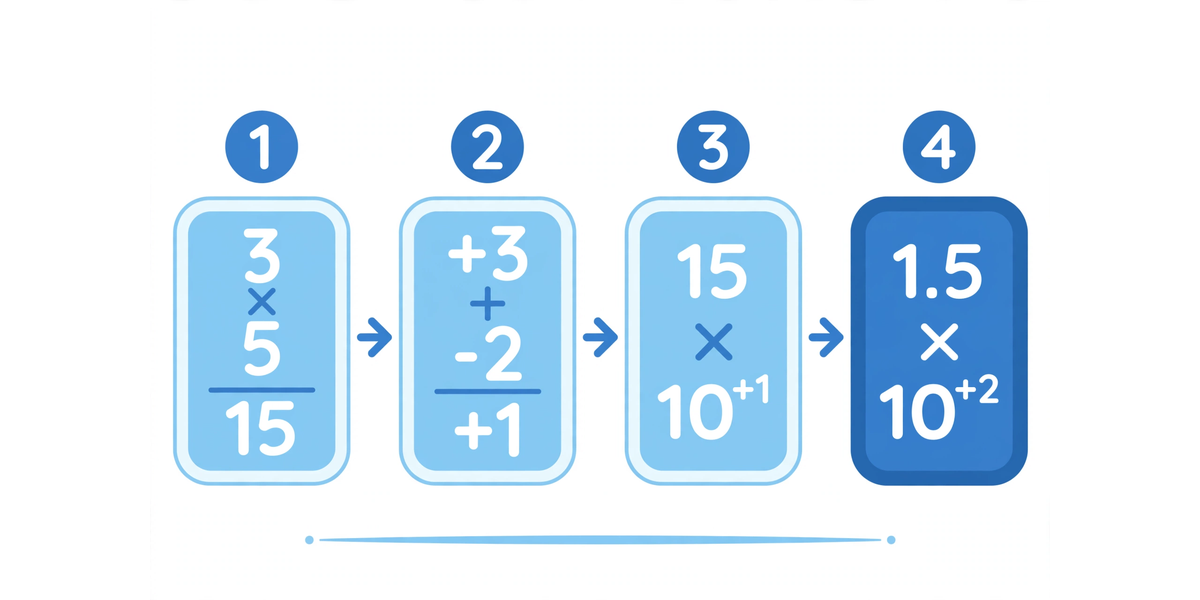
Worked Example: (3 x 10^3) x (5 x 10^-2)
This one mixes a positive and a negative exponent, which is common in physics problems:
- Multiply coefficients: 3 x 5 = 15.
- Add exponents: 3 + (-2) = 1.
- Combine: 15 x 10^1.
- Renormalize: 15 is not between 1 and 10, so shift the decimal left one place and add 1 to the exponent: 1.5 x 10^2 = 150.
Check by expanding: 3,000 x 0.05 = 150. Correct.
Worked Example: (7 x 10^3) x (8 x 10^4)
- Multiply coefficients: 7 x 8 = 56.
- Add exponents: 3 + 4 = 7.
- Combine: 56 x 10^7.
- Renormalize: move the decimal left and raise the exponent: 5.6 x 10^8.
Check by expanding: 7,000 x 80,000 = 560,000,000 = 5.6 x 10^8. Correct.
Worked Example: (6.022 x 10^23) x (2)
Chemistry students meet this pattern when doubling a quantity of moles:
- Multiply coefficients: 6.022 x 2 = 12.044.
- Add exponents: 23 + 0 = 23 (a plain number is 2 x 10^0).
- Combine: 12.044 x 10^23.
- Renormalize: 1.2044 x 10^24.
This is twice Avogadro’s number, the count of atoms in 2 moles of any substance.
How Do You Renormalize After Multiplying?
| Coefficient result | Action | Example |
|---|---|---|
| Between 1 and 10 | None, already correct | 8 x 10^10 |
| 10 or greater | Shift decimal left, add 1 to exponent | 56 x 10^7 becomes 5.6 x 10^8 |
| Less than 1 | Shift decimal right, subtract 1 from exponent | 0.8 x 10^3 becomes 8 x 10^2 |
Skipping renormalization is the most common error on tests. Always finish with a coefficient between 1 and 10.
Where Is Scientific Notation Multiplication Used?
- Astronomy: multiplying a star’s luminosity by the number of stars to estimate a galaxy’s total brightness.
- Chemistry: multiplying Avogadro’s number by a molar mass to find the mass of a sample.
- Finance: estimating total market value, like 3.4 x 10^8 shares times $2.5 x 10^2 per share = 8.5 x 10^10 ($85 billion).
- Engineering: computing power from force times distance when both are extreme values.
Worked Example: (2.5 x 10^-3) x (4 x 10^-5)
Multiplying two small numbers produces a very small result:
- Multiply coefficients: 2.5 x 4 = 10.
- Add exponents: -3 + (-5) = -8.
- Combine: 10 x 10^-8.
- Renormalize: 10 is not below 10’s ceiling, so shift the decimal left and add 1 to the exponent: 1 x 10^-7.
Check by expanding: 0.0025 x 0.00004 = 0.0000001 = 1 x 10^-7. Correct. The double negative in -3 + (-5) is where students most often slip, so write the signs explicitly.
Practice Problems With Answers
- (5 x 10^2) x (3 x 10^3) = 15 x 10^5 = 1.5 x 10^6. Check: 500 x 3,000 = 1,500,000. Correct.
- (9 x 10^-2) x (2 x 10^4) = 18 x 10^2 = 1.8 x 10^3. Check: 0.09 x 20,000 = 1,800. Correct.
- (1.5 x 10^6) x (2 x 10^6) = 3 x 10^12. Check: 1,500,000 x 2,000,000 = 3,000,000,000,000. Correct.
How Do You Multiply Scientific Notation by a Plain Number?
Sometimes only one factor is in scientific notation, such as tripling a quantity of 4 x 10^6. Treat the plain number as having an exponent of 0: 3 = 3 x 10^0. Then multiply coefficients (3 x 4 = 12), add exponents (0 + 6 = 6), and renormalize 12 x 10^6 to 1.2 x 10^7. Check: 3 x 4,000,000 = 12,000,000. Correct.
The same trick works in reverse for division-style problems and in unit conversions, where a conversion factor like 1,000 (1 x 10^3) multiplies a measurement already in scientific notation.
Frequently Asked Questions
Do you add or multiply the exponents when multiplying?
You add them. (4 x 10^4) x (2 x 10^6) = 8 x 10^(4+6) = 8 x 10^10. Multiplying the exponents is a common mistake that gives a wildly wrong answer.
What if the coefficient is bigger than 10 after multiplying?
Renormalize: move the decimal one place left and increase the exponent by 1. For 56 x 10^7, you get 5.6 x 10^8.
How do you multiply when one exponent is negative?
Add them normally, keeping the signs: 3 + (-2) = 1. So (3 x 10^3) x (5 x 10^-2) = 1.5 x 10^2 = 150.
Can you multiply more than two numbers in scientific notation?
Yes. Multiply all coefficients and add all exponents in one pass, then renormalize once at the end.
Why not just expand the numbers and multiply normally?
For extreme values like 6.022 x 10^23, expansion means writing 24 digits and multiplying them by hand, which is slow and error-prone. The exponent rule keeps it to two small operations.
Is this on the SAT and ACT?
Yes. Both tests include scientific notation operations, and AP science exams use them heavily in free-response calculations.