
ROI Calculator
Enter what you invested and what you got back to find your net gain, ROI, annualized ROI, and return multiple.
ROI result
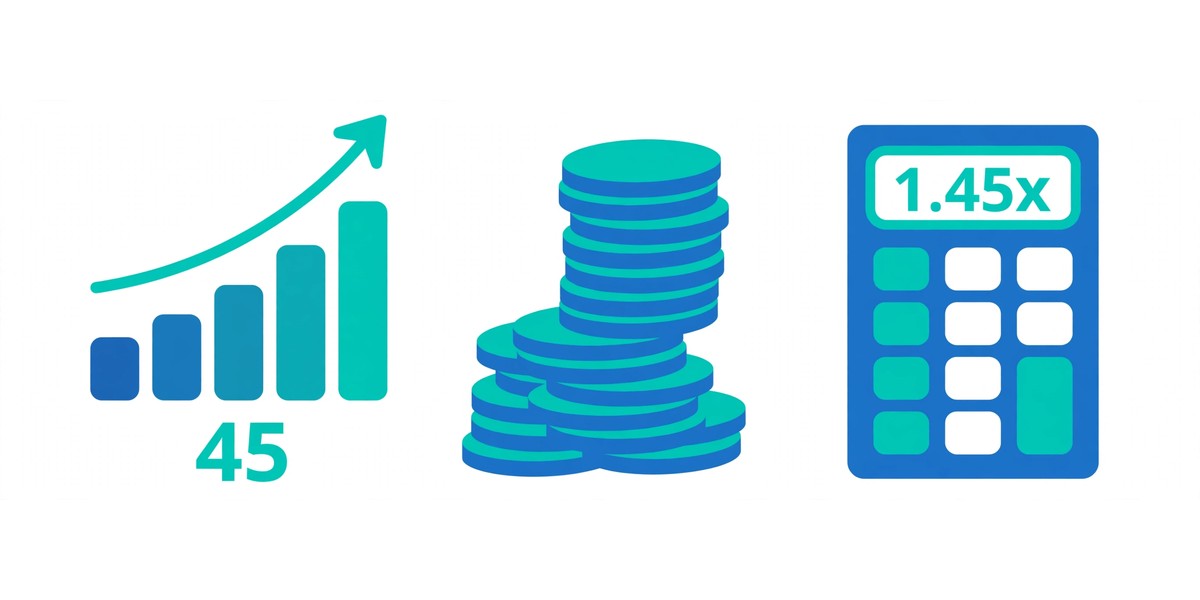
Quick answer: An ROI Calculator measures how much profit an investment made compared with what it cost. Invest $10,000, get back $14,500 after 3 years, and the ROI is 45.00%, with a $4,500 net gain, a 13.19% annualized ROI, and a 1.45x return multiple. Enter your own numbers above to see your result in seconds.
What Is an ROI Calculator?
An ROI Calculator works out the return on investment for any purchase, project, or asset. ROI shows profit as a percentage of the money put in. Subtract the total cost from the amount returned, divide by the total cost, and multiply by 100. A positive result means the investment made money, while a negative result means it lost money.
ROI is popular because it turns very different investments into one number. A $1,000 gain on a $5,000 investment is a 20% ROI, and so is a $10,000 gain on a $50,000 investment. That makes ROI useful for comparing stocks, rental property, a small business, or a marketing campaign.
Investors compare two funds, business owners check whether an ad campaign paid for itself, and savers compare a savings product with a stock fund. The calculator does the arithmetic for you, including extra costs and the annualized rate.
How the ROI Calculator Works
The calculator starts with the investment, the amount returned, and any extra costs. It adds the investment and the costs to get the total invested, subtracts that total from the amount returned to get the net gain, then divides the net gain by the total invested and multiplies by 100 to give the ROI.
Extra costs are real money out of your pocket. Broker fees, taxes, repairs, and closing costs all reduce the true return. If you invest $10,000, pay $500 in fees, and get back $14,500, the total invested is $10,500, the net gain is $4,000, and the ROI is 38.10%. A compound growth tool can show how the same money would grow if the return were reinvested each year.
The return multiple is a second way to read the same result. It divides the amount returned by the total invested, so 1.45x means you got back $1.45 for every $1 invested. Below 1.00x means you lost money, and 2.00x means you doubled your money. Your total net worth figure shows how one investment fits into everything you own and owe.
How to Use the ROI Calculator
- Enter your initial investment in the first box. The example starts with $10,000.
- Enter the amount returned in the second box, the total value you received. The example uses $14,500.
- Enter the holding period in years if you want the annualized ROI. The example uses 3.
- Enter any extra costs or fees in the last box, or leave it blank.
- Click Calculate to see your net gain, ROI, annualized ROI, and return multiple.
- To try another investment, change the numbers and click Calculate again.
ROI Calculator Examples
These worked examples use verified numbers from the calculator. Each row shows the starting amount, the amount returned, the holding period, and the answers.
| Invested | Returned | Years | Net gain | ROI | Annualized ROI | Multiple |
|---|---|---|---|---|---|---|
| $10,000 | $14,500 | 3 | $4,500 | 45.00% | 13.19% | 1.45x |
| $5,000 | $4,250 | Not given | -$750 | -15.00% | Not shown | 0.85x |
| $20,000 | $26,000 | 5 | $6,000 | 30.00% | 5.39% | 1.30x |
| $1,000 | $1,100 | 1 | $100 | 10.00% | 10.00% | 1.10x |
The second row shows why a negative ROI is useful. A $5,000 investment that returns $4,250 loses $750, a -15.00% ROI and a 0.85x multiple. The first row turns $10,000 into $14,500 in 3 years, a 45.00% total ROI and a 13.19% annualized ROI. The annualized figure gives the yearly pace, the fair way to compare investments held for different times. A simple interest comparison helps when the return is a flat yearly rate.
What Is a Good ROI?
There is no single good ROI, because it depends on risk, time held, and what else the money could have done. A 7% yearly return is strong for a broad stock market fund held for many years, but poor for a risky startup that could lose everything. A savings account paying 4% a year is safe, so its lower return is the price of safety.
Time changes the meaning of a total ROI. Turning $1,000 into $2,000 is a 100.00% ROI, but over 10 years it is only a 7.18% annualized ROI and a 2.00x multiple. Over 2 years, the same total would be a 41.42% annualized ROI. The annualized figure turns a total gain into a yearly pace. A savings goal plan uses the same yearly thinking to show how much to set aside each month.
As a rough guide, look for an annualized ROI above inflation. If inflation runs near 3% a year, a 3% ROI only keeps pace, while 7% or more builds real wealth. Judge an investment over several years, after costs, and against a fair benchmark.
ROI Calculator FAQ
How do you calculate ROI?
Subtract the total invested from the amount returned, divide by the total invested, and multiply by 100. For $10,000 invested and $14,500 returned, the gain is $4,500, so the ROI is 45.00%.
What is a good ROI percentage?
It depends on risk and time. An annualized ROI of 7% to 10% is solid for diversified stocks over many years, while a safe savings product may pay 3% to 5%.
What is annualized ROI?
Annualized ROI, also called CAGR, turns a total return into a yearly rate. It is the returned amount divided by the invested amount, raised to the power of one divided by the years, minus one. For $10,000 growing to $14,500 in 3 years, it is 13.19%.
Can ROI be negative?
Yes, when the amount returned is less than the total invested. A $5,000 investment that returns $4,250 has a net loss of $750 and an ROI of -15.00%.
What is the difference between ROI and return multiple?
ROI is the profit as a percentage of the cost, while the multiple is the amount returned divided by the cost. A 45.00% ROI matches a 1.45x multiple, and a -15.00% ROI matches a 0.85x multiple.
Should I include fees in ROI?
Yes, always include fees, taxes, and other costs in the total invested. They reduce the net gain.
Learn More
More financial calculators: the Compound Interest Calculator, the Simple Interest Calculator, the Net Worth Calculator, the Savings Goal Calculator, the Emergency Fund Calculator, and the Commission Calculator.