Percentage Calculator
Find a percent of a number, a part as a percent of a whole, a percentage change, or the original value before a change.
Quick answer: A Percentage Calculator finds a percent of a number, a part as a percent of a whole, a percentage change, or the original value before a change. For example, 20% of 150 is 30, and 30 is 20% of 150. Pick a mode above and enter your numbers.
What Is a Percentage?
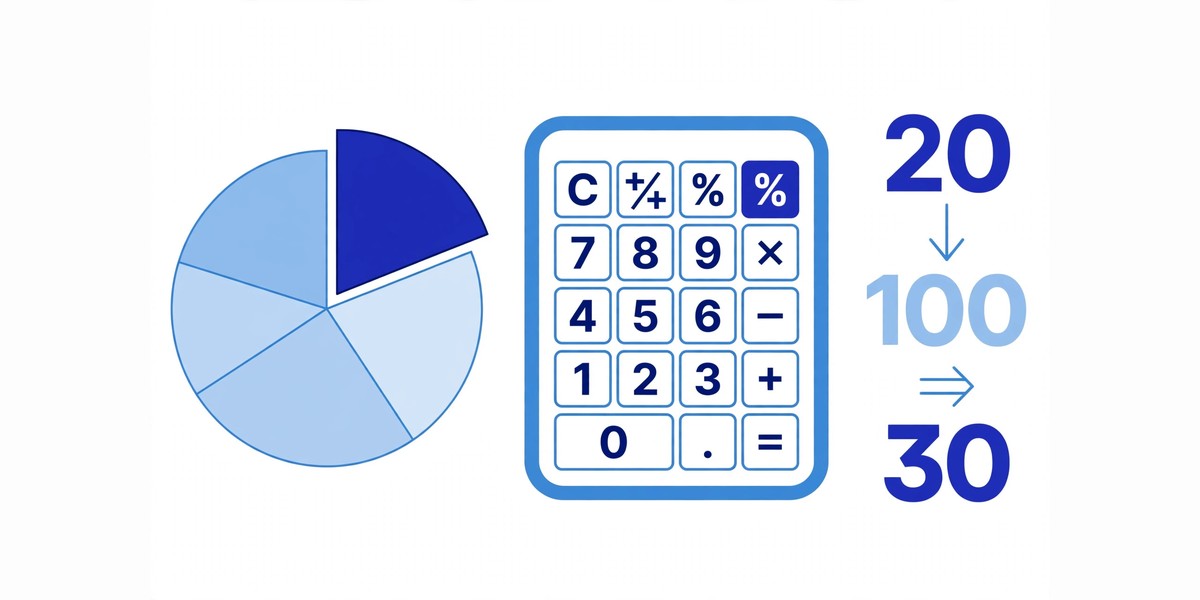
A percentage is a number out of 100. The word comes from the Latin phrase “per centum,” which means “by the hundred.” When you say 20%, you mean 20 out of every 100, or the fraction 20/100, which is the same as 0.20 as a decimal. A score of 30 out of 150 and a score of 40 out of 200 look different, but both are 20%.
Percentages are everywhere: shops show discounts, banks quote interest rates, and teachers grade tests in percentages. A fraction to decimal conversion follows the same idea, since a percent is simply a fraction with 100 as the denominator.
How the Percentage Calculator Works
This Percentage Calculator has five modes, one for each common percentage problem. Pick the mode that matches your question, enter two numbers, and the calculator shows the formula with your numbers, the result, and a plain-English sentence.
The modes are: “What is X% of Y?”, “X is what percent of Y?”, “Percentage change” between an old and a new value, “Increase or decrease by a percent”, and “Original value” for working backward to the value before a change. The last mode is the one shoppers use when a sale price already has a discount applied. If you shop with sale prices often, our discount calculator handles that case directly.
How to Use the Percentage Calculator
- Choose a mode from the dropdown at the top of the calculator.
- Enter the two numbers the labels ask for, such as the percent and the number.
- For the increase, decrease, or original-value mode, choose Increase or Decrease.
- Click Calculate to see the formula, the result, and a sentence that states the answer.
- Repeat with new numbers as needed.
If a field is empty or unusable, such as a whole of zero, the calculator shows a friendly message that tells you what to fix.
Percentage Calculator Examples
One worked example for each mode; every number matches the calculator above.
| Problem | Calculation | Answer |
|---|---|---|
| What is 20% of 150? | (20 / 100) x 150 | 30 |
| 30 is what percent of 150? | (30 / 150) x 100 | 20% |
| Percentage change from 80 to 100 | ((100 – 80) / 80) x 100 | +25% |
| 150 increased by 20% | 150 x (1 + 20/100) | 180 |
| 80 after a 20% discount, original price | 80 / (1 – 20/100) | 100 |
| 200 decreased by 25% | 200 x (1 – 25/100) | 150 |
Notice how the same three numbers, 20, 150, and 30, answer three different questions depending on the mode.
How to Calculate a Percentage by Hand
To find X% of Y, divide X by 100 and multiply by Y. For example, 20% of 150 is (20 / 100) x 150, which is 0.20 x 150, or 30. To find what percent X is of Y, divide X by Y and multiply by 100. For example, 30 out of 150 is (30 / 150) x 100, which is 20%.
To find a percentage change, subtract the old value from the new value, divide by the old value, and multiply by 100. From 80 to 100, that is ((100 – 80) / 80) x 100, a 25% increase. A negative result means a decrease: from 100 to 80, the same formula gives -20%. To increase a number by a percent, multiply it by 1 plus the percent as a decimal. To reverse a change, divide the final value by 1 plus the percent as a decimal for an increase, or by 1 minus the percent for a decrease.
Percentages connect to other math tools here: a ratio calculator compares two numbers the way a percent compares a part with a whole of 100, a scientific notation calculator handles very large or small numbers, and our GPA calculator turns letter grades into a grade point average.
Common Percentage Mistakes to Avoid
The most common mistake is using the wrong base number. A 20% increase followed by a 20% decrease does not return to the starting value: 100 plus 20% is 120, and 120 minus 20% is 96, because the second 20% is taken from 120, not from 100.
A second mistake is mixing up percentage points with percent. If an interest rate rises from 5% to 7%, it rose by 2 percentage points, but the rate itself rose by 40%. A third mistake is adding percentages with different bases. Work one change at a time, using the new value as the base for the next step.
Percentage Calculator FAQ
What is 20% of 150?
20% of 150 is 30: (20 / 100) x 150 = 30.
How do I calculate a percentage increase?
Subtract the old value from the new value, divide by the old value, and multiply by 100.
How do I find the original price before a discount?
Divide the sale price by 1 minus the discount as a decimal: 80 / 0.80 = $100 after a 20% discount. Use the “Original value” mode and choose Decrease.
What is the difference between percent and percentage points?
A percent is a relative change, while a percentage point is an absolute difference between two percents. A rise from 5% to 7% is 2 percentage points but a 40% increase in the rate.
How do I turn a fraction into a percentage?
Divide the top number by the bottom number and multiply by 100: 3/4 = 0.75 = 75%.
Can a percentage be more than 100%?
Yes. If a value grows from 50 to 150, it is 300% of the original, a 200% increase.
Learn More
More math calculators on this site: the Mean Median Mode Calculator for averages, the LCM Calculator for the least common multiple, the Slope Calculator for the steepness of a line, the Pythagorean Theorem Calculator for right triangles, the Age Calculator for exact ages, and the Square Root Calculator for roots and squares.
Languages
Also available in 15 languages: Calculadora de porcentaje, Calculadora de porcentagem, Calculateur de pourcentage, Prozentrechner, Calcolatore di percentuale, Percentagecalculator, Kalkulator procentowy, Yüzde Hesaplayıcı, Kalkulator Persen, Калькулятор процентов, حاسبة النسبة المئوية, प्रतिशत कैलकुलेटर, فیصد کیلکولیٹر, শতাংশ ক্যালকুলেটর, and パーセント計算機.