
Exponent Calculator
Work out powers, roots and logarithms with the steps shown, so you can check every answer.
Your answer
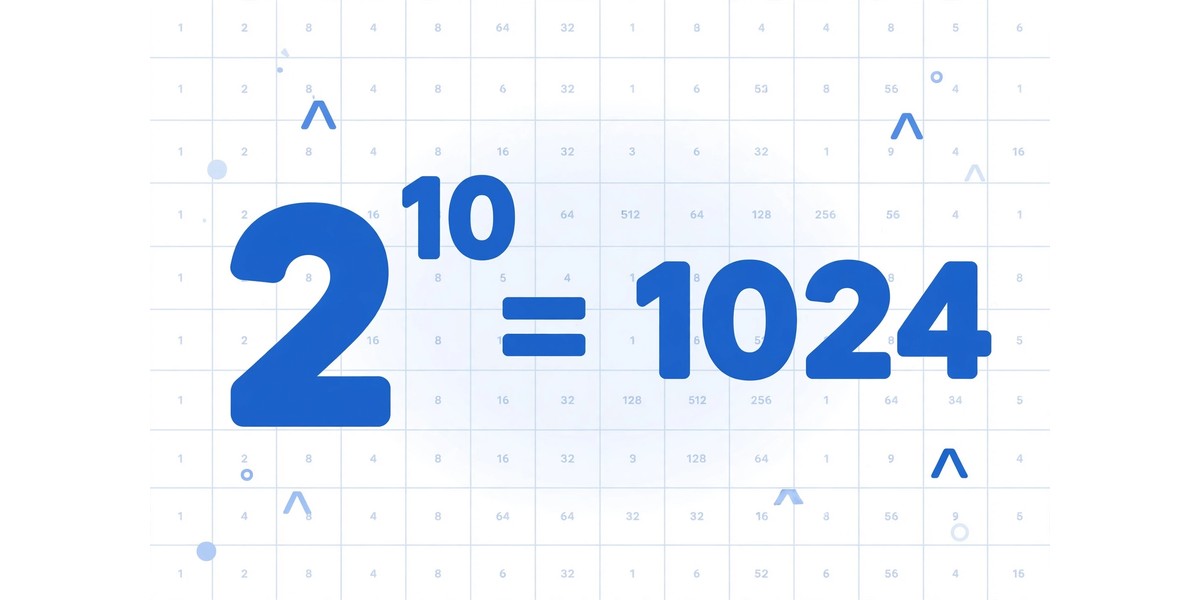
Quick answer: An Exponent Calculator works out powers, roots and logarithms in one place. Enter a base and an exponent to find the power, take the nth root of a number, or solve for the exponent itself. For example, 2 to the power of 10 is 1024, the cube root of 27 is 3, and log base 2 of 1024 is 10.
What Is an Exponent Calculator?
An Exponent Calculator is a maths tool that works out powers, roots and logarithms. Exponents appear everywhere in maths and science, from compound interest to the pH scale.
An exponent tells you how many times to multiply a number by itself. In 2^10, the base is 2 and the exponent is 10, so the answer is 2 multiplied by itself 10 times, which gives 1024. The same idea works for fractional exponents: 9^0.5 is the square root of 9, which is 3.
This calculator has three modes. Power mode finds b to the power n. Root mode finds the nth root of a number, the inverse of a power. Solve mode finds the exponent itself, which is a logarithm. Each answer comes with the rule used and a step-by-step working line. If you need the inverse of a power in the other direction, a square root calculator for finding square roots handles that single job in more depth.
How the Exponent Calculator Works
In power mode, the calculator raises the base to the exponent. Whole-number exponents are repeated multiplication: 5^3 is 5 x 5 x 5, which is 125. A negative exponent gives a reciprocal, so 2^-3 is 1 divided by 2^3, or 0.125. A fractional exponent is a root: 8^(2/3) is the cube root of 8, squared, which is 4.
In root mode, the calculator finds the nth root: "which number, raised to the power n, gives x?" The cube root of 27 is 3, because 3^3 is 27. Odd roots of negative numbers work too: the cube root of -8 is -2. Even roots of negative numbers have no real answer, so the calculator says so plainly. A dedicated cube root calculator for cube roots and their volumes covers that case with extra examples.
In solve mode, the calculator finds the exponent using logarithms. Log base 2 of 1024 is 10, because 2^10 is 1024. It uses the change of base rule, dividing the natural log of the result by the natural log of the base. Very large results are also shown in scientific notation: 2^20 is over a million. A scientific notation calculator for very large and small numbers converts those results into standard form.
How to Use the Exponent Calculator
- Choose a mode: Power, Nth root, or Solve for the exponent.
- In Power mode, enter the base and the exponent, then press Calculate. Try 2 and 10 first.
- In Nth root mode, enter the number and the root. For a cube root, enter 3 as the root.
- In Solve mode, enter the base and the result. The answer is the exponent that gives the result.
- Read the result, the scientific notation form, the reciprocal, and the working line.
- If the calculator shows an error, read it: it explains the problem, such as a negative base with a fractional exponent.
Exponent Calculator Examples
These examples use the verified numbers from the calculator.
| Example | Inputs | Result | Rule used |
|---|---|---|---|
| 2^10 | Base 2, exponent 10 | 1024 | Repeated multiplication |
| 5^3 | Base 5, exponent 3 | 125 | Repeated multiplication |
| 2^-3 | Base 2, exponent -3 | 0.125 | Negative exponent |
| 9^0.5 | Base 9, exponent 0.5 | 3 | Fractional exponent |
| 8^(2/3) | Base 8, exponent 0.6667 | 4 | Fractional exponent |
| 2.5^6 | Base 2.5, exponent 6 | 244.140625 | Repeated multiplication |
| log base 2 of 1024 | Base 2, result 1024 | 10 | Change of base |
| Cube root of 27 | Number 27, root 3 | 3 | Root as a power |
8^(2/3) means "cube root, then square": the cube root of 8 is 2, and 2 squared is 4. For 2.5^6, repeated multiplication gives 244.140625.
Powers, Roots and Logarithms
Three rules cover almost every exponent problem. The product rule says that when you multiply powers with the same base, you add the exponents: 2^3 x 2^4 is 2^7, which is 128. The power of a power rule says you multiply the exponents: (2^3)^2 is 2^6, which is 64. The zero exponent rule says any non-zero number to the power 0 is 1, so 10^0 is 1.
Roots undo powers. The square root of 9 is 3 because 3^2 is 9, and the cube root of 27 is 3 because 3^3 is 27. In general, the nth root of x is x^(1/n), so 9^0.5 is the same as the square root of 9. Logarithms undo powers from the other side: log base 2 of 1024 is 10 because 2^10 is 1024, and log base 10 of 1000 is 3 because 10^3 is 1000. A logarithm needs a positive base other than 1, and a positive result. One special case: 0^0 is treated as 1, the standard convention, while zero to a negative power is not defined.
Frequently Asked Questions
What is 2 to the power of 10?
2 to the power of 10 is 1024: 2 multiplied by itself 10 times.
How do you calculate a negative exponent?
A negative exponent means the reciprocal. 2^-3 is 1 divided by 2^3, which is 1 divided by 8, or 0.125.
What is 9 to the power of 0.5?
9 to the power of 0.5 is 3. An exponent of 0.5 is the square root of 9.
How do you find the cube root of 27?
The cube root of 27 is 3, because 3 x 3 x 3 is 27.
What is log base 2 of 1024?
Log base 2 of 1024 is 10, because 2 to the power of 10 is 1024.
What is 0 to the power of 0?
This calculator treats 0^0 as 1, the standard convention. Zero to a negative power is not defined.
Learn More
More calculators:
- Square Root Calculator - find the square root of any number.
- Cube Root Calculator - work out cube roots and volumes.
- Scientific Notation Calculator - convert numbers to standard form.
- Factorial Calculator - work out factorials.
- Percentage Calculator - find percentages and changes.
- Fraction to Decimal Calculator - convert fractions to decimals.
- LCM Calculator - find the least common multiple.
- Ratio Calculator - simplify and split ratios.
Languages
This Exponent Calculator is also available in: Español, Português, Français, Deutsch, Italiano, Nederlands, Polski, Türkçe, Bahasa Indonesia, Русский, العربية, हिन्दी, اردو, বাংলা, 日本語.