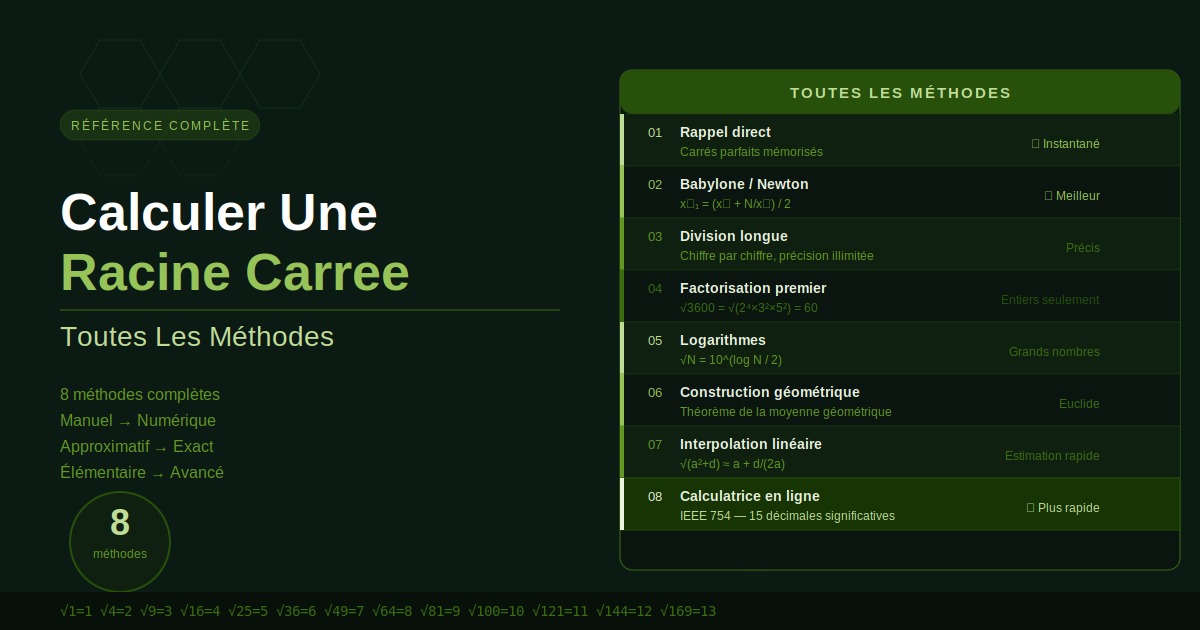
The square root is one of the most important operations in mathematics, appearing in fields ranging from pure geometry to financial modelling and quantum physics. This comprehensive guide brings together every significant method for calculating a square root — manual and digital, approximate and exact, elementary and advanced — providing a complete technical reference for students, educators, and professionals alike.
Foundational Concepts
Definition
The square root of a real number n ≥ 0 is defined as the non-negative number r such that r² = n. It is denoted √n or n^(1/2). The operation is the principal branch of the multivalued inverse of the squaring function.
Domain and Range
- Domain in real numbers: n ≥ 0 (square roots of negative numbers are not real).
- Range in real numbers: r ≥ 0 (the principal square root is always non-negative).
- In complex numbers: √n exists for all n ∈ ℂ.
Relationship to Exponents
√n = n^(1/2). This connects square roots to the broader theory of exponentiation. It also means: √(n^k) = n^(k/2), which is useful for simplification.
Method 1: Direct Recall (Perfect Squares)
The fastest method is recognition. Any student who has memorized the squares of integers from 1 to 25 can compute these roots instantly:
- 1² = 1 → √1 = 1
- 2² = 4 → √4 = 2
- 3² = 9 → √9 = 3
- 4² = 16 → √16 = 4
- 5² = 25 → √25 = 5
- 6² = 36 → √36 = 6
- 7² = 49 → √49 = 7
- 8² = 64 → √64 = 8
- 9² = 81 → √81 = 9
- 10² = 100 → √100 = 10
- 15² = 225 → √225 = 15
- 20² = 400 → √400 = 20
- 25² = 625 → √625 = 25
Method 2: The Babylonian/Newton-Raphson Algorithm
The gold standard for iterative manual computation. Converges quadratically (error squares with each step).
Formula: x_{n+1} = (x_n + N/x_n) / 2
Complete Worked Example: √123
1. Choose x₀ = 11 (since 11² = 121 ≈ 123).
2. x₁ = (11 + 123/11) / 2 = (11 + 11.1818) / 2 = 11.0909
3. x₂ = (11.0909 + 123/11.0909) / 2 = (11.0909 + 11.0904) / 2 = 11.0905
4. x₃: converged. √123 ≈ 11.0905.
True value: 11.09053… — our result is accurate to 5 decimal places after just 3 iterations.
Method 3: The Long Division Method
Produces exact decimal expansions digit by digit. Suitable for situations requiring many decimal places.
Calculate √2 to 4 decimal places
5. Write as 2.00000000 (pairs: 2 | 00 | 00 | 00 | 00).
6. Largest integer whose square ≤ 2: 1 (1²=1). Write 1. Subtract: 2-1=1. Bring down 00: 100.
7. Double current answer (2). Find d: (20+d)×d ≤ 100. d=4: 24×4=96. Write 4. Subtract: 100-96=4. Bring down 00: 400.
8. Double current (28). Find d: (280+d)×d ≤ 400. d=1: 281×1=281. Write 1. Subtract: 400-281=119. Bring down 00: 11900.
9. Double current (282). Find d: (2820+d)×d ≤ 11900. d=4: 2824×4=11296. Write 4. Remainder: 604.
10. Result so far: 1.4142. True value: 1.41421356… Correct to 4 decimal places.
Method 4: Prime Factorization
Most effective for large perfect squares. Every prime factor must appear an even number of times for the number to be a perfect square.
Example: √5765760
11. Factor: 5765760 = 2⁷ × 3² × 5 × 7² × … (factorize stepwise)
12. Identify paired factors and take one from each pair.
13. Remaining unpaired factors stay under the radical.
This method ensures exact results and is the basis for simplifying radical expressions in algebra.
Method 5: Using Logarithm Tables
Before calculators, engineers used logarithm tables to compute square roots:
√N = antilog(log(N) / 2)
Example: √7500
14. log(7500) = log(75 × 100) = log(75) + 2 ≈ 1.8751 + 2 = 3.8751
15. 3.8751 / 2 = 1.9376
16. antilog(1.9376) = 10^1.9376 ≈ 86.6
True value: √7500 = √(2500×3) = 50√3 ≈ 86.603. Highly accurate.
Method 6: Geometric Construction
The geometric mean construction from Euclidean geometry allows the exact construction of √n using compass and straightedge:
17. Draw segment AB of length (1 + n) units.
18. Mark point C on AB such that AC = 1 and CB = n.
19. Draw a semicircle on AB as diameter.
20. Erect a perpendicular at C to AB, meeting the semicircle at D.
21. The length CD = √n exactly (by the geometric mean theorem: CD² = AC × CB = 1 × n = n).
This construction is of theoretical importance and shows that square roots are constructible numbers.
Method 7: Linear Interpolation
Linear interpolation uses the linear approximation between two known values:
√(a + d) ≈ √a + d / (2√a), for small d relative to a.
Example: √101
22. We know √100 = 10. Here d = 1, a = 100.
23. √101 ≈ 10 + 1/(2×10) = 10 + 0.05 = 10.05.
24. True value: 10.04987… — accurate to 3 decimal places with zero iteration.
This method is a first-order Taylor expansion and works best when d is small relative to a.
Method 8: Using an Online Calculator
For practical daily use, online racine carrée calculators offer the fastest and most accurate results. Features of quality online square root calculators include:
- Precision to 15+ significant figures using 64-bit IEEE 754 double-precision floating point.
- Support for square roots of fractions and decimals.
- Simplification output showing both decimal and radical form.
- Mobile-friendly interfaces for use on any device.
- Batch calculation capabilities for multiple inputs.
Comparison of Methods
- Direct recall: Instant, exact — but limited to perfect squares.
- Babylonian method: Fast convergence, any precision — requires arithmetic skill.
- Long division: Unlimited precision, fully manual — tedious for many digits.
- Prime factorization: Exact simplification — works only for integers.
- Logarithm tables: Good for large numbers — requires table access.
- Geometric construction: Exact, elegant — practical only for small numbers.
- Linear interpolation: Instant estimate — loses accuracy as d grows.
- Online calculator: Fastest and most accurate for any number — requires internet access.
Conclusion
The square root has been studied and computed for over 4,000 years, from ancient Babylonian clay tablets to modern floating-point processors. Today, a rich toolkit of methods exists — from elegant geometric constructions to blazingly fast digital algorithms. By understanding all these approaches, you gain not only the ability to calculate square roots in any situation but also a deeper appreciation for the mathematical structures that underlie one of arithmetic’s most fundamental operations. Whether you reach for a pencil or a browser, you are now equipped with every method available.