
Calculating the square root of a number is one of the most foundational skills in mathematics. From basic algebra to advanced engineering, the square root operation appears in countless formulas, equations, and real-world applications. This complete guide covers the definition, properties, methods, and practical uses of square root calculation — giving you a thorough understanding of the topic from the ground up.
Definition and Mathematical Properties
The square root of a number n is a value r such that r × r = n. This is written as r = √n. The operation is the inverse of squaring: if squaring multiplies a number by itself, taking the square root undoes that operation.
Key Properties of Square Roots
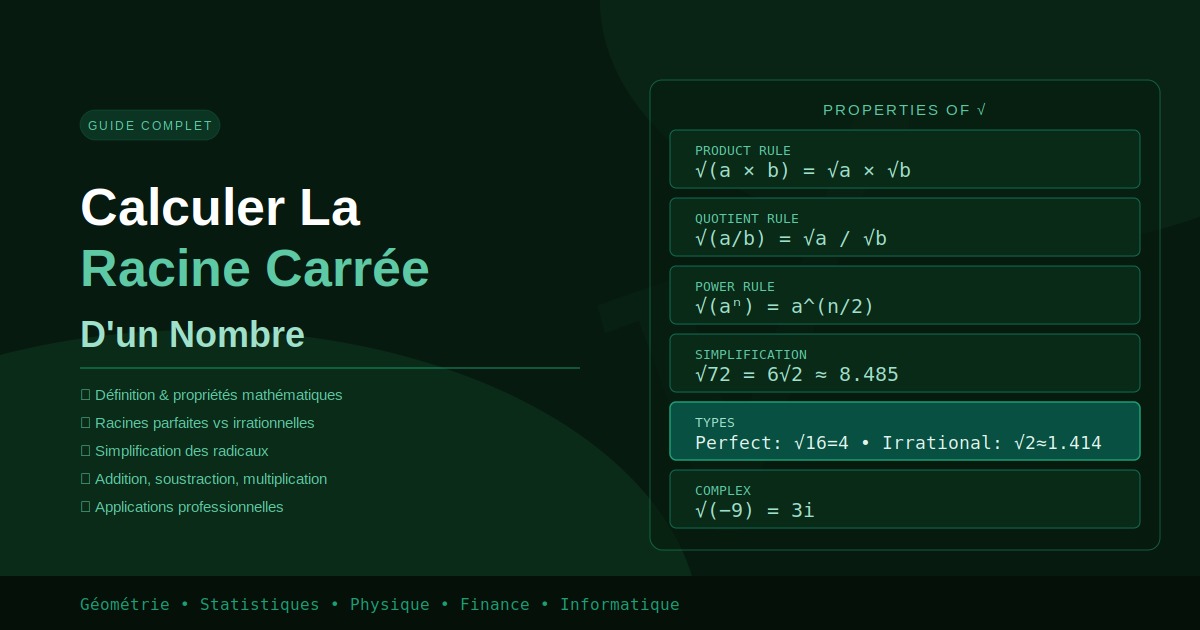
• Product rule: √(a × b) = √a × √b. For example, √(4 × 9) = √4 × √9 = 2 × 3 = 6.
• Quotient rule: √(a/b) = √a / √b. For example, √(25/4) = 5/2 = 2.5.
• Power rule: √(aⁿ) = a^(n/2). For example, √(2⁶) = 2³ = 8.
• Square of square root: (√a)² = a for all a ≥ 0.
• Non-negativity: √a ≥ 0 for all real a ≥ 0.
Types of Numbers and Their Square Roots
Perfect Squares
Numbers whose square roots are integers are called perfect squares: 1, 4, 9, 16, 25, 36, 49, 64, 81, 100, and so on. These are the easiest cases and should be memorized.
Non-Perfect Squares
Most numbers are not perfect squares. Their square roots are irrational — they cannot be expressed as exact fractions and have infinite non-repeating decimal expansions. Examples: √2 = 1.41421…, √3 = 1.73205…, √5 = 2.23606…
Negative Numbers
In the real number system, the square root of a negative number does not exist. However, in the complex number system, √(-1) = i (the imaginary unit), and √(-n) = i√n for any positive n. For example, √(-9) = 3i.
Step-by-Step Guide: Calculating √n Using the Long Division Method
The long division method is the most systematic manual approach. Let us calculate √529 in detail:
1. Write the number as 5|29 (grouping digits in pairs from the right).
2. Find the largest integer whose square ≤ 5: that is 2 (2² = 4). Write 2. Subtract: 5 – 4 = 1.
3. Bring down 29: new dividend is 129.
4. Double the current result (2×2=4). Find digit d such that (40+d)×d ≤ 129. Try d=3: 43×3 = 129. Exact.
5. Answer: 23. Verification: 23² = 529. Correct.
Simplifying Square Root Expressions
Simplification means expressing a square root in its simplest radical form by factoring out perfect square factors.
Example: Simplify √72
6. Factor 72: 72 = 4 × 18 = 4 × 9 × 2 = 36 × 2.
7. √72 = √(36 × 2) = √36 × √2 = 6√2.
8. Since √2 ≈ 1.41421, we get √72 ≈ 6 × 1.41421 = 8.485.
Simplified radical form is preferred in algebra because it is exact and easier to manipulate in further calculations.
Adding and Subtracting Square Roots
Square roots can be added or subtracted only when they share the same radicand (the number under the root sign):
• 3√5 + 2√5 = 5√5 (same radicand — combine coefficients).
• 3√5 + 2√3 = 3√5 + 2√3 (different radicands — cannot be combined).
• √8 + √2 = 2√2 + √2 = 3√2 (simplify √8 = 2√2 first, then combine).
Multiplying and Dividing Square Roots
Multiplication: √a × √b = √(ab). Example: √6 × √10 = √60 = √(4×15) = 2√15.
Division: √a / √b = √(a/b). Example: √75 / √3 = √(75/3) = √25 = 5.
Rationalizing the denominator: When a square root appears in the denominator, multiply numerator and denominator by the same root. Example: 1/√2 = √2/2.
Real-World Applications
• Architecture: Calculating the diagonal of a rectangular room using the Pythagorean theorem requires a square root.
• Navigation: GPS systems calculate distances using the square root of the sum of squared coordinate differences.
• Medicine: Dosage calculations for some medications use the body surface area formula, which involves a square root.
• Engineering: Stress and strain analysis in structural engineering relies on square root operations.
• Data Science: Euclidean distance between data points — a key metric in machine learning — uses square roots.
Common Mistakes to Avoid
• Confusing √(a+b) with √a + √b: These are NOT equal. √(9+16) = √25 = 5, not 3+4 = 7.
• Forgetting the negative root: √9 = ±3, though convention gives +3 as the principal root.
• Applying the square root to negative numbers in real arithmetic: √(-4) is undefined in real numbers.
• Losing simplification opportunities: Always factor out perfect squares before finalizing an answer.
Conclusion
Calculating the square root of a number is a multifaceted skill that underpins vast areas of mathematics, science, and engineering. By mastering the properties of square roots, learning to simplify radical expressions, and understanding the long division algorithm, you gain the tools to handle any square root problem — whether on a written exam or in a professional engineering context. Practice these techniques regularly and they will become second nature.