
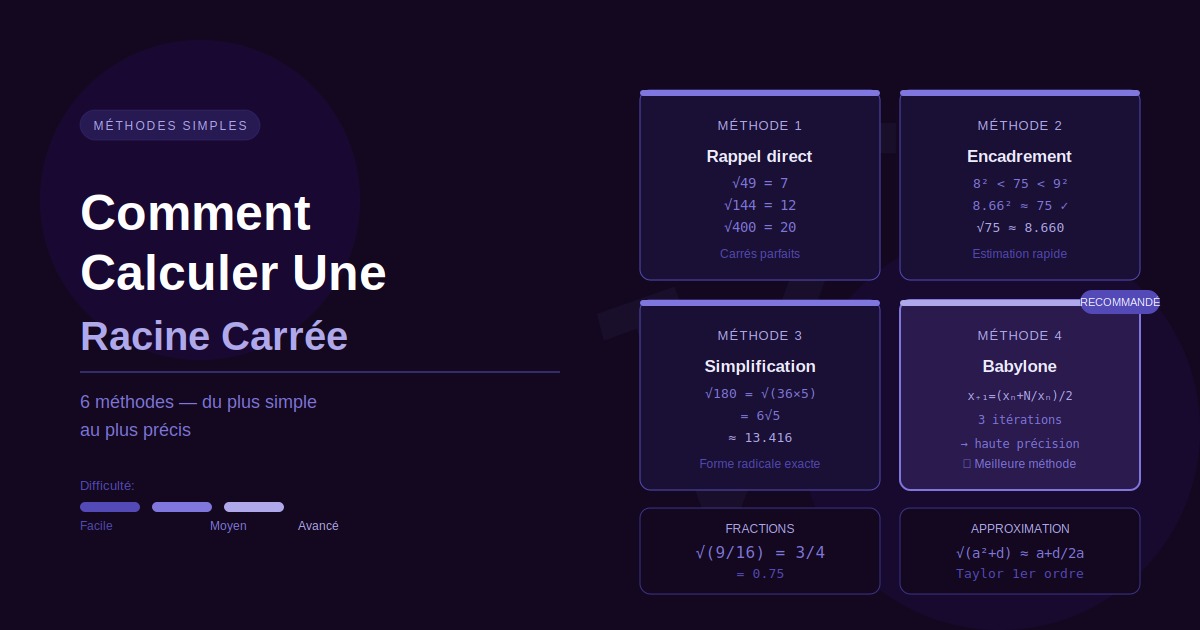
Many students and professionals find themselves asking: how do I calculate a square root? Whether you need a quick mental estimate, a precise decimal answer, or an algebraic simplification, there is a method that fits your situation. This guide presents the most practical and effective methods for calculating a square root, from simple mental tricks to systematic algorithms — all explained in clear, technical terms.
Understanding the Basics
Before diving into methods, let us establish the core concept. The square root of a number N is the value x that satisfies x² = N. The symbol √ (called the radical sign) denotes this operation. For example:
- √36 = 6, because 6² = 36.
- √2 ≈ 1.4142, because 1.4142² ≈ 2.
- √0 = 0, because 0² = 0.
For any non-negative number, there exists exactly one non-negative square root (the principal root). For negative numbers, square roots exist only in the complex number system.
Method 1: Mental Calculation for Perfect Squares
The simplest method — and the fastest — is direct recall. If you have memorized the squares of integers from 1 to 20, you can instantly recognize:
- √169 = 13 (because 13² = 169)
- √289 = 17 (because 17² = 289)
- √400 = 20 (because 20² = 400)
Extend this to larger numbers by recognizing patterns: √40000 = 200 (since √4 = 2 and √10000 = 100, so √40000 = 200).
Method 2: The Estimation and Refinement Method
When the number is not a perfect square, begin by bounding it between two known perfect squares and then refine.
Example: √110
1. 10² = 100 and 11² = 121. So √110 is between 10 and 11.
2. 110 is closer to 100, so try 10.5: 10.5² = 110.25. Very close.
3. Try 10.49: 10.49² = 110.04. Even closer.
4. Try 10.488: 10.488² ≈ 109.99 ≈ 110. Therefore √110 ≈ 10.49.
This approach is ideal when you need a quick, moderately precise answer without pen and paper algorithms.
Method 3: Simplification Using Factoring
For expressions involving radicals, simplification often means finding the simplest exact form rather than a decimal approximation.
Example: Simplify √180
5. Factor 180: 180 = 4 × 9 × 5 = 36 × 5.
6. √180 = √(36 × 5) = √36 × √5 = 6√5.
7. Decimal check: 6 × 2.2360 = 13.416, and indeed √180 ≈ 13.416.
Simplification is essential in algebra, where leaving answers in radical form (6√5) is often preferred over approximate decimals.
Method 4: The Babylonian Iterative Algorithm
For high precision without a calculator, the Babylonian method is unmatched in efficiency. The iterative formula is:
x_{n+1} = (x_n + N/x_n) / 2
Example: Calculate √17 to 4 decimal places
8. Initial guess: x₀ = 4 (since 4² = 16 ≈ 17).
9. x₁ = (4 + 17/4) / 2 = (4 + 4.25) / 2 = 4.125
10. x₂ = (4.125 + 17/4.125) / 2 = (4.125 + 4.1212) / 2 = 4.1231
11. x₃ = (4.1231 + 17/4.1231) / 2 ≈ 4.1231 (converged)
Result: √17 ≈ 4.1231. True value: 4.12310562… — accurate to 5 significant figures after just 3 iterations.
Method 5: Using Square Root Rules for Fractions
Square roots of fractions can be calculated by applying the quotient rule:
√(a/b) = √a / √b
Examples
- √(9/16) = √9 / √16 = 3/4 = 0.75
- √(1/2) = 1/√2 = √2/2 ≈ 0.7071
- √(49/100) = 7/10 = 0.7
When b is not a perfect square, rationalize the denominator by multiplying by √b/√b.
Method 6: Calculating Square Roots on a Number Line
This geometric approach is useful for visualization and proof purposes:
12. Draw a number line. Mark point O at 0 and point A at the number N.
13. Find the midpoint M of segment OA: M is at N/2.
14. Draw a semicircle with diameter OA.
15. At the point marking 1 on the number line, erect a perpendicular to OA.
16. The length of this perpendicular from the number line to the semicircle equals √N.
This elegant construction, known from Euclid, demonstrates that square roots have a natural geometric interpretation.
Choosing the Right Method
- Perfect square? Use direct recall — instant and exact.
- Need a quick estimate? Use bracketing between consecutive perfect squares.
- Need high precision manually? Use the Babylonian algorithm — 3-4 iterations suffice.
- Working in algebra? Use factoring/simplification to get exact radical form.
- Working with fractions? Apply the quotient rule directly.
Conclusion
There is no single best method for calculating a square root — the right choice depends on your context, the precision required, and the tools available. By mastering all the methods in this guide, from mental arithmetic to iterative algorithms, you gain complete flexibility in handling any square root calculation. Practice each method on a variety of numbers until they feel intuitive, and you will be prepared for any mathematical challenge involving square roots.