

BMR is the calories your body burns at complete rest to stay alive, while TDEE is BMR plus everything you do all day: movement, digestion, and exercise. BMR is the baseline; TDEE is the full picture. For weight loss, always base your calorie target on TDEE. Compare your own numbers with this calorie deficit tool.
What Is BMR?
Your basal metabolic rate is the energy your body needs for its most basic functions: breathing, circulating blood, regulating temperature, growing cells, and keeping your brain running. It is measured under strict conditions: lying still, fully rested, in a warm room, after fasting. Think of it as your body’s idle fuel consumption.
BMR typically accounts for 60 to 70 percent of daily calorie burn. It is driven mainly by your size, muscle mass, age, and sex. Bigger bodies and more muscle burn more at rest; aging slowly lowers BMR as muscle declines.
What Is TDEE?
TDEE starts with BMR and adds every other calorie you burn in a day: walking, standing, fidgeting, digesting food, and workouts. Because it includes real life, TDEE is always higher than BMR, sometimes dramatically so for active people. Your TDEE is your maintenance level: eat exactly that many calories and your weight stays stable.
How Do the Formulas Differ?
BMR comes from a body-measurement formula. The Mifflin-St Jeor equations are the standard:
- Men: BMR = 10 x weight (kg) + 6.25 x height (cm) – 5 x age + 5
- Women: BMR = 10 x weight (kg) + 6.25 x height (cm) – 5 x age – 161
TDEE takes that BMR and multiplies it by an activity factor:
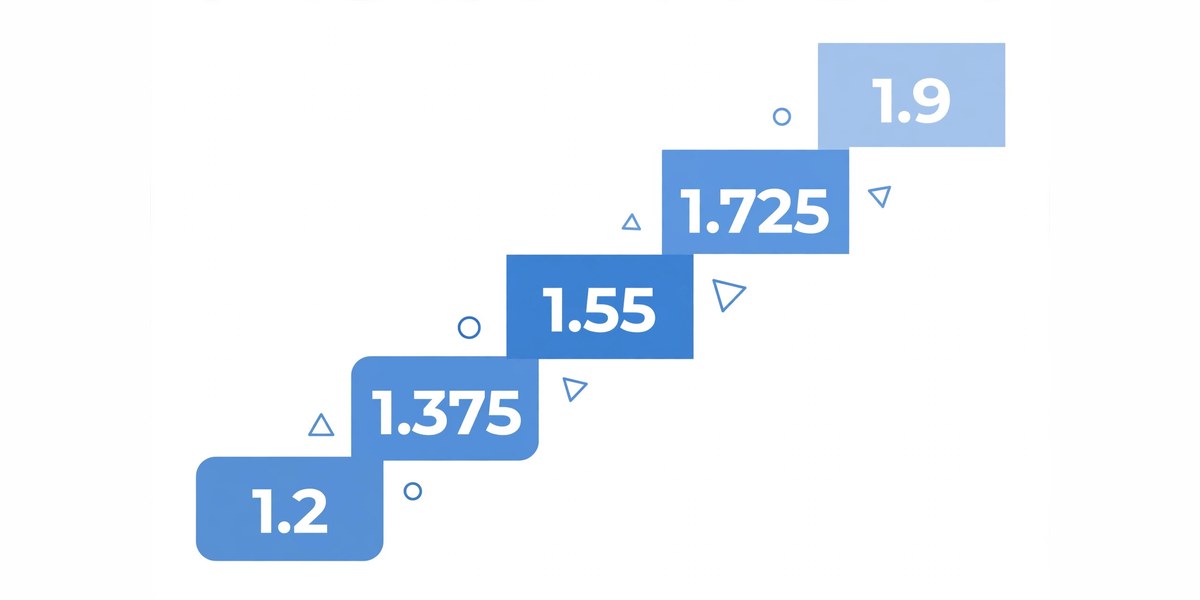
- 1.2 for sedentary, 1.375 for lightly active, 1.55 for moderately active, 1.725 for very active, 1.9 for extra active
So BMR is pure biology, while TDEE is biology times lifestyle. Two people with identical BMRs can have TDEEs that differ by over 1,000 calories if one sits all day and the other trains hard.
Can You Show BMR vs TDEE With Real Numbers?
Take a 50-year-old man, 85 kg (about 187 lb), 175 cm (about 5 ft 9 in), lightly active:
- BMR = 10 x 85 + 6.25 x 175 – 5 x 50 + 5 = 850 + 1,093.75 – 250 + 5 = 1,698.75, about 1,699 calories per day
- TDEE = 1,698.75 x 1.375 = 2,335.78, about 2,336 calories per day
- The gap between them: 2,336 – 1,699 = 637 calories per day from activity and digestion
Now watch how lifestyle changes the gap for the same body. A 40-year-old woman, 60 kg (about 132 lb), 160 cm (about 5 ft 3 in):
- BMR = 10 x 60 + 6.25 x 160 – 5 x 40 – 161 = 600 + 1,000 – 200 – 161 = 1,239 calories per day
- If sedentary: TDEE = 1,239 x 1.2 = 1,486.8, about 1,487 (gap of only 248)
- If very active: TDEE = 1,239 x 1.725 = 2,137.3, about 2,137 (gap of 898)
Same woman, same BMR, but her TDEE swings by 650 calories depending on lifestyle. That swing is the entire difference between an easy diet and a miserable one.
Which One Should You Use for Weight Loss?
Always use TDEE. Here is why: a deficit is defined as eating below maintenance, and TDEE is your maintenance. If you subtract 500 calories from BMR instead of TDEE, you create a deficit that is far too aggressive, because you are ignoring all the calories your daily life already burns.
For the man above, the correct 1-lb-per-week target is TDEE – 500 = 2,336 – 500 = 1,836 calories per day. The wrong version, BMR – 500 = 1,699 – 500 = 1,199 calories per day, would be a brutal and unsustainable cut. One formula choice is the difference between 1,836 and 1,199 calories, which is why this confusion causes so many failed diets.
When Does BMR Alone Matter?
BMR is still useful in a few situations. It sets the absolute floor: eating consistently below BMR is rarely advisable without supervision, since BMR covers the energy your organs need at rest. Clinicians also use BMR-based equations to estimate the needs of bedridden patients, where activity is near zero. And tracking how BMR changes over years shows how aging and muscle loss affect your metabolism.
Side-by-Side Summary
| BMR | TDEE | |
|---|---|---|
| What it measures | Calories burned at complete rest | Calories burned in a full day |
| Includes activity | No | Yes |
| Typical share of burn | 60 to 70 percent | 100 percent |
| Use for weight loss | Safety floor only | Subtract your deficit from this |
| Changes with exercise | Barely | A lot |
Frequently Asked Questions
Is BMR or TDEE higher?
TDEE is always higher than BMR because it equals BMR plus all activity, movement, and digestion calories. The gap is small for sedentary people (around 20 percent above BMR) and large for very active people (up to 90 percent above BMR).
Should I eat below my BMR to lose weight faster?
Not without professional supervision. BMR covers the energy your vital organs need at rest. Eating below it regularly can cause fatigue, hormonal issues, and muscle loss. Most people lose weight best with a target between BMR and TDEE.
Can BMR and TDEE ever be the same?
Practically no. TDEE equals BMR only if you burn zero calories beyond resting metabolism, which is impossible for a living person. Even a fully sedentary day adds about 20 percent on top of BMR through basic movement and digestion.
Does building muscle raise BMR or TDEE?
Both. Muscle tissue burns roughly 6 to 10 calories per pound per day at rest, so more muscle raises BMR slightly. It also lets you train harder and move more, which raises the activity part of TDEE. The combined effect makes weight management easier.
Why do online calculators give different BMR and TDEE numbers?
Different calculators use different formulas (Mifflin-St Jeor, Harris-Benedict, Katch-McArdle) and different activity multiplier scales. Expect 5 to 15 percent variation between tools. Pick one method, use it consistently, and let your two-week weight trend calibrate the real number.
How often should I recalculate BMR and TDEE?
Recalculate every 10 to 15 pounds of weight change, after big shifts in activity (new job, new training program), or about every two to three months during a long diet. Both numbers drift as your body and lifestyle change.