The five largest US states by population — California, Texas, Florida, New York, and Pennsylvania — collectively employ over 80 million workers. Each has its own paycheck tax rules, withholding structures, and quirks that significantly affect take-home pay.
This guide examines how paycheck calculations work across these five states in detail. Whether you are comparing job offers across state lines or just trying to understand why your paycheck looks the way it does, this breakdown will help.
California: the highest tax burden in the country
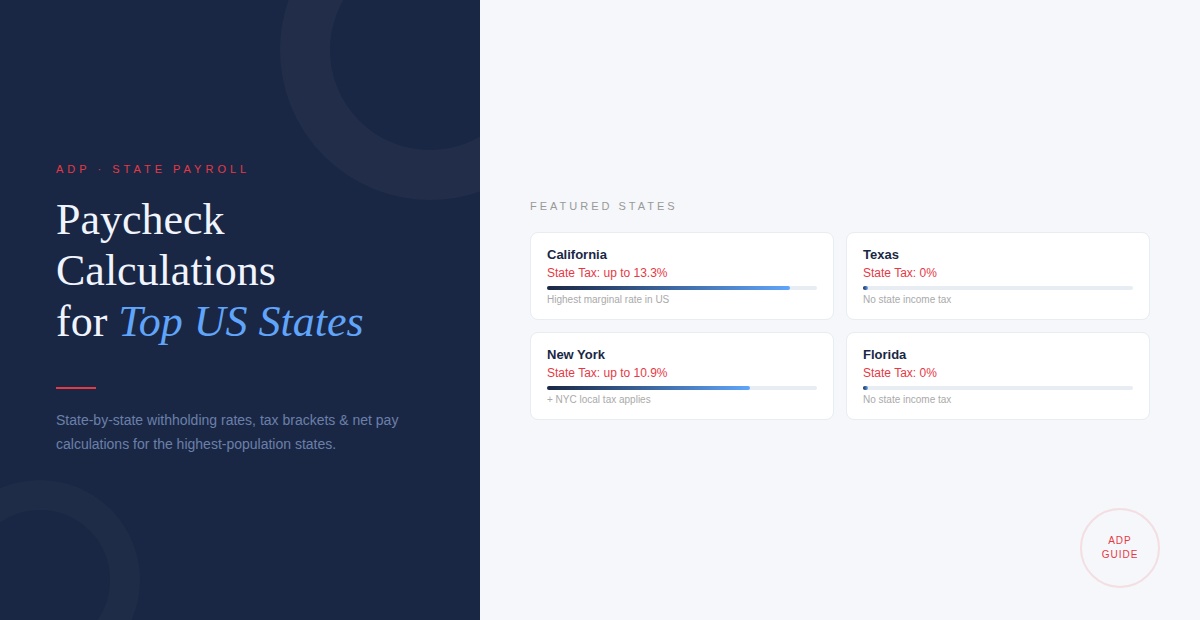
California has the highest state income tax rate in the United States at 13.3% for top earners. It also has the highest number of income tax brackets — 10 in total — making it one of the most complex paycheck states to calculate accurately.
| CA Taxable Income (Single) | State Tax Rate |
| Up to $10,099 | 1% |
| $10,100 – $23,942 | 2% |
| $23,943 – $37,788 | 4% |
| $37,789 – $52,455 | 6% |
| $52,456 – $66,295 | 8% |
| $66,296 – $338,639 | 9.3% |
| $338,640 – $406,364 | 10.3% |
| $406,365 – $677,275 | 11.3% |
| $677,276 – $1,000,000 | 12.3% |
| Over $1,000,000 | 13.3% |
Beyond state income tax, California also withholds State Disability Insurance (SDI) at 0.9% of wages with no wage cap in 2024. This is often missing from generic paycheck calculators and explains why California paychecks frequently look smaller than estimates.
There is no city income tax in California — but Property taxes, cost of living, and sales taxes make the overall California tax burden significant even for middle-income earners.
What California employees frequently miss
- SDI withholding applies to all wages — most calculators forget this
- The 9.3% rate kicks in at a relatively modest $66,296 — catching many middle earners
- Bonus payments are taxed at a flat 10.23% California supplemental rate
- California does not conform to all federal deductions — the state calculation starts differently
Texas: zero state income tax — and what fills the gap
Texas has no personal state income tax. This is the single biggest paycheck advantage of living in Texas compared to states like California or New York. A Texas worker earning $80,000 per year takes home roughly $4,000 to $6,000 more annually than a comparable California worker.
For a paycheck calculation in Texas, the state tax line is simply $0. Federal taxes and FICA still apply, as do any employer-specific deductions. But there is no state withholding form, no state tax brackets, and no SDI equivalent to worry about.
The tradeoff Texas residents often cite is higher property taxes — among the highest in the country — and no state income tax deduction to offset them on federal returns. But for employees receiving a regular paycheck, Texas is genuinely straightforward.
What Texas employees should still pay attention to
- Federal withholding is the primary tax variable — make sure your W-4 is accurate
- No state tax does not mean no taxes — FICA (7.65%) still comes out every pay period
- Some Texas cities charge occupational or business taxes — but not personal income taxes
- Employees working remotely for employers in other states may owe taxes in those states
Florida: another no-income-tax state with a different profile
Like Texas, Florida has no state personal income tax. Florida paychecks are also FICA plus federal tax only for most employees. This makes Florida one of the simpler states for paycheck calculation.
Florida does not have its own state withholding form. Employees in Florida only fill out the federal W-4. This simplicity is one reason Florida has become a major destination for remote workers and retirees from high-tax states.
One thing to note: Florida has a Reemployment Tax that employers pay — but this does not come out of employee paychecks. Employees in Florida have no state-level payroll deductions beyond FICA.
New York: the most layered paycheck in the country
New York State has a progressive income tax with rates from 4% to 10.9%. But what makes New York unique — and makes New York paycheck calculations especially complex — is the additional layer of New York City income tax for residents who live within the five boroughs.
| Tax Layer | Who Pays | Rate Range |
| Federal income tax | All NY workers | 10% – 37% |
| Social Security | All NY workers | 6.2% |
| Medicare | All NY workers | 1.45% |
| NY State income tax | All NY workers | 4% – 10.9% |
| NYC income tax | NYC residents only | 3.078% – 3.876% |
| Yonkers income tax | Yonkers residents only | ~16.75% of NY tax |
A New York City resident earning $90,000 per year can expect to pay federal tax, Social Security, Medicare, New York State tax, and New York City tax — five separate payroll deductions just from government tax obligations. This stacking effect is why NYC take-home pay is often among the lowest in the country for a given salary.
New York State also has its own withholding certificate (IT-2104) separate from the federal W-4. Employees who do not submit this form will have taxes withheld at a default rate that may not match their actual situation.
Pennsylvania: flat rate with local complexity
Pennsylvania uses a flat 3.07% state income tax rate — one of the simpler state structures. However, Pennsylvania is similar to Ohio in that it has an extensive local earned income tax system.
Nearly every municipality in Pennsylvania has a local earned income tax administered through local tax collection agencies. Rates vary by municipality but are typically between 1% and 3%. Most Pennsylvania workers owe local earned income tax both where they live and where they work — with a credit system to avoid full double taxation.
Pennsylvania paycheck items to verify
- State income tax: should be exactly 3.07% of taxable wages — easy to verify
- Local earned income tax: confirm both your resident municipality rate and your workplace municipality rate
- Employee SUI (State Unemployment Insurance): Pennsylvania employees pay a small 0.07% contribution
- Philadelphia city wage tax: if you work in Philadelphia, a city wage tax of approximately 3.75% (residents) or 3.44% (non-residents) applies
Side-by-side: same salary, five states
Here is how an $80,000 annual salary (single filer, biweekly pay, standard deductions only) compares across all five states:
| State | State Tax | Est. Annual State Tax | Est. Biweekly Take-Home |
| California | Varies (avg ~7%) | ~$4,640 | ~$2,280 |
| Texas | None | $0 | ~$2,460 |
| Florida | None | $0 | ~$2,460 |
| New York (upstate) | Varies (avg ~6%) | ~$3,700 | ~$2,320 |
| New York City | State + city avg ~10% | ~$6,400 | ~$2,210 |
| Pennsylvania | Flat 3.07% + local | ~$2,900 | ~$2,370 |
Use our main ADP Paycheck Calculator to run these numbers for your exact salary, filing status, and deductions. Results will be specific to your situation.
Choosing between states: what the paycheck numbers tell you
When comparing jobs or relocation options across these five major states, the paycheck difference is real and significant. Moving from California to Texas on the same $80,000 salary is effectively a raise of roughly $4,500 to $6,000 per year — just from the elimination of state income tax.
However, paycheck take-home is only one variable. Property taxes, cost of living, housing costs, and quality of public services all factor into the full financial picture. The paycheck calculation is the starting point — not the full story.
State tax rates are updated annually. Figures in this guide are illustrative estimates based on 2024 tax year rates. Always run a current calculation for your specific situation.