
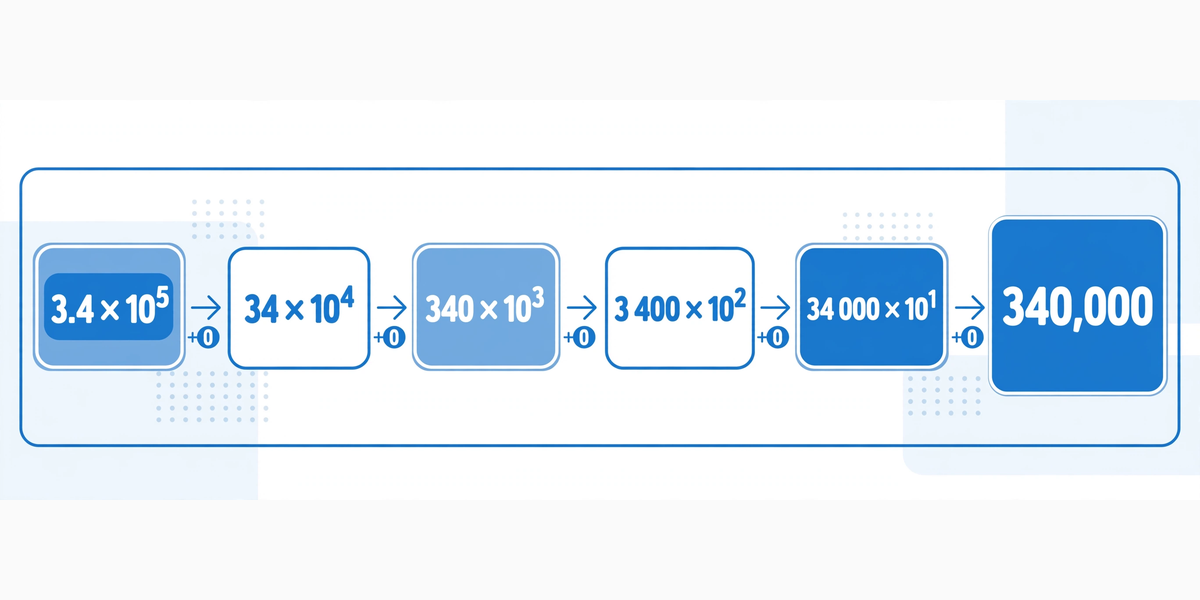
To convert scientific notation to standard form, move the decimal point right for a positive exponent and left for a negative exponent, shifting it by exactly the number of places shown in the exponent and filling empty spots with zeros. For example, 3.4 x 10^5 becomes 340,000 and 3.4 x 10^-4 becomes 0.00034.
What Are the Steps to Convert Scientific Notation to Standard Form?
- Read the exponent. In 7.2 x 10^4 the exponent is 4; in 9.109 x 10^-31 it is -31.
- Check the sign. A positive exponent means a large number, so you move the decimal right. A negative exponent means a small number, so you move it left.
- Move the decimal exactly that many places, adding zeros wherever a digit is missing.
- Write the final standard form with commas as needed for readability.
This is the reverse of the decimal-to-scientific process, and a Scientific Notation Calculator can run the expansion for you while showing each decimal move.

How Do You Expand a Positive Exponent?
A positive exponent tells you how many places the decimal shifts to the right, making the number larger. Add a zero for every empty place.
Worked example: 3.4 x 10^5
- Start with 3.4 and move the decimal 5 places right.
- You need 4 extra zeros after the 34: 3.4 becomes 340000.
- Result: 340,000.
Worked example: 7.2 x 10^4
- Move the decimal 4 places right: 7.2 becomes 72000.
- Result: 72,000.
Worked example: 2.99792458 x 10^8
- Move the decimal 8 places right, filling with zeros: 299792458.
- Result: 299,792,458, the speed of light in meters per second.
How Do You Expand a Negative Exponent?
A negative exponent tells you how many places the decimal shifts to the left, making the number smaller. Place zeros between the decimal point and the first digit as needed.
Worked example: 3.4 x 10^-4
- Move the decimal 4 places left from 3.4.
- You pass 3 spots to the left of the 3, so the result starts 0.00034.
- Result: 0.00034.
Worked example: 1.2 x 10^-7
- Move the decimal 7 places left: six zeros come before the 1.
- Result: 0.00000012.
Worked example: 9.109 x 10^-31
- Move the decimal 31 places left: the first non-zero digit lands in the 31st decimal place.
- Result: 0.0000000000000000000000000000009109 kg, the mass of an electron.
That last expansion shows why scientists rarely write such values out: one miscounted zero changes the answer by a factor of ten.
What Does the Exponent Tell You at a Glance?
| Scientific notation | Exponent | Decimal moves | Standard form |
|---|---|---|---|
| 5.6 x 10^6 | +6 | 6 right | 5,600,000 |
| 7.2 x 10^4 | +4 | 4 right | 72,000 |
| 5.6 x 10^0 | 0 | none | 5.6 |
| 3.4 x 10^-4 | -4 | 4 left | 0.00034 |
| 1.2 x 10^-7 | -7 | 7 left | 0.00000012 |
Notice the pattern: the exponent equals the number of decimal places between the original decimal point and the new one. Verifying that count is the fastest way to catch mistakes.
When Should You Convert Back to Standard Form?
- Final answers in reports. Lab reports often want standard form for values people recognize, like 340,000 instead of 3.4 x 10^5.
- Money and statistics. A budget of $7,000,000,000 reads more naturally than 7 x 10^12 in a news article.
- Checking your work. Expanding the answer confirms the exponent sign and zero count are right.
- Comparing everyday quantities. Standard form helps when numbers fall in a familiar range, like population counts or test scores.
What Are Common Zero-Counting Mistakes?
Most expansion errors come from miscounting zeros. A reliable habit: after expanding, count the digits and compare against the exponent. For 2.99792458 x 10^8, the standard form 299,792,458 must have 9 digits total, which matches an exponent of 8 (one digit before the implied decimal, plus 8 more places).
Another safeguard is the round-trip check: convert your standard-form answer back to scientific notation. If 340,000 converts back to 3.4 x 10^5, your expansion was correct. This two-direction habit is exactly what the calculator tool above automates for you.
Practice Problems With Answers
- Expand 9.3 x 10^7. Move the decimal 7 places right: 93,000,000 (Earth-Sun distance in miles).
- Expand 5 x 10^-7. Move the decimal 7 places left: 0.0000005.
- Expand 1.25 x 10^6. Move the decimal 6 places right: 1,250,000.
- Expand 8.2 x 10^-2. Move the decimal 2 places left: 0.082.
Each answer converts back to its original scientific notation, confirming the zero counts are right.
Why Does 10^0 Equal 1?
Students often stumble on zero exponents during expansion. The rule is simple: any non-zero number raised to the power of 0 equals 1, so 5.6 x 10^0 is just 5.6. You can see why by working backward: 10^3 = 1,000, 10^2 = 100, 10^1 = 10, and each step down divides by 10, so 10^0 = 10 / 10 = 1. Negative exponents continue the pattern: 10^-1 = 0.1, 10^-2 = 0.01, and so on. This ladder makes the whole exponent system consistent in both directions.
Frequently Asked Questions
How do you convert 3.4 x 10^5 to standard form?
Move the decimal 5 places right from 3.4, adding zeros, which gives 340,000. The positive exponent means the number grows larger.
How do you convert 3.4 x 10^-4 to standard form?
Move the decimal 4 places left from 3.4, giving 0.00034. The negative exponent means the number shrinks below 1.
What does 10^0 mean in scientific notation?
Any non-zero number raised to the power 0 equals 1, so 5.6 x 10^0 is simply 5.6. The decimal does not move.
How do you convert e-notation like 3.4e5 to standard form?
E-notation means the same thing: 3.4e5 is 3.4 x 10^5, so expand it the same way to get 340,000. Spreadsheets and calculators use the e format.
What if the coefficient has more digits than the exponent?
Just keep shifting. For 123.456 x 10^2, move the decimal 2 right to get 12,345.6. For a proper scientific form you would first normalize it to 1.23456 x 10^4.
Why do US science classes teach both directions?
Students must convert into scientific notation to simplify calculations, then convert back so final answers are readable. Both directions appear on the SAT, ACT, and AP science exams.