Most paycheck guides focus on large states like California, Texas, and New York. But millions of Americans live and work in smaller states — and those states have their own distinct tax rules that directly affect take-home pay.
This guide covers the paycheck tax landscape across smaller US states. If you live in one of these states, understanding how your state tax works will help you use any paycheck calculator more effectively and interpret your pay stub more accurately.
Why smaller states are often overlooked in paycheck guides
Smaller states — those with populations under 3 million — often get grouped together or skipped entirely in tax guides. That is a mistake. States like Montana, Idaho, Maine, and Vermont all have unique income tax structures. Some are progressive, some are flat, and a few have features that make them genuinely unusual.
The result is that residents of smaller states often use paycheck calculators incorrectly — either selecting the wrong state or not understanding what the output means for their specific situation.
States with no income tax — and what that means for your paycheck
Several smaller states have chosen to eliminate state income tax entirely. This is a significant financial advantage for residents, especially higher earners.
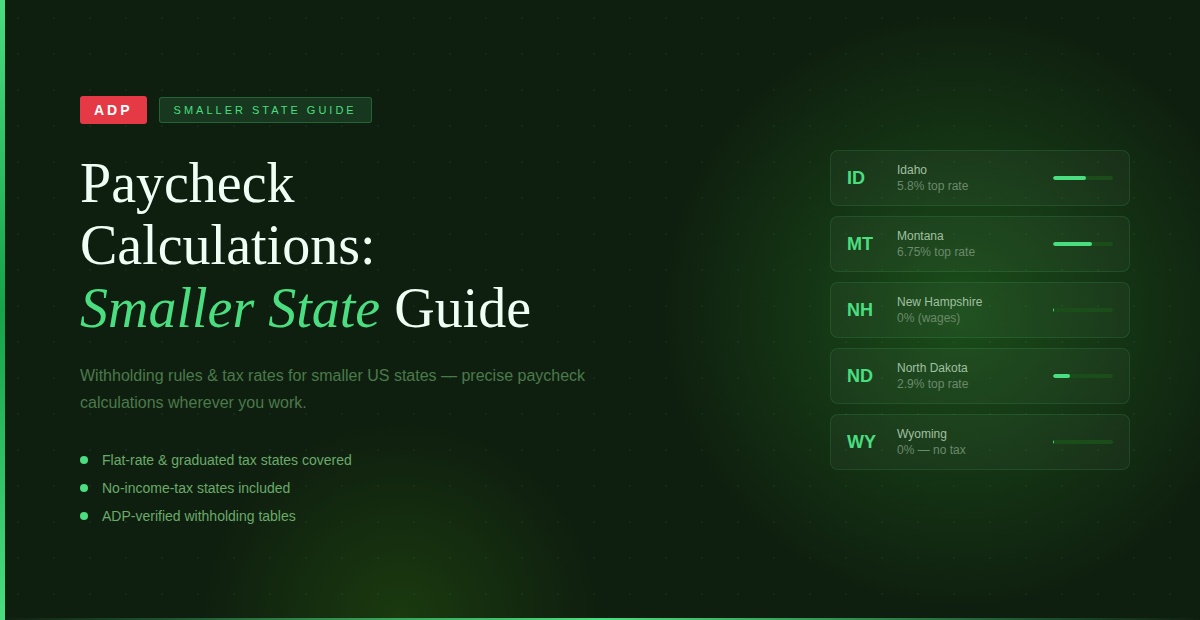
| State | Income Tax | Note |
| Wyoming | None | Also has no corporate income tax |
| South Dakota | None | No personal or corporate income tax |
| Alaska | None | No state income tax or state sales tax |
| New Hampshire | None on wages | Interest and dividends tax being phased out |
| Montana | Progressive | Rates from 1% to 6.75% |
| Idaho | Flat 5.8% | Flat rate since 2023 tax reform |
| Maine | Progressive | Rates from 5.8% to 7.15% |
| Vermont | Progressive | Rates from 3.35% to 8.75% |
How flat-rate states simplify paycheck calculations
Some smaller states use a flat income tax rate. This means everyone — regardless of how much they earn — pays the same percentage. Idaho moved to a flat 5.8% rate as part of a 2023 tax reform. This makes paycheck calculations straightforward: multiply your taxable income by 5.8% and you have your state withholding.
Flat rates are simpler to calculate and easier to verify. If your state tax withholding looks wrong on your pay stub, a flat-rate state makes it easy to spot the error.
Progressive tax states: more complex but more nuanced
States like Maine and Vermont use progressive brackets — similar to the federal system. Lower earners pay a lower percentage, and higher earners pay more. While more complex to calculate manually, these systems are generally considered more equitable.
For paycheck purposes, the practical implication is that your state withholding will look different depending on whether you are in the lower, middle, or upper portion of your state’s income brackets.
Maine’s paycheck tax structure
Maine has three income tax brackets. The lowest bracket starts at 5.8% and the top rate is 7.15%. For someone earning $50,000 per year, the effective Maine state tax rate lands around 5.9% to 6.2% depending on deductions and filing status.
Maine also allows a standard deduction that reduces taxable income before the rate is applied. This is something many paycheck calculators miss if they are not state-specific.
Vermont’s paycheck tax structure
Vermont has a higher top rate than most smaller states at 8.75%. However, this rate only applies to income above $213,150 for single filers. Most Vermont residents fall into the 3.35% or 6.6% brackets.
Vermont also conforms closely to federal taxable income — meaning it uses the same starting point as your federal return, which simplifies the calculation considerably.
What smaller state residents should watch for on their paychecks
If you live in a smaller state, here are the key items to verify on every pay stub:
- State income tax line — confirm the rate matches your state’s current rate
- Standard deduction application — some states apply their own deduction before calculating withholding
- Local taxes — even smaller states sometimes have city or county taxes (Portland, Maine has a local tax for example)
- SDI or SUI — some states withhold employee contributions to state disability or unemployment insurance
The hidden paycheck impact: state-specific withholding forms
Most people know about the federal W-4. Fewer people know that many states have their own withholding forms. If you recently moved to a new state and did not submit a state withholding form to your employer, you may be having the wrong amount withheld.
States with their own withholding forms include Maine, Vermont, Montana, and Idaho — among others. Check with your HR or payroll department to confirm the correct form is on file.
Reciprocity agreements between smaller states
Some smaller states have reciprocity agreements with neighboring states. This means if you live in one state and work in another, you only pay income tax in your state of residence — not the state where you work.
For example, if you live in New Hampshire and work in Maine, you would generally only owe taxes to New Hampshire (which has no wage income tax). These agreements vary, and not all neighboring states have them. Always verify the current status of any reciprocity agreement that might apply to your situation.
How to use a paycheck calculator effectively for smaller states
When using a paycheck calculator for a smaller state, keep these steps in mind:
- Always select your exact state — never use a nearby larger state as a substitute
- Use your state withholding form (not just the federal W-4) as the source for your withholding elections
- Factor in any local taxes specific to your city or county
- Check whether your state has any unique deductions or credits that affect withholding
- Run the calculation with and without pre-tax deductions to see the full tax impact
Use our main ADP Paycheck Calculator to calculate your exact take-home pay for your smaller state. Select your state from the dropdown to get state-specific results.
The bottom line for smaller state residents
Living in a smaller state does not mean your paycheck tax situation is simple. Some smaller states have high rates. Some have quirks in their withholding systems. And some — like Wyoming, South Dakota, and Alaska — offer a genuine financial advantage in the form of no state income tax.
The key is to understand your specific state’s rules and use a calculator that actually accounts for them. A generic calculator that does not distinguish between states will give you an inaccurate result.
Tax rules in smaller states change frequently due to legislative sessions. Always verify current rates with your state’s department of revenue or a licensed tax professional.