
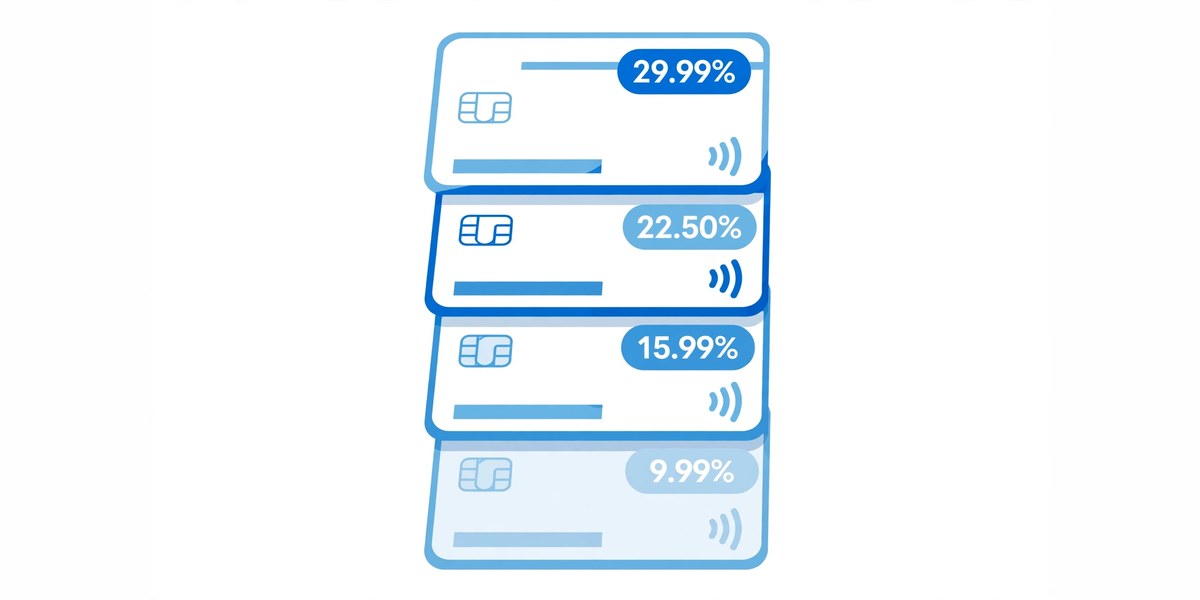
Direct answer: The debt avalanche method is a payoff strategy where you pay minimums on all debts and send every extra dollar to the debt with the highest APR first. When that debt is cleared, you roll its payment into the next-highest APR debt. It mathematically minimizes total interest and payoff time compared to any other payoff order.
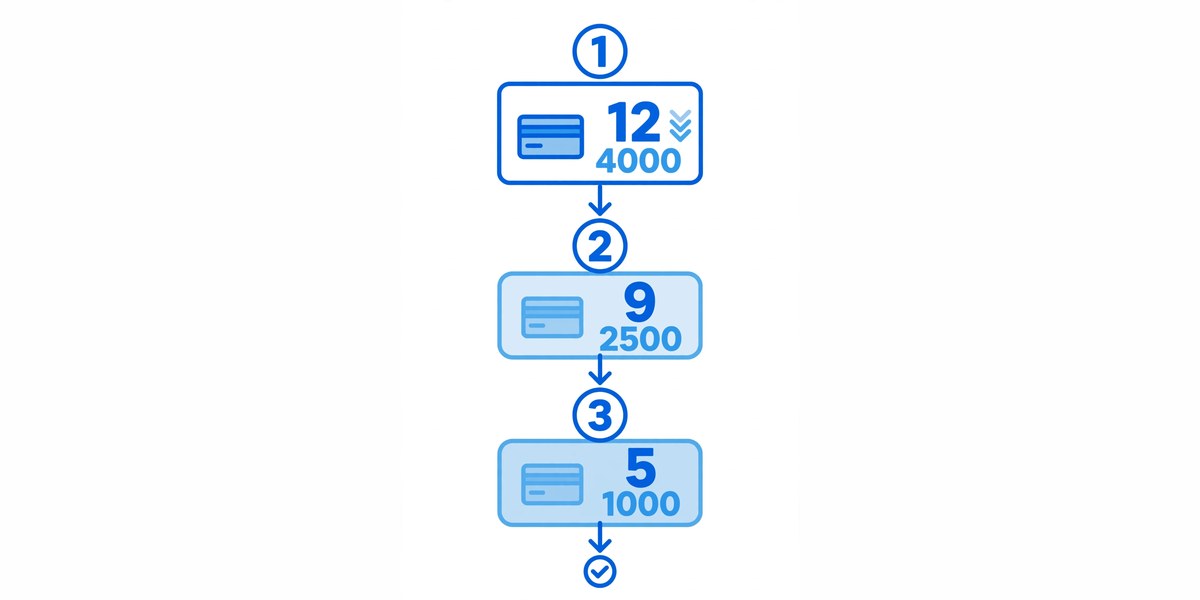
How Does the Debt Avalanche Method Work?
The method has four simple steps:
- List every debt with its balance, APR, and minimum payment.
- Rank them by APR, highest first. Ignore the balances for ranking purposes.
- Pay all minimums on time every month so no late fees or penalty rates appear.
- Aim all extra money at the top-ranked debt. When it hits zero, redirect its full payment to the next debt down the list.
The “avalanche” name comes from the acceleration: as each expensive debt dies, its payment joins the attack on the next one, so your effective extra payment grows every time a debt clears.
Avalanche Worked Example With Verified Numbers
Two cards and a $200 extra payment each month:
- Card X: $6,000 balance at 24% APR, $150 minimum
- Card Y: $4,000 balance at 18% APR, $100 minimum
Avalanche targets Card X first (24% beats 18%). Here is the verified outcome versus the snowball method, which would target the smaller $4,000 balance first:
| Avalanche (APR first) | Snowball (balance first) | |
|---|---|---|
| First debt cleared | Card X, month 22 | Card Y, month 15 |
| Second debt cleared | Card Y, month 32 | Card X, month 34 |
| Total months | 32 | 34 |
| Total interest | $2,821.05 | $3,385.46 |
Avalanche saves $564.41 in interest and finishes two months earlier. Snowball clears its first debt seven months sooner, which is the entire trade-off in one picture: money versus momentum.
Why Does Avalanche Always Win on Interest?
Every dollar of debt costs you its APR per year. A dollar at 24% costs $0.24 per year; a dollar at 18% costs $0.18. Killing the 24% dollar first removes the most expensive interest from your life as early as possible. No other ordering can beat that, because interest accrues on every open balance every month.
The math holds regardless of balances. A $500 balance at 29.99% still outranks a $9,000 balance at 12.99% under avalanche, and correctly so: the small balance is growing faster in percentage terms, and it dies quickly anyway once targeted.
When Does Avalanche Not Win?
Avalanche always wins on dollars, but dollars are not everything:
- Motivation slumps. If your highest-APR debt is also your largest, avalanche can mean a year or more before any debt fully clears. Some people quit before the first win.
- Tiny nuisance debts. A $200 medical bill at 0% interest barely matters mathematically, but clearing it removes a collector call and a mental burden.
- 0% promo balances. A 0% balance transfer ranks last under avalanche, which is usually right, but watch the promo expiration date. If the promo ends before you finish the higher-APR debts, the deferred interest can ambush you.
In these cases, a hybrid works well: clear sub-$1,000 nuisances first, then run pure avalanche on the rest. Verify the cost of any exception with a debt payoff calculator before committing.
How to Set Up Avalanche Payments
- Rank your debts by APR today, highest first. Write the order on paper or a note on your phone.
- Automate every minimum payment so nothing is ever late. Late fees and penalty APRs near 30% destroy the avalanche math.
- Automate one extra payment to the top-ranked debt, even if it is only $50. Automation beats willpower.
- Roll payments forward. When a debt clears, add its old minimum to the extra payment attacking the next debt. Never let your total monthly payment shrink.
- Recalculate quarterly. New balances, rate changes, or a balance transfer offer can reshuffle the ranking.
Avalanche vs Snowball vs Consolidation: How to Pick
Avalanche and snowball are payoff orders, while consolidation is a refinancing tool, and they can be combined. The decision tree is simple. If you can get a consolidation loan at a rate well below your card APRs, take it, then run avalanche on the remaining debts, which is now just the loan itself plus anything you did not consolidate.
If consolidation is unavailable or the rate barely beats your cards, skip it and run pure avalanche or snowball on the cards directly. A 0% balance transfer is a third option: it beats both methods during the promo window because no interest accrues at all, but it only works if you can clear the transferred balance before the promo expires.
Whichever route you choose, the ranking principle stays the same: expensive debt first, cheap debt last, minimums everywhere, extra payments concentrated. That principle is the avalanche method, whether you apply it to five cards or to one consolidation loan plus two leftover cards.
Frequently Asked Questions
What is the debt avalanche method in simple terms?
Pay minimums on all debts, then put all extra money toward the debt with the highest interest rate. When it is paid off, move to the next-highest rate. It is the cheapest and fastest payoff order.
Is avalanche better than snowball?
Yes, mathematically. In a verified $10,000 example, avalanche saved $564.41 in interest and finished two months earlier than snowball. Snowball only wins on early motivation, clearing its first debt seven months sooner.
Who invented the debt avalanche method?
No single person invented it; it is simply the mathematically optimal ordering, long taught in personal finance. It gained its name as the analytical counterpart to Dave Ramsey’s popular debt snowball method.
Does avalanche work with different minimum payments?
Yes. You always pay every minimum first, whatever each one is, then concentrate the extra on the highest-APR debt. The minimums just reduce the extra available each month.
What if two debts have the same APR?
Break the tie by targeting the smaller balance first. You get a quick win at zero extra interest cost, since equal rates mean the ordering between them does not change total interest.
Can I use avalanche for student loans?
Yes. Avalanche works for any debts with fixed rates: credit cards, student loans, auto loans, and personal loans. Rank them all by APR in one list, including federal and private student loans separately since their rates differ.