Most people know roughly what their take-home pay is every month, but far fewer know how to work backwards from that number to figure out their gross salary or the exact amount of tax being withheld. Whether you are negotiating a job offer, verifying your payslip, planning your finances, or helping an employee understand their compensation, the ability to reverse calculate income tax and payroll tax is genuinely valuable. This guide explains exactly how to do it, step by step, with formulas and examples.
What Is a Reverse Income Tax Calculation?
A standard income tax calculation goes forward: you start with your gross salary (what you earn before any deductions), apply the applicable tax rates, and arrive at your net take-home pay. A reverse income tax calculation does the opposite — you start with the net amount and work backwards to find the gross income and the total tax withheld.
This is also referred to as:
- Reverse salary tax calculation
- Net to gross calculation
- Gross-up calculation
- Reverse payroll tax calculation (when employer payroll taxes are also factored in)
It answers the question: “If my take-home pay is $X, what was my gross salary, and how much tax was taken out?”
Why Would You Need to Reverse Calculate Income Tax?
There are several common situations where reverse income tax calculation is needed:
Job offer negotiations: When a recruiter offers you a package, you might want to know what your actual take-home will be — or conversely, if you know what take-home you need, you can back-calculate the gross you should ask for.
Go from taxes to salary — reverse: Tax authorities and payroll teams sometimes only have net payment records and need to gross them up for reporting purposes.
Bonus and commission gross-ups: Employers who want to give employees a specific after-tax bonus amount use reverse payroll tax calculation to determine how much gross to pay so the employee nets the desired figure.
Verifying payslips: Employees can use a reverse income tax approach to check that their payslip deductions are correct.
Freelancers and contractors: Self-employed individuals estimating their quarterly tax obligations often work backwards from their expected income tax liability to verify their net earnings.
Reverse income tax calculator Canada, UK, and other countries: Non-residents and expats moving between countries often need to reverse calculate what a local salary translates to after local taxes.
The Key Difference: Income Tax vs. Sales Tax Reversal
Before going further, it is critical to understand why the formula for reversing income tax is different from the formula for reversing sales tax.
- Sales tax is added on top of a base price: Total = Base × (1 + rate). So reversing it means: Base = Total ÷ (1 + rate).
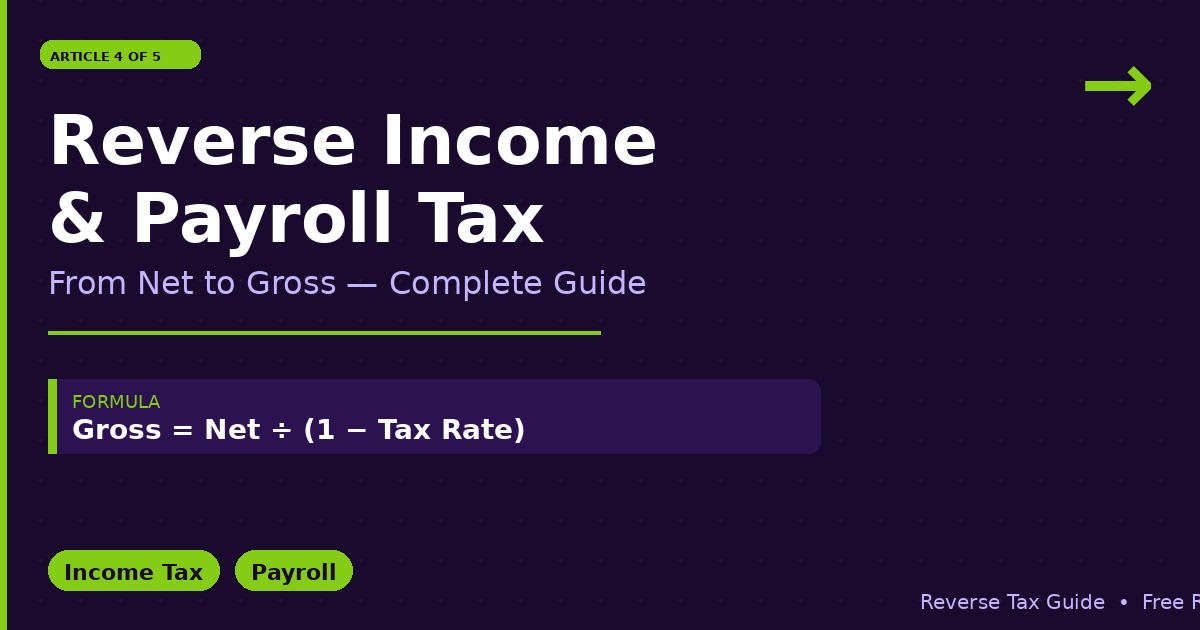
- Income tax is taken out of gross income: Net = Gross × (1 − rate). So reversing it means: Gross = Net ÷ (1 − rate).
This distinction matters enormously. Using the wrong formula gives you a wrong answer.
Flat Rate Reverse Income Tax Formula
If a single flat tax rate applies to all income (common in some countries and for specific withholding situations), the formula is simple:
Gross Income = Net Income ÷ (1 − Tax Rate)
Example: Net pay = $3,400 per month, flat income tax rate = 15%
Gross = $3,400 ÷ (1 − 0.15) = $3,400 ÷ 0.85 = $4,000 Tax withheld = $4,000 − $3,400 = $600
Verification: $4,000 × (1 − 0.15) = $4,000 × 0.85 = $3,400 ✓
This flat rate approach works well for:
- Countries with flat income tax systems
- Situations where a single withholding rate applies (e.g., supplemental wage withholding in the US at 22%)
- Simple back-of-envelope estimates
Progressive Income Tax: How to Reverse Calculate Gross From Net
Most countries use progressive income tax systems, meaning different portions of income are taxed at different rates. In the US federal system, for example, the first portion of income is taxed at 10%, the next at 12%, then 22%, and so on up to 37%. The UK uses 20%, 40%, and 45% bands.
Because of this structure, there is no single formula to reverse calculate income tax precisely in a progressive system. Instead, the process works as follows:
Step-by-Step Reverse Calculation for Progressive Tax
Step 1: Start with your known net income (take-home pay after all taxes).
Step 2: Estimate which tax bracket range your gross income likely falls in. If you earn a comfortable salary, you are probably not in the lowest bracket.
Step 3: Add back the tax owed at your estimated top bracket rate to get an approximate gross.
Step 4: Check whether this estimated gross falls within the bracket you assumed. If it does, verify by recalculating the full tax liability on that gross.
Step 5: Adjust up or down and repeat until the forward calculation of tax on your estimated gross produces the known net.
This iterative approach is why people use an income tax reverse calculator or a federal income tax reverse calculator tool rather than doing it fully by hand for progressive systems.
US Federal Income Tax: Reverse Calculation Example
Let us walk through a simplified reverse income tax calculator USA example using 2024 federal tax brackets for a single filer.
Known: Monthly net pay = $5,000 → Annual net = $60,000 Goal: Find annual gross income and total federal tax
Step 1: Assume gross is in the 22% bracket range (roughly $47,150–$100,525 for single filers).
Step 2: The tax structure means:
- First $11,600 taxed at 10% = $1,160
- Next $35,550 taxed at 12% = $4,266
- Remainder taxed at 22%
Step 3: Total tax on first two brackets = $5,426. This means net after those brackets = Gross − $5,426. We need net = $60,000, so Gross ≈ $60,000 + estimated total tax.
Iterative estimate: Try Gross = $77,000
- Tax on $11,600 at 10% = $1,160
- Tax on $35,550 at 12% = $4,266
- Tax on ($77,000 − $47,150) = $29,850 at 22% = $6,567
- Total federal tax = $11,993
- Net = $77,000 − $11,993 = $65,007 (too high — reduce gross)
Try Gross = $72,000:
- Tax on $11,600 at 10% = $1,160
- Tax on $35,550 at 12% = $4,266
- Tax on ($72,000 − $47,150) = $24,850 at 22% = $5,467
- Total federal tax = $10,893
- Net = $72,000 − $10,893 = $61,107 (close but slightly high)
Try Gross = $71,000:
- Tax on $24,850 − $1,000 = $23,850 at 22% = $5,247
- Total federal tax = $10,673
- Net = $71,000 − $10,673 = $60,327 (very close)
In practice, a federal income tax reverse calculator handles this iteration automatically. The key insight is that with progressive tax, you must account for all brackets, not just the marginal rate.
Reverse Payroll Tax Calculation: Including Employer Taxes
When employers need to gross up payroll, they must also account for payroll taxes beyond income tax. In the US, this includes:
- Social Security: 6.2% employee + 6.2% employer (up to wage base)
- Medicare: 1.45% employee + 1.45% employer
- Additional Medicare Tax: 0.9% on wages over $200,000 (employee only)
For a reverse payroll tax calculation where the goal is to give an employee a specific net amount:
Gross = Net ÷ (1 − Employee Income Tax Rate − Employee SS Rate − Employee Medicare Rate)
Example: Desired net bonus = $5,000, combined employee deductions = 22% income tax + 6.2% SS + 1.45% Medicare = 29.65%
Gross = $5,000 ÷ (1 − 0.2965) = $5,000 ÷ 0.7035 = $7,108.74
This gross amount, when subjected to a 29.65% combined deduction rate, nets down to $5,000.
If the employer also wants to cover the employer portion of payroll taxes, the gross-up calculation becomes even larger — this is an employer reverse calculate taxes scenario.
Reverse Income Tax: Canada
In Canada, income is subject to both federal and provincial income tax, plus CPP (Canada Pension Plan) and EI (Employment Insurance) contributions. A reverse income tax calculator Canada calculation must account for all of these.
Federal tax rates in Canada for 2024 range from 15% to 33% across five brackets. Provincial rates vary widely — Quebec has the highest combined rates in the country, which is why reverse income tax calculator Quebec searches are especially common.
For a rough flat-rate Canadian gross-up:
- Combined federal + provincial effective rate (mid-income): approximately 28–38%
Example (approximate): Net = $4,000/month, effective combined rate ≈ 30%
Gross = $4,000 ÷ 0.70 = $5,714 Tax = $5,714 − $4,000 = $1,714
For precise results, a reverse income tax calculator Canada uses actual bracket data.
Reverse Income Tax: United Kingdom
The UK has three main income tax bands (excluding Scotland):
- Personal Allowance: £12,570 (0%)
- Basic Rate: 20% on income up to £50,270
- Higher Rate: 40% on income from £50,271 to £125,140
- Additional Rate: 45% above £125,140
A reverse income tax calculator UK calculation also needs to account for National Insurance contributions (NICs), which add 8% on earnings between £12,570 and £50,270.
Simplified UK example: Net = £2,500/month → Annual net = £30,000 Assuming all income in the basic 20% band (after personal allowance):
Taxable gross ≈ £30,000 ÷ 0.80 = £37,500 (before adding personal allowance back) True gross = £37,500 + £12,570 = approximately £50,070
A full UK reverse income tax calculation includes NICs, making a dedicated reverse income tax calculator UK tool the most practical approach.
Tips for Accurate Reverse Income/Payroll Tax Calculations
- Know your effective tax rate (total tax ÷ gross income) vs. your marginal rate (rate on the last dollar). Use the effective rate for simple gross-ups.
- Account for all deductions — not just income tax. Payroll includes pension contributions, health insurance premiums, and social security equivalents.
- For progressive systems, always iterate — one formula pass will not be sufficient.
- Verify by running the gross back through the forward tax calculation.
- Use jurisdiction-specific tools when precision matters — tax laws change annually.
Conclusion
Reversing income and payroll tax calculations is more complex than reversing sales tax because income tax operates on a “taken out of” basis rather than “added on top.” For flat-rate situations, the formula Gross = Net ÷ (1 − rate) gives you the answer directly. For progressive tax systems in the US, Canada, UK, or elsewhere, an iterative approach — or a dedicated reverse income tax tool — is necessary. Understanding the method behind the calculation means you can verify any result and ensure your gross-up figures are accurate every time.