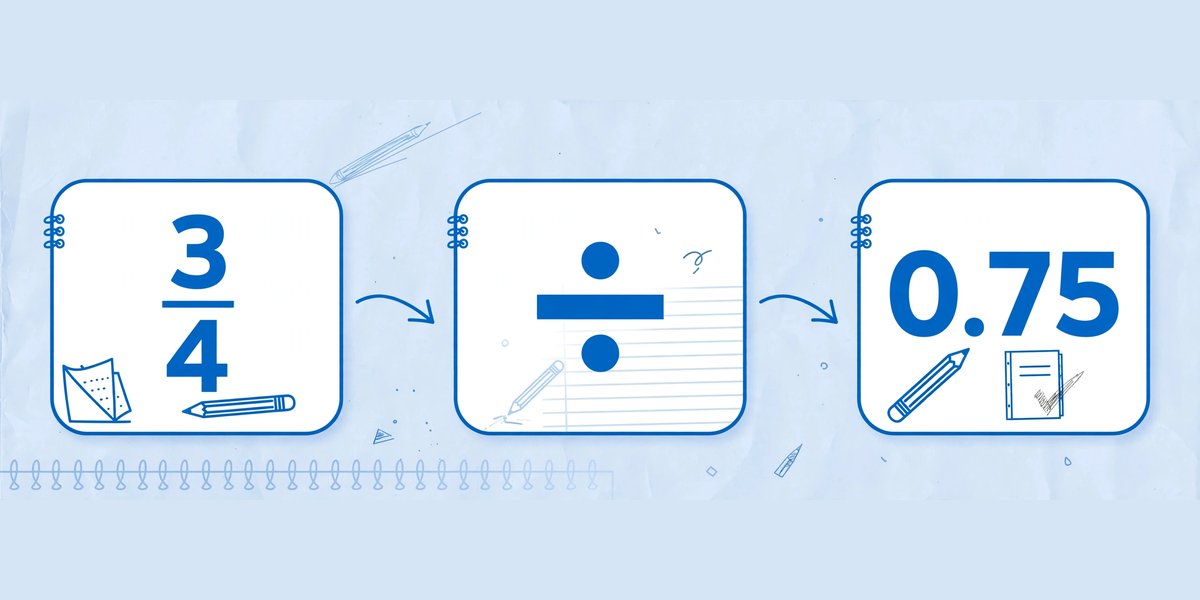
Direct answer: To convert a fraction to a decimal, divide the numerator (top number) by the denominator (bottom number). For example, 3/4 becomes 0.75 because 3 divided by 4 equals 0.75. Use long division for paper-and-pencil work, or a fraction to decimal calculator for instant results with step-by-step working.
What Does Converting a Fraction to a Decimal Actually Mean?
A fraction and a decimal are two ways of writing the same value. The fraction 1/2 and the decimal 0.5 describe exactly the same amount. Converting simply means rewriting the value in decimal form, which is often easier to compare, add, or type into a calculator.
The reason division works is that a fraction bar is a division symbol. The fraction 3/4 literally means 3 divided by 4. Once you see the bar as division, the whole conversion becomes one operation.
How Do You Convert a Fraction to a Decimal by Hand?
Follow these steps for any fraction:
- Write it as division. Turn 5/8 into 5 divided by 8.
- Set up long division. Place the numerator inside the division bracket and the denominator outside.
- Add a decimal point and zeros. Write 5.000 inside the bracket so you have digits to bring down.
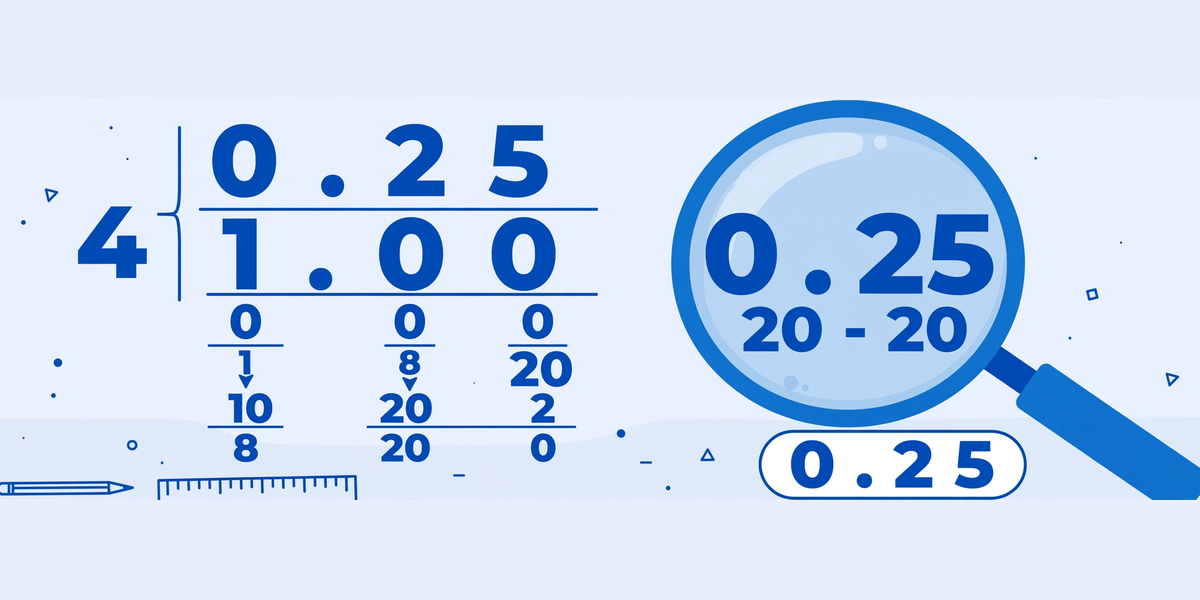
- Divide digit by digit. 8 fits into 50 six times (6 x 8 = 48), remainder 2. Bring down a 0 to make 20. 8 fits into 20 two times (2 x 8 = 16), remainder 4. Bring down a 0 to make 40. 8 fits into 40 five times exactly.
- Read the answer. The digits you found are 0.625, so 5/8 = 0.625.
What Are Some Worked Examples?
Here are conversions done start to finish, each verified by division:
- 1/2 = 0.5. 2 fits into 10 five times (5 x 2 = 10), remainder 0. Done.
- 3/4 = 0.75. 4 fits into 30 seven times (7 x 4 = 28), remainder 2. Bring down 0 to make 20. 4 fits into 20 five times exactly.
- 1/5 = 0.2. 5 fits into 10 two times exactly.
- 7/8 = 0.875. 8 fits into 70 eight times (8 x 8 = 64), remainder 6. Bring down 0 to make 60. 8 fits into 60 seven times (7 x 8 = 56), remainder 4. Bring down 0 to make 40. 8 fits into 40 five times exactly.
- 1/3 = 0.333… 3 fits into 10 three times (3 x 3 = 9), remainder 1, forever. The 3 repeats.
Should You Simplify the Fraction First?
Simplifying is optional but helpful. A fraction like 6/8 divides the same as 3/4, but 3/4 is easier to work with by hand. To simplify, divide both numbers by their greatest common divisor. For 6/8, the GCD is 2, so 6/8 becomes 3/4, which converts to 0.75. Either way you get the same decimal, so simplify when it makes the division easier.
What If the Fraction Is Improper or a Mixed Number?
An improper fraction has a numerator larger than the denominator, like 7/4. The method does not change: 7 divided by 4 equals 1.75. The answer is simply greater than 1.
For a mixed number like 2 3/8, convert the fraction part first (3/8 = 0.375) and add the whole number: 2 + 0.375 = 2.375. Alternatively, rewrite the mixed number as an improper fraction first. 2 3/8 becomes 19/8, and 19 divided by 8 equals 2.375. Both paths reach the same answer.
What Mistakes Should You Avoid?
- Dividing the wrong way. It is numerator divided by denominator, not the reverse. 3/4 means 3 divided by 4, which is 0.75, not 1.333.
- Forgetting the decimal point. When you add zeros, place the decimal point in the answer directly above its position in the dividend.
- Stopping too early on repeating decimals. 1/3 is 0.333…, not 0.3 or 0.33. Mark the repeating digit so the value stays exact.
- Dividing by zero. A denominator of zero is undefined. No decimal exists for 4/0.
When Is This Conversion Useful in Real Life?
Fraction-to-decimal conversion shows up constantly. Recipes list 1/3 cup, but a digital kitchen scale needs 0.33 cups. A 25 percent sale is 1/4 off, which is 0.25 of the price. Tape measures read in fractions like 5/16 inch, while calculators and spreadsheets want 0.3125. Test scores, sports statistics, and survey results all switch between the two forms. Knowing the hand method means you can convert anywhere, even without a phone nearby.
How Can You Check Your Answer?
Every conversion can be verified by reversing it. Multiply your decimal answer by the original denominator. If you get the numerator back, the conversion is correct. For example, you found that 5/8 = 0.625. Multiply 0.625 by 8: 0.625 x 8 = 5.0, which matches the numerator 5. The answer checks out.
Try it with 7/8 = 0.875: 0.875 x 8 = 7.0, correct. For repeating decimals, use the fraction form to check: 1/3 = 0.333… and 0.333… x 3 = 0.999…, which equals 1. This reverse check catches the most common error, dividing the numbers in the wrong order, because the check will not return the numerator.
Frequently Asked Questions
What is the fastest way to convert a fraction to a decimal?
Type the numerator, press the divide key, type the denominator, and press equals on any calculator. For 9/16, that gives 0.5625 instantly. For a result with steps shown, use an online converter.
How do you convert 1/8 to a decimal?
Divide 1 by 8 to get 0.125. 8 fits into 10 once (1 x 8 = 8), remainder 2. Bring down 0 to make 20, 8 fits twice (2 x 8 = 16), remainder 4. Bring down 0 to make 40, 8 fits five times exactly.
Can every fraction become a decimal?
Yes, as long as the denominator is not zero. Every fraction converts to either a terminating decimal (like 1/2 = 0.5) or a repeating decimal (like 1/3 = 0.333…).
How do you convert a fraction to a decimal without a calculator?
Use long division: divide the numerator by the denominator, adding a decimal point and zeros to the numerator as needed. Work one digit at a time until the remainder reaches zero or starts repeating.
What is 2/5 as a decimal?
2/5 equals 0.4. Divide 2 by 5: 5 fits into 20 four times exactly, so the answer is 0.4.
Why do some conversions repeat forever?
After simplifying, if the denominator contains any prime factor other than 2 or 5, the division never reaches a zero remainder and the digits cycle. That is why 1/3 repeats but 1/4 = 0.25 stops cleanly.