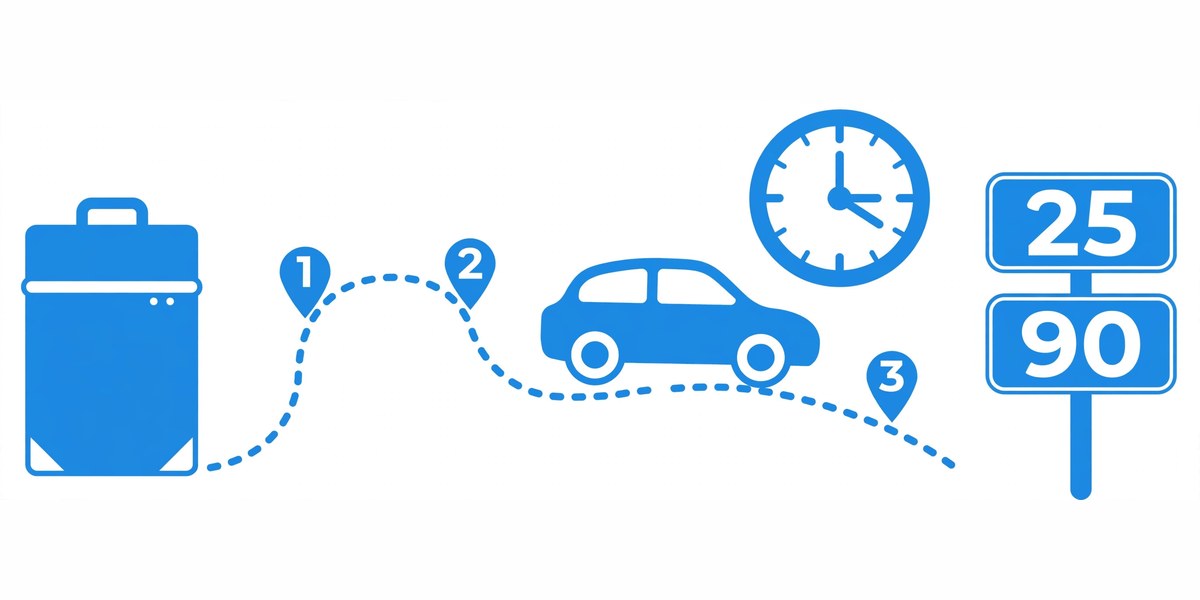
Quick answer: To find how long a trip takes, divide the distance by your speed: time = distance / speed. A 300-mile drive at 60 mph takes 300 / 60 = 5 hours. Then add time for fuel, food, and rest stops to get your real door-to-door travel time.
“How long will my trip take?” is the question behind every departure time, every flight booking, and every “are we there yet?” The formula is one division, but a good estimate also accounts for stops, traffic, and unit conversions. This guide covers the time formula, real route examples, and a planning method that keeps your arrival estimates honest.
What Is the Formula for Travel Time?
The formula is:
Time = Distance / Speed
Distance is the length of your route. Speed is how fast you expect to travel on average, not your top speed. Dividing gives the moving time, the hours and minutes you actually spend in motion.
Simple examples:
- 300 miles at 60 mph = 300 / 60 = 5 hours.
- 240 km at 80 km/h = 240 / 80 = 3 hours.
- 10 km run at 12 km/h = 10 / 12 = 0.8333 hours = 50 minutes.
How Do You Calculate Trip Time Step by Step?
- Find the route distance from a map app, road signs, or mile markers. Write it down with units.
- Pick a realistic average speed, not the speed limit. Highway trips in the US often average 60 to 65 mph once traffic and slower stretches are included.
- Divide distance by speed. 280 miles / 65 mph = 4.31 hours.
- Convert the decimal to hours and minutes. Multiply the decimal part by 60: 0.31 x 60 = 18.6, so 4.31 hours is about 4 h 18 min.
- Add stop time. Two 15-minute stops add 30 minutes, giving 4 h 48 min door to door.
A free speed-distance-time tool does steps 3 and 4 instantly and shows the hours-and-minutes breakdown for you.
Real Trip Examples with Verified Math
- City to city: 280 miles at 65 mph = 280 / 65 = 4.31 h = 4 h 18 min of driving. With two 15-minute stops, plan 4 h 48 min.
- Long haul: 790 miles at 70 mph = 790 / 70 = 11.29 h = 11 h 17 min of driving. With an hour of stops, plan about 12 h 17 min.
- Metric road trip: 500 km at 100 km/h = 5 h of driving. Add 40 minutes of stops for a 5 h 40 min trip.
- Morning run: 10 km at 12 km/h = 0.8333 h = 50 min.
- Swim session: 1,000 m at 1.2 m/s = 1,000 / 1.2 = 833.33 s = 13.89 min, or 13 min 53 s.
- Around the world: Earth’s circumference is 40,075 km. At a steady 100 km/h it would take 40,075 / 100 = 400.75 h, which is 400.75 / 24 = 16.7 days of nonstop driving.

How Do You Convert Decimal Hours to Hours and Minutes?
Calculators return decimals like 4.31 hours, but nobody says “arrive in 4.31 hours.” Convert like this:
- Keep the whole number as hours: 4.31 becomes 4 hours.
- Multiply the decimal part by 60: 0.31 x 60 = 18.6 minutes.
- Round to the nearest minute: 4 h 19 min (or about 4 h 20 min for planning).
More conversions: 0.5 h = 30 min, 0.25 h = 15 min, 0.75 h = 45 min, 2.5 h = 2 h 30 min, 11.29 h = 11 h 17 min (0.29 x 60 = 17.4).
Should You Use the Speed Limit or a Lower Average?
Always plan with an average below the speed limit. Here is why:
- Traffic and lights: city sections and congestion pull the average down sharply.
- Terrain: hills, curves, and construction zones slow you below the posted limit.
- Stops: fuel, food, and rest breaks add zero miles but real minutes.
A practical rule: estimate the speed-limit time, then add 10 to 15 percent. A 5-hour speed-limit estimate becomes 5.5 to 5.75 hours in the real world. For the 280-mile example at a 65 mph average, the pure math says 4 h 18 min; a safe plan says about 4 h 45 min.
How Do Stops Change the Total?
| Driving time | Stops | Total trip time |
|---|---|---|
| 3 h | 1 x 15 min | 3 h 15 min |
| 5 h | 2 x 15 min | 5 h 30 min |
| 8 h | 3 x 20 min | 9 h |
| 11 h 17 min | 4 x 20 min | 12 h 37 min |
For trips over 4 hours, plan a break every 2 hours. For trips over 8 hours, plan a meal stop plus fuel stops, and consider whether an overnight break is safer than pushing through.
What About Flights and Mixed Travel?
For flights, the formula still works on the air distance: a 2,925 km flight at 900 km/h takes 2,925 / 900 = 3.25 h, or 3 h 15 min in the air. But door-to-door time needs extras:
- Airport arrival buffer: 2 hours for domestic, 3 hours for international.
- Boarding and taxiing: about 30 to 45 minutes each end.
- Connections: add the full layover, never the scheduled minimum.
For mixed trips, calculate each leg separately and add them. Drive 1 hour to the airport, fly 3 h 15 min, then drive 45 minutes: total moving time is 5 hours before buffers.
Frequently Asked Questions
How long does it take to drive 100 miles at 60 mph?
100 / 60 = 1.67 hours, which is 1 hour 40 minutes (0.67 x 60 = 40.2). At 70 mph the same trip takes 100 / 70 = 1.43 hours, or about 1 hour 26 minutes.
How do I estimate arrival time?
Divide distance by your realistic average speed, convert to hours and minutes, add stop time, then add that total to your departure time. Leaving at 9:00 AM for a 4 h 48 min trip means arriving around 1:48 PM.
Why do map apps disagree with distance divided by speed limit?
Map apps use historical traffic data, speed changes along the route, and expected delays instead of one flat speed. Their estimate is usually closer to reality than distance divided by the posted limit.
How do I calculate time when speed is in m/s and distance in km?
Convert to matching units first. For 5 km at 2 m/s: 5 km = 5,000 m, then 5,000 / 2 = 2,500 seconds = 41.67 minutes, about 41 min 40 s.
What is a good average speed for a US road trip?
Plan on 55 to 65 mph for interstate-heavy routes once stops are excluded, and 45 to 55 mph for routes with towns and two-lane roads. Mountainous or congested routes can average under 45 mph.
How much buffer should I add for an important arrival?
Add 15 percent for routine trips and 25 to 30 percent when missing the arrival has real consequences, like catching a flight. A 4-hour estimate becomes 4 h 36 min with 15 percent buffer.