
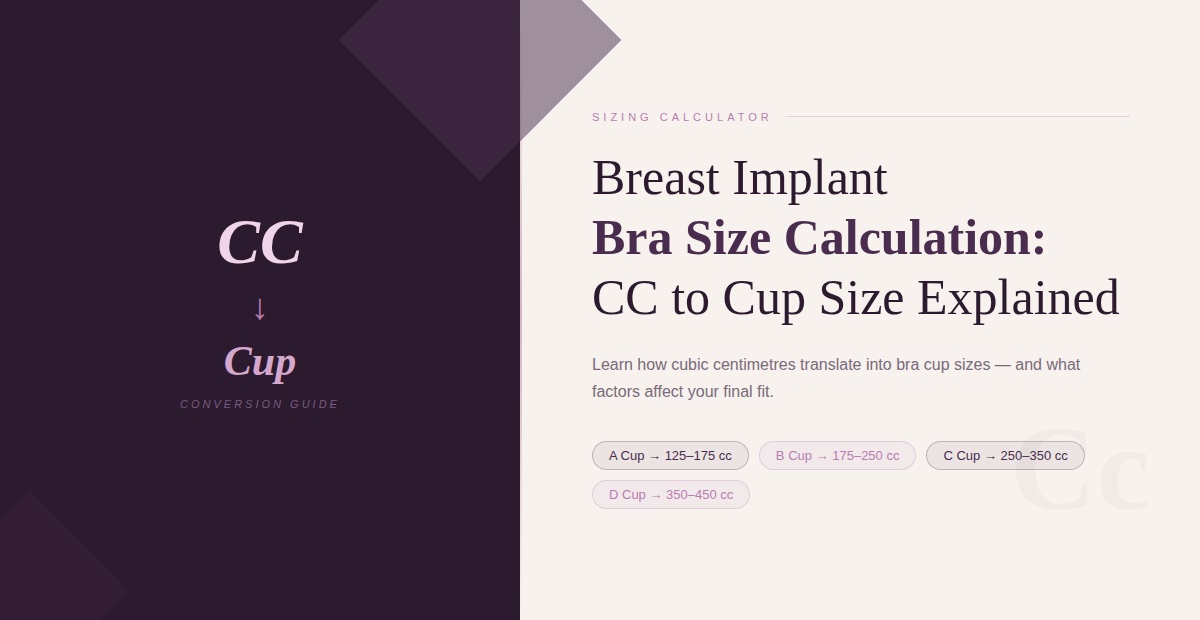
One of the most practical questions people ask before breast augmentation surgery is simple: what bra size will I be afterward? You might be going from a 34A to a full B, or from a 36C to a D. The answer matters for everything from buying clothes to setting realistic expectations about your outcome.
A breast implant bra size calculator bridges the gap between the clinical world of implant volumes (measured in cc) and the everyday world of bra shopping. This guide explains exactly how the breast implants bra size calculator works, what the numbers mean, why cup size predictions are inherently approximate, and how to use this information alongside the broader breast implant size calculator process.
Medical disclaimer: This article is intended for educational preparation. Implant sizing must be finalized with a board-certified plastic surgeon who evaluates your specific anatomy in person. Bra size predictions are estimates with natural variation based on individual anatomy and healing.
Why Bra Size Prediction Is Complicated After Implants
Before diving into how a breast implant bra size calculator works, it helps to understand why this calculation is inherently approximate. Bra sizing itself is not a precise science — cup sizes are relative to band size, not absolute measurements of breast volume. A D cup means different things depending on whether the band size is 32 or 40.
Additionally, the same cc volume of implant can produce different bra cup results depending on:
- Your starting breast volume and tissue distribution
- The implant’s profile (high profile implants project more; low profile implants sit flatter and wider)
- Whether the implant is placed under the muscle (submuscular) or over it (subglandular)
- How your chest wall curves and how the implant settles during healing
- Bra brand and fit differences — cup sizing varies significantly across manufacturers
A breast implant bra size calculator gives you a statistically reasonable estimate, not a guaranteed outcome. Most patients end up within one cup size of what a good calculator predicts — which is useful for planning purposes but should not be taken as a surgical promise.
How a Breast Implant Bra Size Calculator Works
A breast implant bra size calculator combines three inputs to estimate your post-surgery bra size:
- Your current bra band size (the number — 32, 34, 36, etc.)
- Your implant volume in cc
- Your current cup size (the letter — A, B, C, D, etc.)
The calculator adds the estimated volume of the implant (converted from cc to an approximate cup-size equivalent at your band size) to your existing breast volume (estimated from your current cup letter), then expresses the total as a new cup letter at your existing band size.
The fundamental math behind every breast implant cup size calculator is based on the established relationship between cup volume and band size: each cup size at a given band represents approximately 150 to 200 cc of additional breast volume. This range varies with band size — a C cup on a 32 band contains less volume than a C cup on a 38 band.
The Cup-Volume Relationship by Band Size
| Band Size | Approx. Volume Per Cup Size Step (cc) | Example: B to C Cup Increase |
| 30 or 32 band | ~130–150 cc per cup | ~135 cc of implant for +1 cup |
| 34 band | ~150–165 cc per cup | ~157 cc of implant for +1 cup |
| 36 band | ~165–180 cc per cup | ~170 cc of implant for +1 cup |
| 38 band | ~180–200 cc per cup | ~188 cc of implant for +1 cup |
| 40 band | ~195–220 cc per cup | ~205 cc of implant for +1 cup |
| 42 band or larger | ~215–240+ cc per cup | ~225+ cc of implant for +1 cup |
Why this matters: If you are a 34B and want to reach a 34D, you are targeting approximately two cup size increases at a 34 band. That requires roughly 314 to 330 cc of implant volume — before accounting for any existing breast tissue that is already working toward the D cup volume. This is exactly the calculation a breast implant bra size calculator runs automatically.
Step-by-Step: How to Use a Breast Implant Bra Size Calculator
Step 1 — Measure Your Band Size
Measure your chest circumference directly under the bust with the tape measure parallel to the floor. Round to the nearest even number. If your measurement is 33 inches, your band size is 34. If it is 35 inches, your band is 36. This is your anchor — your band size will not change with implants (unless your body weight changes significantly).
Step 2 — Determine Your Current Cup Size
Measure the fullest part of your bust (with a light bra on or without). Subtract the band measurement from this number. Each inch of difference represents approximately one cup size: 1 inch = A, 2 inches = B, 3 inches = C, 4 inches = D, 5 inches = DD/E, and so on. Note your current cup letter.
Step 3 — Know Your Implant Volume
This step requires either using a breast implant cc size calculator to establish your proportionate volume range, or working with implant volumes suggested by your surgeon. Enter the cc volume you are considering into the bra size calculator.
Step 4 — Calculate Your Projected Cup Size
The breast implant bra size calculator takes your current cup letter, your band size, and your proposed implant cc. It estimates the additional cup size increase from the implant and adds it to your current size. The output is your estimated post-surgery bra size expressed as band number + cup letter (for example, 34D).
Step 5 — Consider the Variability Range
Any reliable breast implant cup size calculator acknowledges a range of ± one cup size around the projection. If the tool predicts 34D, your realistic range is 34C to 34DD. Factors like implant profile, placement depth, and individual healing account for that variability. Plan your wardrobe expectations accordingly.
Practical Examples: Breast Implant Bra Size Calculator in Action
Example 1: 34A Starting Size, Targeting 34C
Current bra: 34A | Two cup size increase = approximately 300–330 cc needed at a 34 band
Breast implant cc size calculator output: 300 cc to 350 cc is proportionate for most 34-band frames
Projected result with 325 cc implant: 34C to 34D range, depending on profile and placement
Note: Starting with very little existing breast tissue (A cup), the implant cc does most of the visual work, and the result tends to track closely with the calculator’s projection.
Example 2: 36C Starting Size, Targeting 36DD
Current bra: 36C | Two cup size increase = approximately 330–360 cc needed at a 36 band
Starting tissue (C cup at 36 band) already provides meaningful volume — the implant adds to it
Projected result with 350 cc implant: 36D to 36DD range, with final result influenced significantly by implant profile
Note: Patients starting with more existing tissue often find their post-surgery cup size exceeds calculator predictions because the implant volume builds on a fuller base.
Example 3: 38B Starting Size, Seeking Modest Enhancement
Current bra: 38B | Target: 38C to 38D (one to two cup increase)
At 38 band, each cup step is approximately 188–200 cc
A 275–350 cc implant produces a 38C to 38D result in most cases
Note: At larger band sizes, a modest cc volume produces a proportionate enhancement. A 300 cc implant that would look dramatic on a 32A frame looks like a balanced enhancement on a 38B frame.
Bra Shopping After Implants: What Changes and What to Expect
Once your implants have settled (typically 3 to 6 months post-surgery), you may find that standard off-the-shelf bras fit differently than before. Here is what to expect:
- Your band size usually stays the same, unless body weight changes post-surgery
- Cup size will increase as projected by your breast implants bra size calculator
- Cup shape may change — implants often produce more forward projection and upper pole fullness than natural tissue
- Some patients find they need to size up in the cup and down in the band in European sizing systems
- Sports bras and underwire bras may require a trial period — the shape of augmented breasts in bra styles can take adjustment
- Many patients benefit from a professional bra fitting 3 to 4 months after surgery once swelling has fully resolved
It is common for augmentation patients to go through a brief period of trying multiple bra styles before finding what works best for their new shape. High-profile implants tend to produce more fullness in the upper cup; moderate-profile implants tend to project more naturally across the full cup. This affects which bra styles are most flattering.
The Relationship Between the Breast Implant Size Calculator and Bra Size
The breast implant size calculator and the breast implant bra size calculator are two tools that work in sequence. The sizing calculator comes first — it tells you what cc range is proportionate to your body, using breast base width and body frame measurements as the foundation. The bra size calculator comes second — it translates those cc options into post-surgery bra size estimates.
Using both together gives you a complete picture: the sizing calculator ensures you are not choosing an implant that physically does not fit your anatomy, and the bra size calculator helps you connect that volume to a practical everyday outcome — the bra size you will be shopping in.
The ideal workflow is:
- Use the breast implant size calculator to find your proportionate cc range
- Identify two or three specific cc options within that range you want to explore
- Run each option through the breast implant bra size calculator to project post-surgery size
- Bring both sets of results to your surgical consultation
- Discuss with your surgeon how profile and placement might affect the bra size prediction
Common Bra Size Calculation Mistakes to Avoid
When using a breast implant bra size calculator, these are the most common errors that lead to unrealistic expectations:
- Using an incorrect current bra size — if you are wearing the wrong size now, the projection will be off from the start. Get professionally measured before using any calculator.
- Expecting an exact cup size result — bra size predictions from cc volumes are estimates within a range, not guarantees. Allow for one cup size variability in your planning.
- Not accounting for implant profile — a high-profile 350 cc implant and a moderate-profile 350 cc implant will fit differently in a bra despite having the same volume.
- Choosing cc based on desired cup size alone — cup size should be a reference point, not the driving factor. Breast base width and tissue coverage must be the primary constraints.
- Planning wardrobe purchases too early — wait until implants have fully settled (3 to 6 months post-surgery) before investing significantly in new bras. Shape and size stabilize over time.
Frequently Asked Questions
Q1: How accurate is a breast implant bra size calculator?
Most patients end up within one cup size of what a well-designed breast implant bra size calculator predicts. The calculation is most accurate when your input bra size is correctly measured (not self-estimated), and when the proposed implant cc and profile are known. Variability arises from implant profile, placement (under vs. over muscle), individual tissue characteristics, and differences between bra brands.
Q2: How many cc is one cup size increase?
At an average 34 to 36 band size, approximately 150 to 180 cc corresponds to one cup size increase. At larger band sizes (38 to 40), one cup step requires approximately 185 to 210 cc. At smaller band sizes (30 to 32), one cup step may require only 130 to 150 cc. These are the values that breast implant cup size calculators use to generate their projections.
Q3: Can I use a breast implants bra size calculator before knowing my exact implant size?
Yes — running multiple cc values through the calculator is exactly how it is meant to be used during the planning stage. Try your proportionate cc range in increments (for example, 275, 325, and 375 cc) to see how each volume translates to cup size, then use those projections as discussion points with your surgeon.
Q4: Will my band size change after breast augmentation?
Breast augmentation does not typically change your band size (the number). The band measurement is taken around your chest under the bust — this dimension is determined by your ribcage, not your breast size. Your cup letter will increase based on your implant volume. If you also gain or lose weight around the time of surgery, the band size may shift accordingly.
Q5: I am a 34A with very little breast tissue — will the bra size calculator be accurate for me?
For patients starting with very little breast tissue (A cup), the breast implant bra size calculator tends to be slightly more accurate because the implant cc is doing most of the volume work. When existing tissue is significant (C cup and above), the interaction between implant volume and existing tissue can push results above the calculator’s projection. Starting from a small base gives the calculator fewer variables to account for.
Q6: What if my surgeon recommends a different size than what the bra size calculator suggests?
Your surgeon’s recommendation takes precedence. The calculator provides a planning framework based on external measurements, but your surgeon has assessed your actual tissue thickness, chest wall characteristics, skin laxity, and symmetry in person. If there is a discrepancy, ask your surgeon to explain why the implant they recommend will produce the best result for your anatomy — it is a productive conversation that almost always leads to better understanding.
Conclusion
A breast implant bra size calculator is a powerful planning tool that helps you translate the clinical language of implant volumes into the everyday reality of bra sizes. By understanding how cc volumes correspond to cup size increases at your specific band size, you can approach your surgical consultation with realistic expectations and clear goals.
Remember that the bra size calculator works best in combination with the breast implant size calculator — use sizing first to find your proportionate cc range, then use the bra size calculator to understand what those volumes mean for your wardrobe. Together, these tools give you the clearest possible picture of what your outcome might look like — while keeping your surgeon’s expertise firmly at the center of the final decision.