BMR Calculator
Find your basal metabolic rate and your daily calorie needs with the Mifflin-St Jeor equation.
Your results
| Activity level | Daily calories (TDEE) |
|---|---|
| Sedentary | |
| Lightly active | |
| Moderately active | |
| Very active | |
| Extra active |
BMR is the calories your body burns at complete rest. TDEE adds your activity, so it is the calories needed to maintain your current weight.
Quick answer: A BMR Calculator estimates the calories your body burns at complete rest, using the Mifflin-St Jeor equation. A 35-year-old man who weighs 80 kg and is 180 cm tall has a BMR of 1,755 kcal per day, and with moderate activity his daily need rises to 2,720 kcal.
What Is a BMR Calculator?
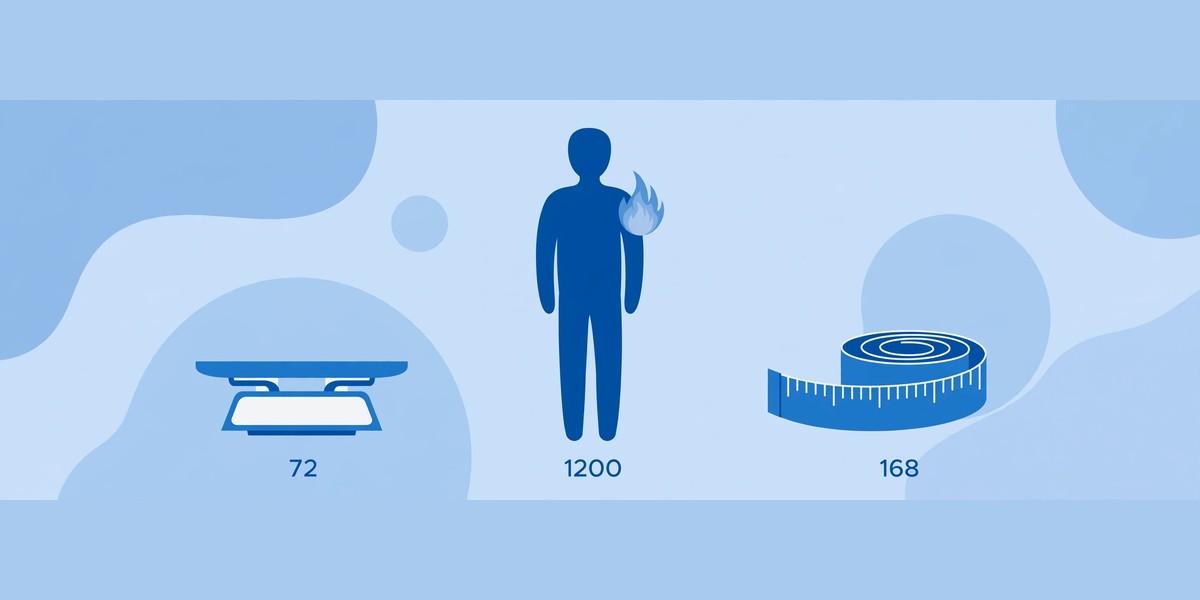
A BMR Calculator works out your basal metabolic rate, the calories your body needs each day just to stay alive at rest. Breathing, keeping your heart beating, and running your brain and organs all burn energy, even when you lie still all day.
BMR is measured in kilocalories per day (kcal/day). Most adults have a BMR between 1,200 and 2,400 kcal per day, depending on sex, age, weight, and height. Men usually have a higher BMR than women of the same age and weight, because they carry more muscle. A calorie deficit planner builds directly on your BMR, turning it into a daily target for steady weight loss.
How the BMR Calculator Works
This BMR Calculator uses the Mifflin-St Jeor equation, the formula most dietitians use today. It needs only four inputs: your sex, your age, your weight, and your height.
For men, the formula is BMR = 10 x weight in kg + 6.25 x height in cm - 5 x age in years + 5. For women, it is the same except for - 161 at the end instead of + 5. The calculator converts imperial units to metric first, so both give the same result.
Once it has your BMR, the calculator multiplies it by an activity factor to give your total daily energy expenditure, or TDEE: 1.2 for sedentary, 1.375 for lightly active, 1.55 for moderately active, 1.725 for very active, and 1.9 for extra active.
How to Use the BMR Calculator
- Choose Metric or Imperial at the top: kilograms and centimetres, or pounds, feet, and inches.
- Select your sex, since men and women use slightly different formulas.
- Enter your age in years, from 15 to 80.
- Enter your weight, in kilograms for metric or in pounds for imperial.
- Enter your height, in centimetres for metric or in feet and inches for imperial.
- Pick your activity level for a typical week, then press Calculate BMR.
BMR Calculator Examples
Check any of these by entering the same numbers above.
| Person | Inputs | BMR | TDEE |
|---|---|---|---|
| Man, 35 years | 80 kg, 180 cm, moderate activity | 1,755 kcal/day | 2,720 kcal/day |
| Woman, 30 years | 70 kg, 165 cm, light activity | 1,420 kcal/day | 1,953 kcal/day |
| Man, 30 years | 175 lb, 5 ft 10 in, sedentary | 1,760 kcal/day | 2,112 kcal/day |
For the first man: 10 x 80 + 6.25 x 180 - 5 x 35 + 5 = 1,755 kcal per day, and 1,755 x 1.55 = 2,720.25, rounded to 2,720. For the woman: the formula gives 1,420.25, rounded to 1,420, and 1,420.25 x 1.375 = 1,952.84, rounded to 1,953.
Imperial conversion: 175 lb is 79.38 kg and 5 ft 10 in is 177.8 cm, so the formula gives 1,760.05, rounded to 1,760, and the sedentary factor of 1.2 gives 2,112. The table below shows the daily need at every activity level for a BMR of 1,755.
| Activity level | Factor | Daily calories (TDEE) |
|---|---|---|
| Sedentary | 1.2 | 2,106 kcal |
| Lightly active | 1.375 | 2,413 kcal |
| Moderately active | 1.55 | 2,720 kcal |
| Very active | 1.725 | 3,027 kcal |
| Extra active | 1.9 | 3,335 kcal |
BMR vs TDEE: What Is the Difference?
BMR is what you burn at complete rest, as if you stayed in bed all day without moving. TDEE is what you actually burn in a real day, because it adds walking, working, and exercising on top of your BMR. Mixing them up is the most common mistake in calorie planning.
Use your BMR to understand your baseline, and use your TDEE to set your food intake. If your TDEE is 2,720 kcal and you eat 2,720 kcal a day, your weight should stay roughly steady. Eat 500 kcal less than your TDEE each day and you lose about 1 lb a week. A macro targets calculator can then split that daily total into protein, carbs, and fat.
Your BMR falls slowly as you age, by roughly 1 to 2 percent per decade after 20. Strength training helps, since keeping muscle raises your BMR, which is one reason a daily protein target matters when you train. A weight loss planner combines your BMR, your activity, and your goal into a dated plan.
Frequently Asked Questions
How accurate is a BMR Calculator?
It is accurate within about 10 percent for most adults, which is close enough to plan meals. The only way to measure BMR exactly is indirect calorimetry in a lab.
What is the difference between BMR and RMR?
BMR is the strict laboratory measure of energy use at complete rest, after an overnight fast. RMR is measured under less strict conditions and runs about 10 percent higher.
Does BMR change when I lose weight?
Yes. As you lose weight, your BMR falls, because a smaller body needs less energy. Losing 10 kg can lower it by roughly 100 kcal per day, so recalculate after every 5 kg lost.
Can I raise my BMR?
You can raise it modestly. Building muscle is the most effective way, since muscle burns more energy at rest than fat. Crash diets do the opposite: very low calories can lower your BMR.
Should I eat my BMR or my TDEE calories to lose weight?
Eat below your TDEE, not below your BMR. Eating 300 to 500 kcal less than TDEE gives steady fat loss, while eating below your BMR for long periods can cost you muscle.
What activity level should I choose?
Choose the level that matches a typical week, not your hardest week. Desk work with no exercise is sedentary, light exercise one to three days a week is lightly active, and daily hard training is very active.
Learn More
More fitness calculators:
- Calorie Deficit Calculator - turn your BMR into a daily weight loss target.
- Macro Calculator - split your daily calories into protein, carbs, and fat.
- Protein Intake Calculator - find how much protein you need each day.
- Weight Loss Calculator - build a plan from your current weight to your goal.
- BMI Calculator - check your body mass index alongside your BMR.
- Body Fat Percentage Calculator - estimate your body fat from simple measurements.
Languages
This BMR Calculator is also available in: Español, Português, Français, Deutsch, Italiano, Nederlands, Polski, Türkçe, Bahasa Indonesia, Русский, العربية, हिन्दी, اردو, বাংলা, 日本語.