Asphalt Calculator
Work out how many tons of asphalt you need for a driveway, parking area or road from its length, width and finished thickness, with an optional material cost.
The weight uses the density you entered and the finished, compacted thickness. Most people order a little over the estimate for waste and uneven ground, so check your supplier’s delivery minimums before you order.
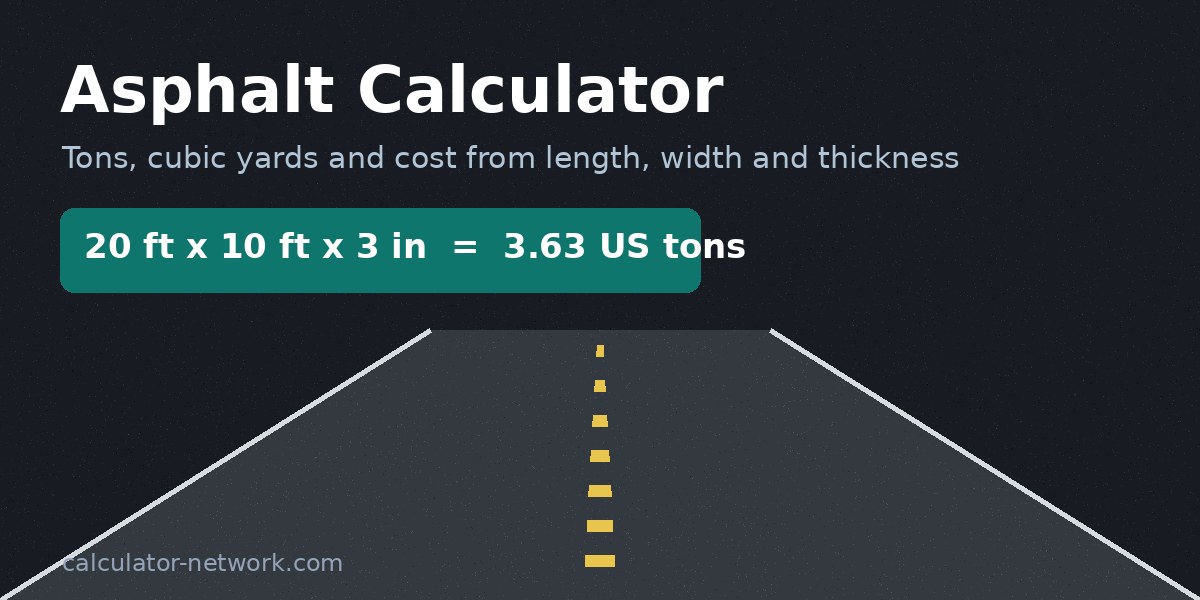
This asphalt calculator estimates how many tons of asphalt you need for a driveway, parking area or road. Enter the length, width and thickness, and it gives you the weight in US tons and metric tonnes, plus a material cost if you add a price per ton. A 20 x 10 ft driveway at 3 inches needs 3.63 US tons.
How this asphalt calculator works
Asphalt is sold by weight, but a paving job is measured by size, so the calculation has two steps. First, the volume of the layer:
Area = length x width, and Volume = area x thickness
The thickness is entered in inches and divided by 12 to turn it into feet, which gives the volume in cubic feet. Dividing cubic feet by 27 gives cubic yards, and multiplying by 0.0283168 gives cubic metres. Second, the weight of that volume:
Weight = volume x density, and US tons = weight in pounds / 2,000
Compacted hot mix asphalt weighs about 145 pounds per cubic foot, so the calculator starts with 145 as the density. Real mixes run from about 140 to 150 pounds per cubic foot, and your supplier can give you the exact figure for your mix, so the density field stays editable. Metric tonnes are the same weight divided by 2,204.62 pounds. It is the same volume-first approach used by the Gravel Calculator and the Concrete Calculator.
How to use the asphalt calculator
- Measure the length and width of the area in feet. For an L-shaped area, split it into rectangles, work each one out separately and add the tons together.
- Enter the finished thickness in inches. A residential driveway is commonly 3 inches, parking areas and busy entrances are often 4 to 6 inches, and a resurfacing layer can be 1.5 to 2 inches.
- Check the density. Leave it at 145 lb per cubic foot for standard hot mix, or enter the figure your supplier quotes.
- Add a price per US ton if you want a material cost estimate. Leave it at 0 to skip the cost row.
- Select Calculate asphalt and read the area, volumes, weights and cost. The headline figure is the US tons you order.
Asphalt calculator examples
The table below uses the same formulas and the standard 145 lb per cubic foot density, so you can check your own result.
| Project | Area (sq ft) | Volume (cubic feet) | Volume (cubic yards) | Weight (lb) | Asphalt (US tons) |
|---|---|---|---|---|---|
| Driveway 20 x 10 ft, 3 inches thick | 200 | 50.00 | 1.85 | 7,250 | 3.63 |
| Parking area 30 x 20 ft, 4 inches thick | 600 | 200.00 | 7.41 | 29,000 | 14.50 |
| Patch 10 x 10 ft, 2 inches thick | 100 | 16.67 | 0.62 | 2,416.67 | 1.21 |
Work through the driveway row by hand: 20 x 10 ft is 200 square feet, 200 x 3 / 12 is 50 cubic feet, and 50 / 27 is 1.85 cubic yards (1.42 cubic metres). At 145 lb per cubic foot the layer weighs 7,250 lb, which is 3.63 US tons, or 3.29 metric tonnes. At $100 per ton the material cost is $362.50, worked out from the unrounded tonnage.
What changes how much asphalt you need?
Thickness is the biggest lever. Doubling the thickness doubles the tons, so the difference between a 3 inch and a 4 inch layer on 200 square feet is a full extra ton. Area works the same way: every extra 100 square feet at 3 inches adds about 1.81 tons. Density matters less but is not nothing: the same driveway needs 3.50 tons at 140 lb per cubic foot and 3.75 tons at 150, which is why your supplier's real mix density beats a guess. An uneven base is the hidden factor, taking more material to level than the flat measurement suggests. The same area-times-depth habit covers the layers under the asphalt too: the Mulch Calculator uses it for loose coverings, and base stone is estimated the same way.
Ordering asphalt without running short
Plants sell hot mix by the ton with a minimum load, and running short costs far more than a small surplus. Most estimators add 5 to 10 percent to the calculated figure for waste, spillage, edges and low spots in the base. On the driveway example, 5 percent takes the order from 3.63 tons to about 3.81 tons, and 10 percent takes it to about 3.99 tons, so ordering 4 tons covers both. Order in one delivery if you can, because hot mix cools while it waits. Confirm the thickness as the crew lays it: a layer that drifts from 3 inches to 2.5 inches saves material on the day but cracks and ruts early.
Frequently asked questions
How many tons of asphalt do I need for a 20 by 10 foot driveway?
At 3 inches thick with the standard density of 145 lb per cubic foot, you need 3.63 US tons (7,250 lb, 3.29 metric tonnes). At 4 inches thick the same driveway needs 4.83 tons, so confirm the thickness before you order.
How much does a cubic yard of asphalt weigh?
One cubic yard is 27 cubic feet, so at 145 lb per cubic foot it weighs 27 x 145 = 3,915 lb, which is about 1.96 US tons. A denser mix at 150 lb per cubic foot weighs about 2.03 tons per cubic yard.
What density should I use in this asphalt calculator?
Start with 145 lb per cubic foot, the standard estimating figure for compacted hot mix. Most mixes fall between 140 and 150. If your supplier quotes a specific density for your mix, use that figure instead.
How thick should asphalt be for a driveway?
About 3 inches of compacted asphalt over a solid gravel base suits most home driveways. Areas that carry delivery trucks or parked heavy vehicles are usually 4 to 6 inches, and a resurfacing overlay on sound existing asphalt can be 1.5 to 2 inches.
Should I order more asphalt than the calculator shows?
Yes, a little. Add 5 to 10 percent for waste, uneven ground and edges that run deeper than planned. Running short mid-job is the expensive outcome.
How much does asphalt cost per ton?
Hot mix prices vary by region and plant, and change with oil prices. Enter your local price per US ton in the calculator and it multiplies it by the tonnage: at $100 per ton, the 3.63 ton driveway example costs $362.50 in material alone.