

Salary to Hourly Calculator
A $60,000 yearly salary equals about $28.85 per hour when you work 40 hours a week for 52 weeks a year. The core formula is simple: divide your annual pay by your total yearly hours (hours per week times weeks per year). Use the free calculator above to convert any salary to an hourly rate, or flip it to see what an hourly wage adds up to per year.
How to Convert Salary to Hourly Pay
- Start with your annual gross salary. Use the figure before taxes, usually the number on your offer letter. If you are paid monthly, multiply by 12; biweekly, multiply by 26; weekly, multiply by 52.
- Find your total yearly hours. Multiply the hours you actually work each week by the number of weeks you work per year. A standard full-time schedule is 40 hours times 52 weeks, which equals 2,080 hours.
- Divide annual pay by yearly hours. A $60,000 salary divided by 2,080 hours gives $28.85 per hour (60,000 / 2,080 = 28.846, rounded to $28.85).
- Adjust for your real schedule. If you work 37.5 hours a week, your yearly hours are 1,950 (37.5 x 52), and $60,000 becomes $30.77 per hour. If you take two weeks of unpaid vacation, use 50 weeks instead of 52.
- Compare offers fairly. Once you have the hourly equivalent, you can line up a salary offer against an hourly offer, or against overtime pay, on the same scale.
Salary to Hourly Examples (Verified)
These conversions assume a standard full-time schedule of 40 hours per week and 52 weeks per year (2,080 total hours). Every figure below was calculated and double-checked.
| Annual Salary | Hourly Rate | Weekly Pay | Monthly Pay |
|---|---|---|---|
| $35,000 | $16.83 | $673.08 | $2,916.67 |
| $50,000 | $24.04 | $961.54 | $4,166.67 |
| $60,000 | $28.85 | $1,153.85 | $5,000.00 |
| $75,000 | $36.06 | $1,442.31 | $6,250.00 |
| $100,000 | $48.08 | $1,923.08 | $8,333.33 |
Math check: $75,000 / 2,080 = 36.0577, which rounds to $36.06 per hour. Weekly pay is annual pay divided by 52 ($75,000 / 52 = $1,442.31), and monthly pay is annual pay divided by 12 ($75,000 / 12 = $6,250.00).
Why Your Schedule Changes the Answer
The 2,080-hour year is a benchmark, not a rule. Many salaried jobs expect 45 or 50 hours a week, and that extra time quietly lowers your real hourly rate. A $60,000 salary at 50 hours a week works out to $23.08 per hour (60,000 / 2,600), a full $5.77 less than the 40-hour figure. On the other hand, a 37.5-hour workweek raises that same $60,000 to $30.77 per hour (60,000 / 1,950).
Unpaid time off matters too. If you take three unpaid weeks a year, your paid weeks drop to 49, so a $60,000 salary over 1,960 hours (40 x 49) equals $30.61 per hour. Always use the hours you actually work, not the hours on paper, for an honest number.
Gross Pay vs. Take-Home Pay
This calculator works with gross pay, meaning your earnings before taxes, Social Security, Medicare, health premiums, and retirement contributions. Your take-home hourly rate will be lower. As a rough guide, a single filer earning $60,000 might keep around $45,000 to $48,000 after federal taxes and FICA, which is roughly $21.63 to $23.08 per take-home hour. For budgeting, convert your net pay instead of your gross pay.
Using the Reverse Calculation
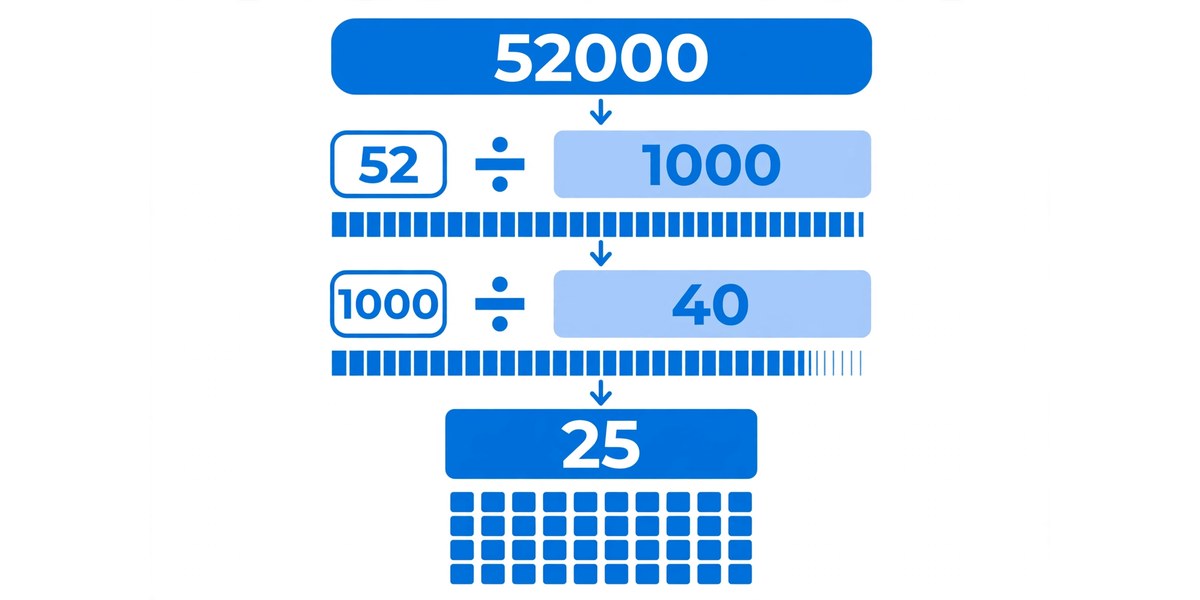
Switch the calculator to “Hourly to salary” mode to annualize a wage. Multiply the hourly rate by your weekly hours and then by your yearly weeks. At $25 per hour on a 40-hour week for 52 weeks, you earn $52,000 a year, $4,333.33 a month, $1,000 a week, $2,000 every two weeks, and $200 for an 8-hour day. This reverse math is handy when an employer quotes an hourly rate and you want the big-picture number for budgeting or loan applications.
Frequently Asked Questions
Is a salary always based on 2,080 hours a year?
No. The 2,080 figure (40 hours x 52 weeks) is the standard full-time benchmark used for comparison, but your employer may assume a different schedule. Check your offer letter or HR policy for the official yearly hours, and use the calculator’s custom hours and weeks fields for an exact figure.
Should I use gross or net pay in the calculation?
Use gross pay for offer comparisons, because taxes and deductions vary by person and state. Use net pay when you want to know what each hour of work actually puts in your pocket for budgeting purposes.
How does overtime change the math for salaried workers?
Exempt salaried employees usually get no extra pay for hours beyond 40, which is why long weeks drag the effective hourly rate down. Non-exempt hourly employees earn 1.5 times their rate for overtime under federal law, which can make an hourly job pay more than a salary that looks bigger on paper.
What about part-time salaries?
The same formula works. If you earn $30,000 working 25 hours a week for 52 weeks, your rate is $23.08 per hour (30,000 / 1,300). Enter your actual weekly hours in the calculator.
Does the calculator include benefits like PTO and health insurance?
No, it converts cash pay only. Benefits have real value, though. Two weeks of paid vacation is worth about 4 percent of your salary, and employer health coverage can be worth $7,000 or more a year. Add that value before comparing a salary offer with an hourly offer that has no benefits.
Why is my converted rate different from my employer’s figure?
Employers sometimes annualize using 2,000 hours (40 hours x 50 weeks, treating two weeks as holidays) instead of 2,080. That raises the quoted hourly rate slightly. Ask which divisor your employer uses so you are comparing the same thing.