
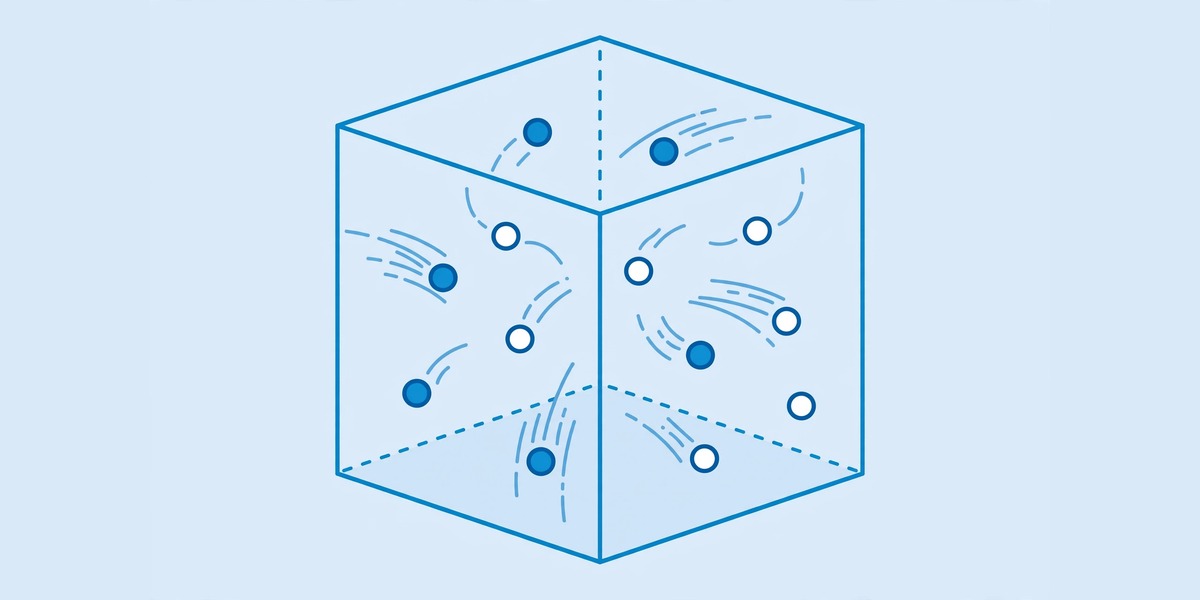
The ideal gas law, PV = nRT, is the equation that links the pressure, volume, temperature, and amount of a gas. P is pressure, V is volume, n is moles, R is the gas constant (0.08206 L atm / (mol K)), and T is absolute temperature in kelvin. It predicts how a gas behaves when conditions change.
What Does Each Letter Stand For?
Before the equation can help you, each symbol needs a concrete meaning and a unit. The table below is the whole vocabulary of the ideal gas law.
| Symbol | Name | What it measures | Common units |
|---|---|---|---|
| P | Pressure | How hard the gas pushes on the container walls | atm, kPa, psi, mmHg, bar |
| V | Volume | The space the gas occupies | L, mL, m3, ft3 |
| n | Moles | The amount of gas particles | mol |
| R | Gas constant | The bridge between energy and temperature scales | 0.08206 L atm / (mol K) |
| T | Temperature | The average kinetic energy of the particles | K (kelvin, always) |
The equation says something beautifully simple: pressure times volume equals the amount of gas times a constant times temperature. Double the temperature (in kelvin) while holding everything else fixed, and the pressure doubles. Halve the volume, and the pressure doubles. Every gas calculation you will meet in general chemistry is some version of that sentence.
The Three Assumptions Behind the Law
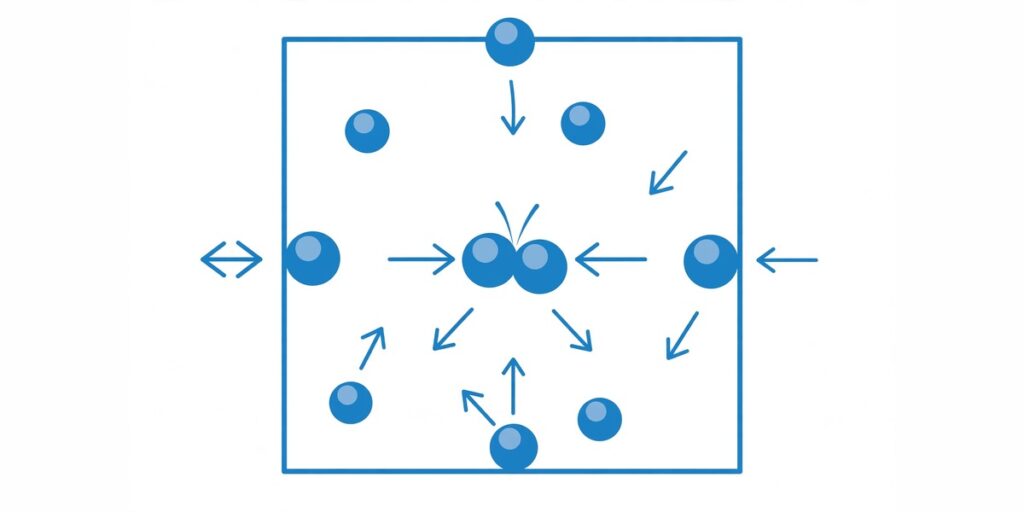
The ideal gas law is not a law of nature in the strict sense. It is a model built on three assumptions about how gas particles behave. Real gases follow it closely when these assumptions are nearly true.
- Particles are point masses. The model pretends each molecule takes up zero space. This works when the container is huge compared to the molecules, which is true for ordinary gases at ordinary pressures.
- There are no intermolecular forces. The particles neither attract nor repel each other. They fly in straight lines until they hit something. At low pressure and high temperature, attractions are too weak and brief to matter.
- Collisions are perfectly elastic. When particles bounce off each other or the walls, no kinetic energy is lost. The gas never “runs down” on its own, which is why a sealed tank holds its pressure indefinitely.
Two more ideas complete the picture: the particles move constantly in random directions, and their average kinetic energy is directly proportional to the absolute temperature. That last point is why T must be in kelvin. Zero kelvin means zero motion; zero Celsius emphatically does not.
A Number Worth Memorizing: 22.4 Liters
Here is the single most useful number in gas chemistry. At standard temperature and pressure, 0 C (273.15 K) and 1 atm, one mole of any ideal gas occupies 22.41 liters, usually rounded to 22.4 L. Watch it fall straight out of the equation:
V = nRT / P = (1 mol x 0.08206 L atm / (mol K) x 273.15 K) / 1 atm = 22.41 L
The moles cancel, the atmospheres cancel, the kelvin cancels, and liters survive. That number is the same for oxygen, nitrogen, helium, or any mixture, because the ideal gas law does not care what the particles are. It only cares how many there are and how fast they move.
This gives you a built-in sanity check for every gas problem. If your answer says one mole of gas at room conditions occupies 0.5 L or 500 L, something went wrong with your units. The right neighborhood is always tens of liters per mole.
See It Work: Gas in a Soda Bottle
Take a 2-liter soda bottle pressurized to 3 atm at room temperature, 25 C (298 K). How many moles of gas are inside? Use the rearranged form n = PV / RT:
n = (3 atm x 2 L) / (0.08206 L atm / (mol K) x 298 K) = 6 / 24.45 = 0.245 mol
That is about a quarter of a mole, roughly 7 grams of carbon dioxide. The same three-step pattern, convert temperature to kelvin, match units to R, substitute and divide, answers every “how much gas” question you will meet. You can check calculations like this in seconds with our ideal gas law calculator, which runs the same steps and shows the substitution.
Where the Ideal Gas Law Shows Up in Daily Life
This equation is quietly running behind scenes you would never associate with chemistry class:
- Car tires: a tire inflated to 32 psi on a cool morning reads near 36 psi after highway driving heats the air inside. Same moles, same volume, higher temperature, higher pressure.
- Scuba tanks: a 10 L tank filled to 200 atm at 20 C holds n = (200 x 10) / (0.08206 x 293.15) = 83.1 mol of air, about 2.4 kg. Dive shops rely on exactly this math.
- Weather balloons: a balloon filled with 2.0 L of helium at ground level expands as it rises into lower pressure, which is why high-altitude balloons are launched partly empty.
- Airbags: a crash sensor triggers a reaction that floods the bag with nitrogen gas in about 30 milliseconds. Engineers size the gas charge with PV = nRT so the bag fills fully without bursting.
Frequently Asked Questions
What is the ideal gas law in simple words?
It is the rule that pressure times volume equals moles times the gas constant times temperature (PV = nRT). It tells you how a gas responds when you squeeze it, heat it, or change how much of it there is.
Who discovered the ideal gas law?
No single person did. It combines Boyle’s law, Charles’s law, and Avogadro’s law, which were found experimentally in the 1600s through the early 1800s. Emile Clapeyron merged them into PV = nRT in 1834.
Why must temperature be in kelvin?
The equation needs an absolute scale where zero means zero molecular motion. Celsius has an arbitrary zero (the freezing point of water), so 20 C is not “twice as hot” as 10 C. In kelvin it is: 293 K versus 283 K, and ratios work correctly.
Do real gases follow the ideal gas law?
Approximately, yes, at low pressure and high temperature. Nitrogen and oxygen at 1 atm and room temperature obey it within about 1 percent. Near condensation or at hundreds of atmospheres, deviations grow and corrected equations are needed.
What is R in the ideal gas law?
R is the gas constant, 0.08206 L atm / (mol K) when pressure is in atmospheres and volume is in liters. Other unit systems use 8.314 J / (mol K) or 62.36 L torr / (mol K). The number changes; the constant does not.
How is the ideal gas law used in real life?
Engineers use it to size pressure vessels, meteorologists use it to model the atmosphere, divers use it to plan air supply, and doctors use it in ventilators and anesthesia machines. Anywhere a gas is stored, moved, or heated, PV = nRT is nearby.