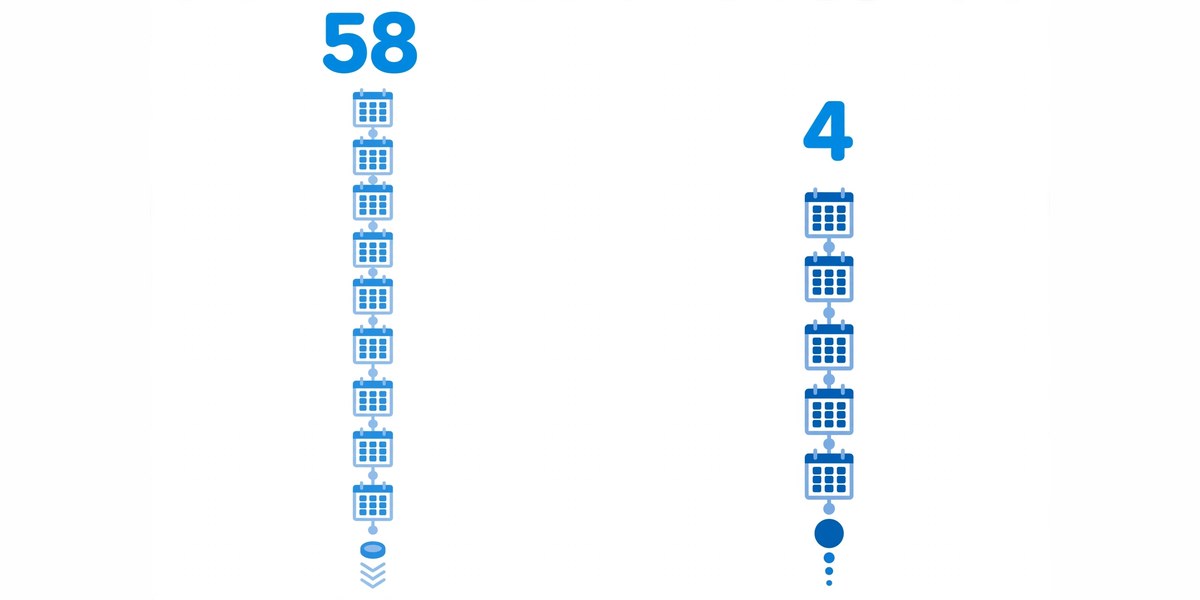
Direct answer: Paying only minimums can take decades. On a $6,523 balance at 21% APR with typical 2%-of-balance minimums ($25 floor), payoff takes 699 months (58.3 years) with $34,114 in interest. Paying a fixed $200 per month instead clears the same debt in 49 months (4.1 years) with only $3,227 in interest.
How Are Minimum Payments Calculated?
Most US credit card issuers set the minimum at 1 to 2% of the statement balance, plus any interest and fees, with a floor of $25 to $40. On a $6,523 balance at 21% APR, a 2% minimum is about $130.46 in month one. That sounds reasonable until you see where the money goes.
In month one, interest alone is $114.15 (balance x 21% / 12). Of your $130.46 payment, only $16.31 touches the principal. The other 87.5% is pure interest. Every month looks like this, which is why the balance barely moves.
What Does the Minimum Payment Trap Look Like Year by Year?
Here is the verified trajectory for that $6,523 balance at 21% APR, paying the 2% minimum ($25 floor) each month:
| After | Total paid | Interest paid | Balance remaining |
|---|---|---|---|
| 1 year | $1,568.18 | $1,348.56 | $6,303.38 |
| 5 years | $7,330.41 | $6,303.79 | $5,496.38 |
| 10 years | $13,507.12 | $11,615.46 | $4,631.34 |
Read that again: after ten years and $13,507 in payments, you still owe $4,631.34, and $11,615.46 of your money went to interest. The full payoff takes 699 months. You would pay $40,637 total on a $6,523 debt, with $34,114 of it interest.
Why Do Minimum Payments Take So Long?
Three mechanics conspire against you. First, the minimum shrinks as the balance shrinks, so your payment falls over time instead of staying fixed. By year ten, the 2% minimum on a $4,631 balance is only about $93, and interest eats most of it.
Second, interest compounds monthly on almost the entire original balance for years. Third, the payment is calibrated to keep the account current, not to pay it off. Issuers profit most when you pay slowly, and the minimum formula reflects that.
Since 2009, US law has required your statement to show a minimum-payment warning with the payoff time and total cost. Check yours: the numbers are usually shocking.
How Much Faster Is a Fixed Monthly Payment?
Now compare the same $6,523 debt at 21% APR with a fixed $200 payment every month:
| Strategy | Months | Years | Total interest | Total paid |
|---|---|---|---|---|
| Minimums only (2%, $25 floor) | 699 | 58.3 | $34,114 | $40,637 |
| Fixed $200/month | 49 | 4.1 | $3,227 | $9,750 |
The fixed payment costs $69.54 more than the first minimum, yet it finishes 54 years sooner and saves $30,887 in interest. With $200 fixed, the balance is already cut in half by month 30. Run your own debt through a debt payoff calculator to see the same comparison with your numbers.
What Should You Do Instead of Paying Minimums?
- Convert to a fixed payment. Pick the highest fixed amount your budget allows and autopay it monthly. Fixed beats percentage-based every time.
- Target the highest APR first. With multiple cards, pay minimums on all, then aim the extra at the highest rate (the avalanche method).
- Ask for a lower rate. One phone call can shave points off your APR, and every point shortens the payoff.
- Consider a balance transfer. Moving the balance to a 0% card for 12 to 21 months means 100% of your payment hits principal during the promo.
- Stop adding new charges. New purchases at 21% APR undo the progress your fixed payment buys.
What Does the Law Require Lenders to Tell You?
The Credit CARD Act of 2009 forced issuers to print a minimum-payment warning on every statement. It must show how many months payoff takes at minimum payments, the total amount you will pay, and what a fixed higher payment would achieve. For the $6,523 example, that box would show roughly 58 years and $40,637 total at minimums versus about 4 years and $9,750 at $200 per month.
Most people never read the box, which is a shame, because it is the lender itself admitting the minimum is a bad deal. If you have a statement nearby, find that disclosure right now. It personalizes everything in this article with your real balance and your real APR, and it is often the jolt that turns minimum payers into fixed payers.
The law also capped certain fees and required 45 days notice before rate increases, but it did not cap the minimum formula. The 1 to 2% minimum remains legal, so the trap is fully intact. Regulation gave you the warning label; escaping the trap is still your job.
Frequently Asked Questions
How long does it take to pay off $6,500 in credit card debt with minimum payments?
At 21% APR with 2%-of-balance minimums, a $6,523 balance takes 699 months (58.3 years) and costs $34,114 in interest. A fixed $200 payment clears it in 49 months with $3,227 in interest.
Is it bad to only pay the minimum on a credit card?
It keeps your account in good standing, but it is one of the most expensive ways to carry debt. After ten years of minimums on our example, you would have paid $13,507 and still owe $4,631.
Why is my credit card balance not going down?
Because most of your minimum payment goes to interest. In month one of the example, $114.15 of a $130.46 payment was interest, leaving only $16.31 to reduce the balance.
What is the minimum payment warning on my statement?
Since 2009, US card statements must disclose how long payoff takes at minimum payments and the total cost. It also shows what a fixed higher payment would achieve, which is usually dramatically better.
Does paying only the minimum hurt my credit score?
Paying the minimum on time does not hurt your score directly, but the high balance keeps your utilization ratio high, which drags the score down. Paying more lowers utilization and usually raises your score.
What is a good fixed payment amount?
Whatever you can sustain above the minimum. Even $70 extra per month on the example debt saves years and thousands of dollars. The key word is fixed: never let the payment shrink as the balance drops.