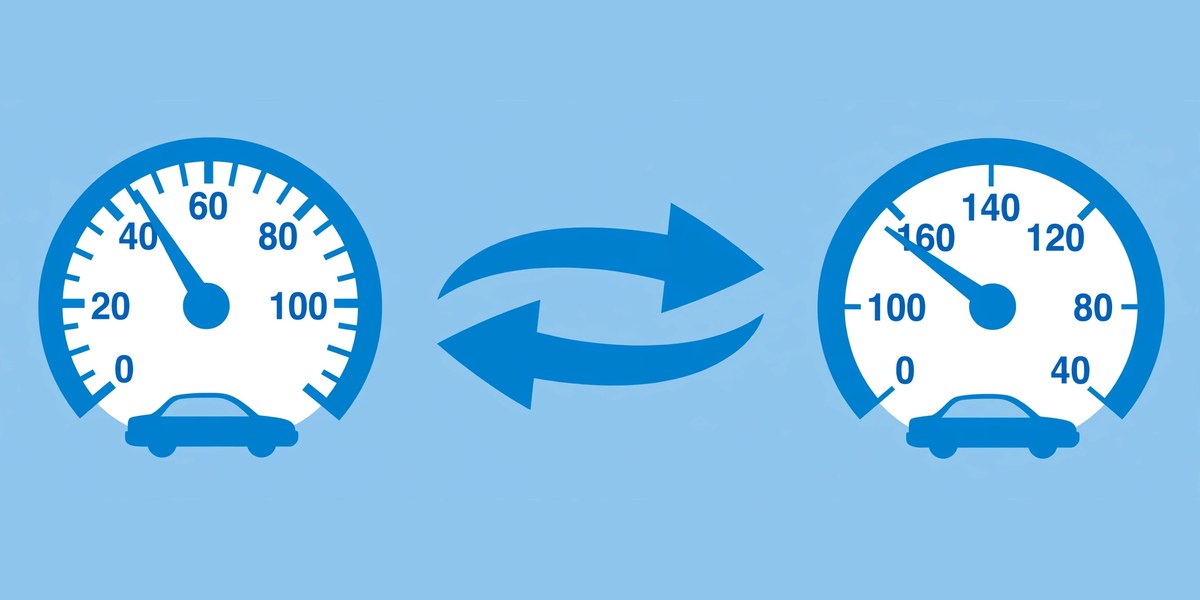
Quick answer: To convert mph to kph, multiply by 1.609344 (60 mph = 96.56 kph). To convert kph to mph, multiply by 0.621371 (100 kph = 62.14 mph). For knots, divide kph by 1.852 or mph by 1.150779 (60 mph = 52.14 knots). These factors are exact by international definition.
American road signs read mph, most of the world reads kph, and boats and planes read knots. Travelers, drivers near the Canadian border, and aviation fans all hit the same problem: converting between these speed units quickly and correctly. This guide gives you the exact factors, the formulas, memory shortcuts, and full reference tables.
What Are the Exact Conversion Factors?
These are defined values, not approximations:
- 1 mph = 1.609344 kph (exact, by definition of the international mile)
- 1 kph = 0.621371 mph
- 1 knot = 1.852 kph (exact, one nautical mile per hour)
- 1 knot = 1.150779 mph
- 1 m/s = 3.6 kph = 2.236936 mph
Because the mile and the nautical mile are legally defined in metric terms, the mph-to-kph and knot-to-kph factors never change. Any table or tool using different factors is rounding, not using a competing standard.
How Do You Convert MPH to KPH?
kph = mph x 1.609344
Worked examples:
- 30 mph speed limit = 30 x 1.609344 = 48.28 kph
- 60 mph cruising = 60 x 1.609344 = 96.56 kph
- 70 mph freeway = 70 x 1.609344 = 112.65 kph
Mental shortcut: multiply mph by 1.6 and add a little. 60 mph x 1.6 = 96, and the true answer is 96.56. For driving purposes the shortcut is close enough; for paperwork use the full factor.
How Do You Convert KPH to MPH?
mph = kph x 0.621371
Worked examples:
- 50 kph city street = 50 x 0.621371 = 31.07 mph
- 100 kph highway = 100 x 0.621371 = 62.14 mph
- 120 kph freeway = 120 x 0.621371 = 74.56 mph
Mental shortcut: take about five eighths of the kph value. 100 kph x 0.625 = 62.5, very close to the true 62.14 mph. Or halve the kph and add 10 percent: 100 / 2 = 50, plus 10 = 60, close to 62.14.
What Is a Knot and How Do You Convert It?
A knot is one nautical mile per hour. A nautical mile is 1,852 meters, defined as one minute of latitude, which is why navigators love it: distances on a chart convert directly to travel time. To convert:
- Knots to kph: multiply by 1.852. A 20-knot boat speed = 20 x 1.852 = 37.04 kph.
- Knots to mph: multiply by 1.150779. 20 knots = 20 x 1.150779 = 23.02 mph.
- Kph to knots: divide by 1.852. 100 kph = 100 / 1.852 = 54.00 knots.
- Mph to knots: divide by 1.150779. 60 mph = 60 / 1.150779 = 52.14 knots.
Aviation uses knots worldwide, so a pilot reporting 150 knots is flying 150 x 1.852 = 277.80 kph (172.62 mph).
MPH to KPH and Knots Reference Table
| MPH | KPH | Knots |
|---|---|---|
| 20 | 32.19 | 17.38 |
| 30 | 48.28 | 26.07 |
| 40 | 64.37 | 34.76 |
| 50 | 80.47 | 43.45 |
| 60 | 96.56 | 52.14 |
| 70 | 112.65 | 60.83 |
| 80 | 128.75 | 69.52 |
KPH to MPH and Knots Reference Table
| KPH | MPH | Knots |
|---|---|---|
| 30 | 18.64 | 16.20 |
| 50 | 31.07 | 27.00 |
| 80 | 49.71 | 43.20 |
| 100 | 62.14 | 54.00 |
| 120 | 74.56 | 64.79 |
How Do You Convert M/S to MPH and KPH?
Meters per second shows up in sports timing, science classes, and weather reports. The factors:
- M/s to kph: multiply by 3.6. A 10 m/s sprint = 36 kph.
- M/s to mph: multiply by 2.236936. 10 m/s = 22.37 mph.
- Mph to m/s: multiply by 0.44704. 60 mph = 26.82 m/s.
- Kph to m/s: divide by 3.6. 36 kph = 10 m/s.
Check with a famous number: Usain Bolt averaged 100 / 9.58 = 10.44 m/s over his world record. In mph that is 10.44 x 2.236936 = 23.35 mph, and in kph it is 10.44 x 3.6 = 37.58 kph. All three describe the same run.
When Does Each Unit Matter in Real Life?
- Driving in the US or UK: think in mph. A 25 mph school zone is 40.23 kph if you are used to metric.
- Driving in Canada, Mexico, or Europe: think in kph. A 100 kph limit feels slow at first because it is only 62.14 mph.
- Boating and sailing: think in knots. A 6-knot sailboat makes 6 x 1.852 = 11.11 kph, a relaxed cruising pace.
- Flying: think in knots. Commercial jets cruise near 450 to 500 knots, which is 833 to 926 kph.
- Running and science: think in m/s or min/km. Sprint speeds convert cleanly: 10 m/s is exactly 36 kph.
For quick checks on the road or at the dock, a speed distance time calculator with unit conversion beats mental math, especially when you also need distance or travel time.
Frequently Asked Questions
Is 1 mph exactly 1.609344 kph?
Yes. The international mile is defined as exactly 1,609.344 meters, so the conversion factor is exact. Rounded values like 1.61 are fine for estimates but not for official records.
Why do boats and planes use knots instead of mph?
Because one knot equals one nautical mile per hour, and one nautical mile equals one minute of latitude. A navigator can read distance straight off a chart’s latitude scale and know the travel time at once.
How do I convert kph to knots in my head?
Halve the kph value and add a touch. 100 kph halved is 50, and the true answer is 54.00 knots. For a closer estimate, divide by 1.85, which most phone calculators handle fine.
Which is faster, 100 kph or 60 mph?
100 kph is faster. Converting: 100 kph = 62.14 mph, which beats 60 mph, and 60 mph = 96.56 kph, which loses to 100 kph. When two speeds use different units, always convert one before comparing.
Do speedometers show both mph and kph?
Most modern cars show both, with the primary unit large and the secondary unit small on the dial or digital display. Rental cars abroad often let you switch the primary unit in the settings menu.
How many knots is 100 mph?
100 / 1.150779 = 86.89 knots. And 100 knots is 115.08 mph, a useful pair for comparing fast boats and light aircraft.