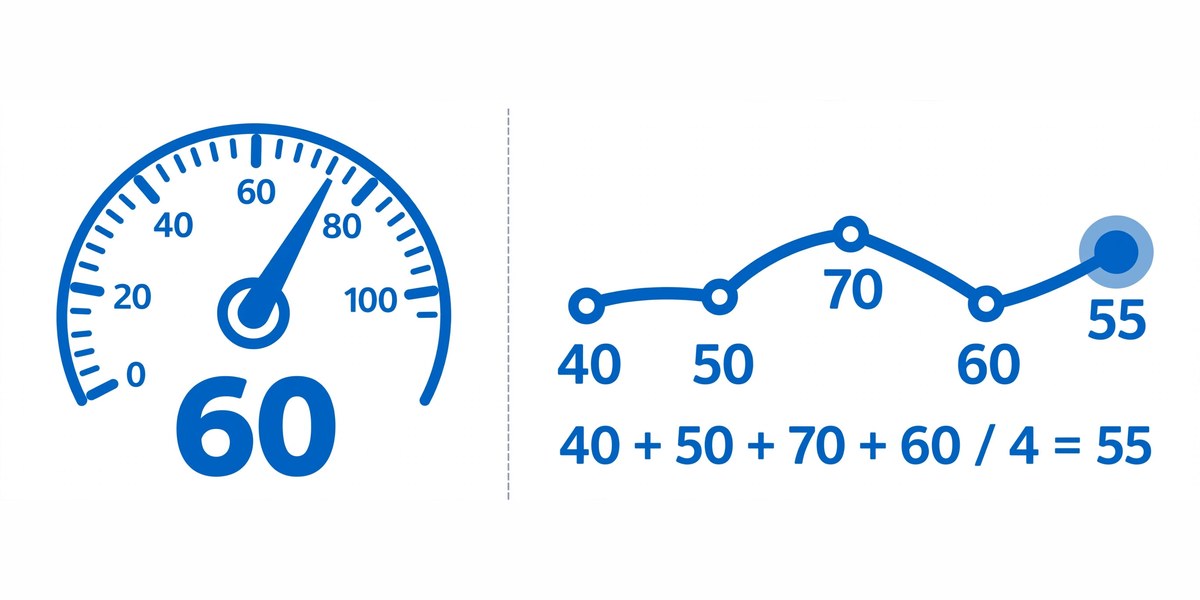
Quick answer: Average speed is total distance divided by total time for a whole trip, while instantaneous speed is how fast you are moving at one exact moment, the number on your speedometer. A 120-mile trip in 2 hours averages 60 mph even if the speedometer swung between 30 and 70 mph along the way.
Students mix these two up constantly, and drivers do too: the speedometer and the trip computer seem to disagree, but both are right. One reports the moment, the other reports the whole journey. This guide explains each type of speed, shows how to calculate both, and works through driving, running, and racing examples.
What Is Average Speed?
Average speed spreads the whole trip evenly across the whole clock:
Average speed = Total distance / Total time
It does not care that you sped up, slowed down, or stopped for coffee. Drive 120 miles in 2 hours and your average speed is 60 mph, no matter what the speedometer did in between. In metric terms, that is 60 x 1.609344 = 96.56 km/h.
The key word is total: total distance includes every mile, and total time includes every minute, even the minutes spent parked. That is why average speed almost always feels lower than you expect.
What Is Instantaneous Speed?
Instantaneous speed is your speed at one single instant. Your car’s speedometer shows it. A radar gun measures it. Mathematically, it is the limit of average speed as the time interval shrinks toward zero: the speed over a shorter and shorter slice of the trip.
You never truly measure an instant; instruments measure over a tiny interval. A GPS updates about once per second, so the “instant” speed on your phone is really the average over the last second. For everyday purposes, that is close enough to count.
How Do Average and Instantaneous Speed Differ on a Real Drive?
Picture this two-hour trip:
- First hour: open highway at a steady 70 mph. Distance covered: 70 x 1 = 70 miles.
- Second hour: small towns and traffic lights, averaging 50 mph. Distance covered: 50 x 1 = 50 miles.
Total distance is 70 + 50 = 120 miles. Total time is 2 hours. Average speed is 120 / 2 = 60 mph.
Notice what happened: the speedometer read 70 for a full hour and never read 60 for long, yet the trip average is exactly 60 mph. The average is a summary of the journey; the speedometer is a snapshot of a moment. Neither is wrong.
Now add a 30-minute lunch stop. Distance is still 120 miles, but total time is 2.5 hours, so the average drops to 120 / 2.5 = 48 mph. The speedometer never showed 48, but the trip average did.

Why Does My Speedometer Disagree with My Trip Average?
This is the most common real-world confusion, and it has three causes:
- Stops count in the average. Every red light and rest stop adds time without adding distance, dragging the average down.
- Slow sections weigh heavily. Time spent at low speeds contributes more minutes per mile than time at high speeds.
- The speedometer shows now, the computer shows the whole trip. They answer different questions, so different numbers are expected.
Example: a 15-mile city trip takes 45 minutes (0.75 hours). Average speed is 15 / 0.75 = 20 mph, even though the speedometer touched 45 mph on the open stretches. The lights and traffic in between did the damage.
Average vs Instantaneous Speed in Sports
Racing makes the difference dramatic because the numbers are extreme:
- Usain Bolt’s 100 m record: 100 meters in 9.58 seconds averages 10.44 m/s (37.58 km/h). But his fastest 20-meter split took 1.61 seconds, which is 20 / 1.61 = 12.42 m/s (44.72 km/h) of instantaneous speed. His peak was about 19 percent higher than his average.
- Marathon record pace: 42.195 km in about 2.019 hours averages 20.90 km/h (12.98 mph). Elite runners hold remarkably steady splits, so their instantaneous speed stays close to the average, unlike a sprinter’s.
- Cycling time trial: a rider averaging 50 km/h over an hour still hits 70 km/h on descents and drops to 30 km/h on climbs. Only the average decides the finishing time.
Coaches care about both: the average predicts race results, while instantaneous peaks reveal sprinting power and pacing mistakes.
How Do You Calculate Each One?
| Average speed | Instantaneous speed | |
|---|---|---|
| Formula | Total distance / total time | Limit of distance / time as time approaches zero |
| Measured by | Odometer and clock | Speedometer, radar gun, GPS |
| Example | 120 miles / 2 h = 60 mph | Speedometer reading 70 mph right now |
| Can it be zero mid-trip? | No, unless the trip never moves | Yes, at every red light |
| Used for | Trip planning, race results, fuel estimates | Speed limits, pacing, safety |
To practice the average-speed calculation with your own numbers, try a calculator for speed, distance, and time and compare its answer with your speedometer readings.
Can Average Speed Ever Exceed Top Speed?
Never. The average is a blend of everything that happened, so it sits at or below the fastest moment. If anything, remember the reverse rule that catches planning mistakes: your trip average will always sit below your cruising speed, because stops and slowdowns only pull it down.
Frequently Asked Questions
Is the speedometer showing average or instantaneous speed?
Instantaneous speed. It measures how fast the wheels are turning right now. Your trip computer’s average speed is the separate number computed from total distance and total time.
How do I calculate average speed with multiple segments?
Add up all the distances, add up all the times (including stops), then divide. Do not average the speeds directly: 70 mph for 1 hour and 50 mph for 1 hour averages (70 + 50) / 2 = 60 mph only because the times are equal. With unequal times, that shortcut fails.
What is the difference between speed and velocity here?
Speed is the magnitude: 60 mph. Velocity adds direction: 60 mph north. Average velocity can be zero for a round trip, while average speed counts every mile twice.
Why is instantaneous speed defined with calculus?
Because any real measurement covers a small time interval, giving a tiny average. Calculus takes the limit as that interval shrinks to zero, defining the exact speed at a mathematical instant.
Which one do speed limits apply to?
Instantaneous speed. A speed camera or radar gun measures how fast you are going at that moment, not your trip average. Averaging 55 mph does not excuse a 75 mph reading.
How close is GPS speed to true instantaneous speed?
Very close at steady speeds. Consumer GPS computes speed from position changes about once per second, so during hard acceleration or sharp turns it lags reality by a fraction of a second.