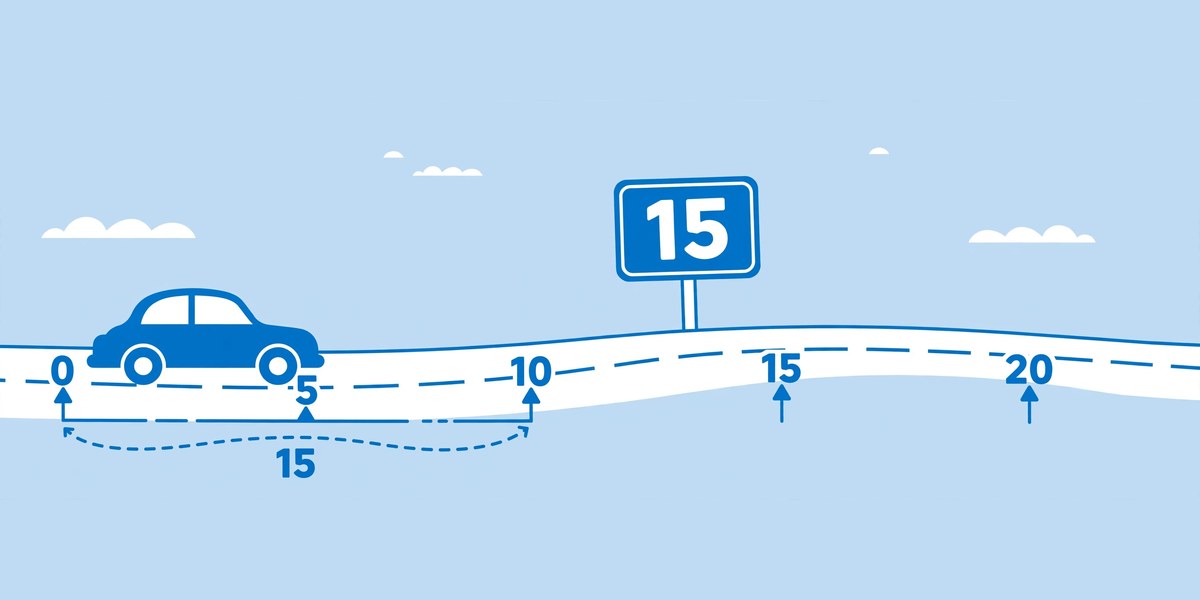
Quick answer: To calculate distance, multiply speed by time: distance = speed x time. For example, driving at 65 mph for 2.5 hours covers 65 x 2.5 = 162.5 miles (261.52 km). Make sure the time unit matches the speed unit, converting minutes to hours when needed.
How far will you get before the fuel runs out? How far did that flight actually cover? Distance questions come up in road trips, training plans, and travel budgets. The math is simple multiplication, but the mistakes almost always come from mismatched units. This guide shows the distance formula with worked examples you can verify.
What Is the Formula for Distance?
The formula is:
Distance = Speed x Time
Speed tells you how much ground you cover per unit of time, and time tells you how many of those units passed. Multiplying them gives the total ground covered. If you drive at 60 mph for 3 hours, the 60 and the 3 multiply to 180 miles.
This is the middle formula of the speed distance time trio. Speed = distance / time finds how fast, distance = speed x time finds how far, and time = distance / speed finds how long.
How Do You Calculate Distance Step by Step?
- Write down the speed with its unit, for example 65 mph.
- Write down the time with its unit, for example 2.5 hours.
- Match the time unit to the speed unit. If speed is per hour, time must be in hours. Convert minutes by dividing by 60: 45 minutes becomes 0.75 hours.
- Multiply speed by time. 65 x 2.5 = 162.5 miles.
- Label the answer. The distance unit matches the speed’s distance unit: mph gives miles, km/h gives kilometers.
The most common error is skipping step 3. Multiplying 100 km/h by 45 minutes without converting gives 4,500, which is wrong by a factor of 60. The correct math is 100 x 0.75 = 75 km. Or use an online calculator that solves all three formulas and handles the unit math for you.
Worked Distance Examples with Real Numbers
- Road trip: 65 mph for 2.5 h = 162.5 miles (261.52 km). Check: 162.5 / 2.5 = 65.
- Commute: 100 km/h for 45 min = 100 x 0.75 = 75 km (46.60 miles). Check: 75 / 0.75 = 100.
- Walking: 5 km/h for 40 min = 5 x 0.6667 = 3.33 km (2.07 miles). Check: 3.33 / 0.6667 = 5.
- Flight: 900 km/h for 3.25 h = 2,925 km (1,817.51 miles). Check: 2,925 / 3.25 = 900.
- Cycling: 12 mph for 1.5 h = 18 miles (28.97 km). Check: 18 / 1.5 = 12.
- Swimming: 1.2 m/s for 10 min (600 s) = 1.2 x 600 = 720 m (0.72 km). Check: 720 / 600 = 1.2.
How Far Do You Go in One Hour?
Sometimes the simplest table is the most useful. Distance covered in exactly one hour at common speeds:
| Speed | Distance in 1 hour (km) | Distance in 1 hour (miles) |
|---|---|---|
| 5 km/h (walking) | 5 km | 3.11 miles |
| 25 km/h (cycling) | 25 km | 15.53 miles |
| 60 km/h (city highway) | 60 km | 37.28 miles |
| 60 mph (US highway) | 96.56 km | 60 miles |
| 100 km/h (freeway) | 100 km | 62.14 miles |
| 500 mph (jet) | 804.67 km | 500 miles |
Scale any row to your own trip: at 60 mph, 20 minutes (one third of an hour) covers 20 miles, and 90 minutes covers 90 miles.
How Do Units Affect the Distance Formula?
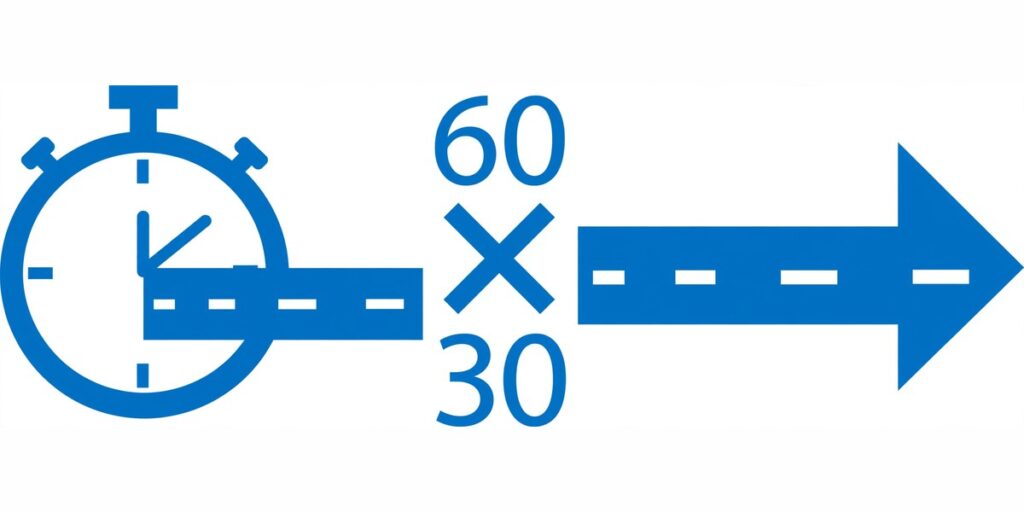
The formula only works when the time unit matches the “per” in the speed unit:
- km/h with hours gives kilometers. Example: 80 km/h x 2 h = 160 km.
- mph with hours gives miles. Example: 55 mph x 4 h = 220 miles.
- m/s with seconds gives meters. Example: 2 m/s x 30 s = 60 m.
- km/h with minutes needs conversion first: divide minutes by 60. Example: 90 km/h x 20 min = 90 x 0.3333 = 30 km.
To report the answer in a different unit, convert at the end: 220 miles x 1.609344 = 354.06 km.
Can You Calculate Distance Without a Speedometer?
Yes, using steady landmarks and a clock:
- Note the time when you pass a known starting point, such as a mile marker.
- Note the time when you pass a known ending point.
- Find your average speed from the known distance and elapsed time.
- Multiply that average speed by any other time period to estimate distance.
Example: you cover 10 miles between two exits in 12 minutes (0.2 hours), so your average speed is 10 / 0.2 = 50 mph. In the next 30 minutes at the same pace you will cover 50 x 0.5 = 25 miles.
What About Extreme Distances?
The same formula scales to enormous numbers. Light travels at 299,792 km/s. In 8 minutes 20 seconds (500 seconds), the time light takes to reach Earth from the Sun, it covers 299,792 x 500 = 149,896,000 km, about 149.9 million kilometers. No new math is needed, only bigger numbers and careful unit tracking.
Frequently Asked Questions
What is the distance formula in words?
Distance equals speed multiplied by time. If you know how fast something moves and how long it moves, multiplying the two numbers gives the total distance traveled.
Do I convert minutes to hours before multiplying?
Yes, whenever the speed is per hour. Divide minutes by 60 first. For 45 minutes at 100 km/h, use 0.75 hours to get 75 km, not 4,500.
How do I find distance when speed changes during the trip?
Split the trip into segments with steady speeds, calculate each segment’s distance, and add them up. Driving 1 hour at 70 mph and 1 hour at 50 mph covers 70 + 50 = 120 miles.
What is the difference between distance and displacement?
Distance is the total path traveled. Displacement is the straight-line change in position. A 400-meter lap run covers 400 meters of distance but zero displacement, since you finish where you started.
How do I estimate distance from a map scale?
Measure the route in centimeters or inches, then multiply by the scale. On a 1:100,000 map, 5 cm represents 5 x 100,000 = 500,000 cm, which is 5 km. Add 10 to 20 percent for winding roads.
Why does my odometer differ from speed x time?
Because your speed varied. The formula gives exact distance only for constant speed. For real trips it gives the average-speed distance, while the odometer measures every speed change exactly.