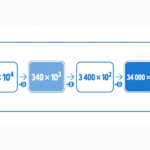
To convert a number to scientific notation, move the decimal point until exactly one non-zero digit remains to its left, then multiply by 10 raised to the number of places you moved the decimal. Move left for large numbers and use a positive exponent; move right for small numbers and use a negative exponent. For example, 5,600,000 becomes 5.6 x 10^6.
What Are the Steps to Convert a Number to Scientific Notation?
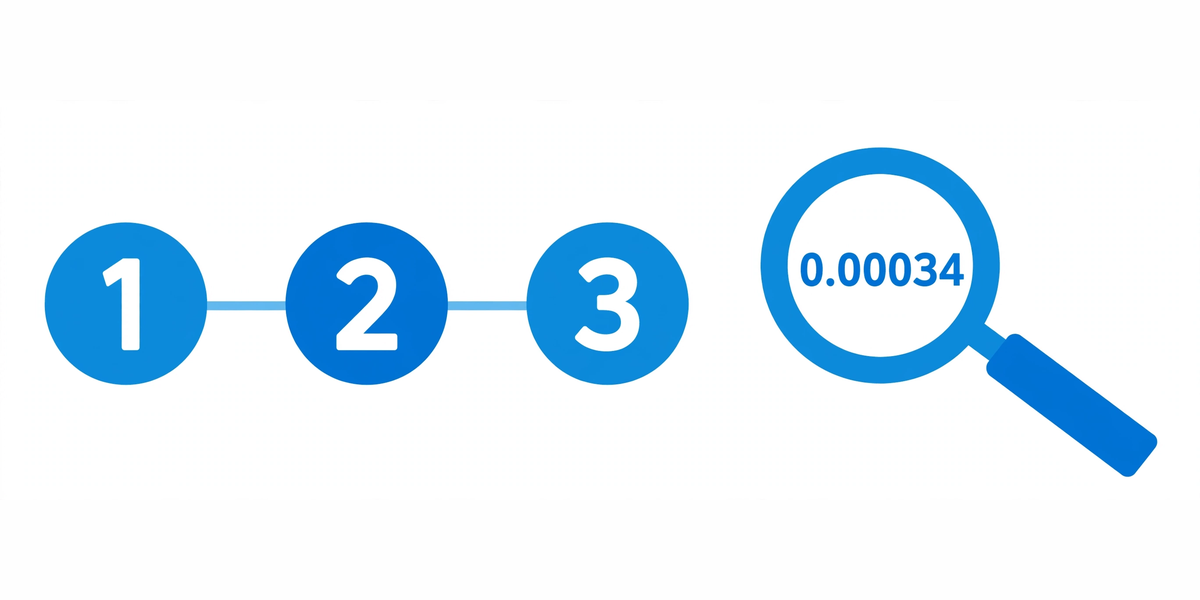
Follow these five steps every time and the conversion becomes automatic:
- Write down the number in its standard form, such as 72,000 or 0.00034.
- Locate the decimal point. Whole numbers like 72,000 have an invisible decimal at the end: 72000.
- Move the decimal so that only one non-zero digit sits to its left. For 72,000 that gives 7.2.
- Count the places moved. That count becomes your exponent, positive if you moved left, negative if you moved right.
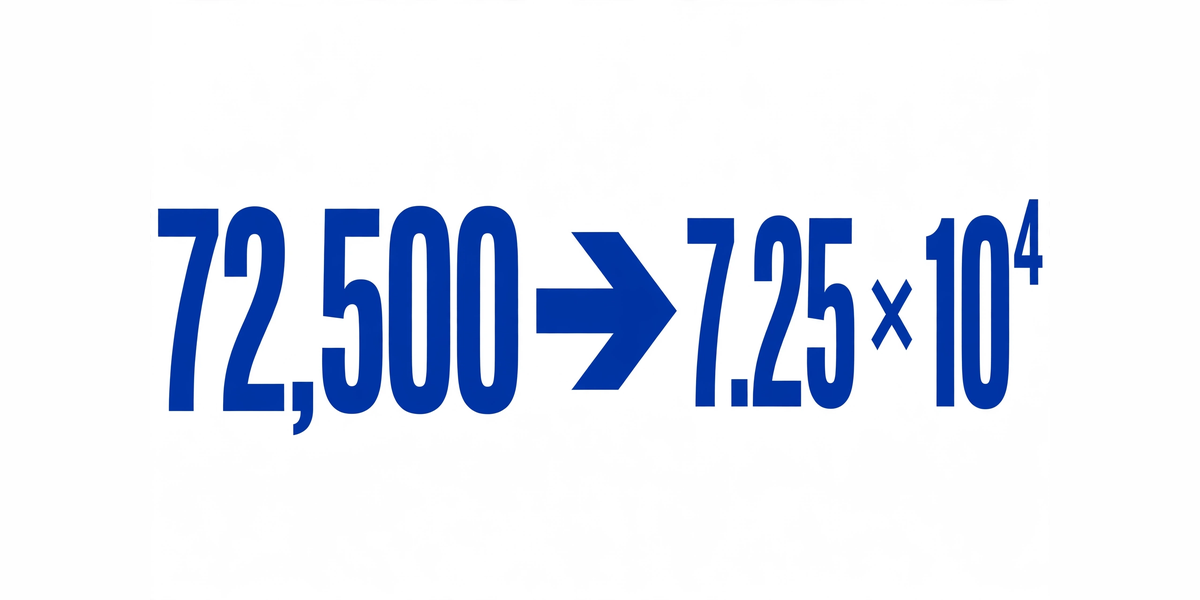
- Write the result as coefficient x 10^exponent. So 72,000 becomes 7.2 x 10^4.
If typing all this by hand feels slow, a Scientific Notation Calculator performs the same steps instantly and shows the decimal moves for you.
How Do You Convert a Large Number to Scientific Notation?
Large numbers, anything bigger than 10, use a positive exponent because you move the decimal to the left. Each leftward move makes the exponent grow by one.
Worked example: 5,600,000
- Start: 5,600,000.
- Move the decimal left 6 places: 5.6
- Exponent = 6 (moved left, so positive).
- Result: 5.6 x 10^6.
Check it: 5.6 x 1,000,000 = 5,600,000. Correct.
Worked example: 340,000
- Start: 340,000.
- Move the decimal left 5 places: 3.4
- Result: 3.4 x 10^5.
Check: 3.4 x 100,000 = 340,000. Correct.
Worked example: the speed of light, 299,792,458 m/s
- Move the decimal left 8 places: 2.99792458
- Result: 2.99792458 x 10^8 m/s.
Check: 2.99792458 x 100,000,000 = 299,792,458. Correct.
How Do You Convert a Small Number to Scientific Notation?
Small numbers, anything between 0 and 1, use a negative exponent because you move the decimal to the right. Count every place you pass until one non-zero digit sits left of the decimal.
Worked example: 0.00034
- Start: 0.00034
- Move the decimal right 4 places: 3.4
- Exponent = -4 (moved right, so negative).
- Result: 3.4 x 10^-4.
Check: 3.4 / 10,000 = 0.00034. Correct.
Worked example: 0.00000012
- Move the decimal right 7 places: 1.2
- Result: 1.2 x 10^-7.
Check: 1.2 / 10,000,000 = 0.00000012. Correct.
Worked example: electron mass, 0.0000000000000000000000000000009109 kg
- Count the zeros after the decimal before the 9: there are 30 of them, so the decimal moves 31 places right.
- Result: 9.109 x 10^-31 kg.
Writing 31 zeros by hand invites mistakes, which is exactly why physicists never write this value in standard form.
What Is the Rule for the Exponent Sign?
The direction of the decimal move decides the sign:
| Move direction | Number size | Exponent sign | Example |
|---|---|---|---|
| Left | Greater than 10 | Positive | 72,000 = 7.2 x 10^4 |
| Right | Less than 1 | Negative | 0.00034 = 3.4 x 10^-4 |
| None needed | Between 1 and 10 | Zero | 5.6 = 5.6 x 10^0 |
A handy memory trick used in US classrooms: Left for Large means a positive (pLus) exponent; right for smaLL gives a negative (minus) exponent.
What Are Common Mistakes When Converting to Scientific Notation?
- Forgetting to normalize the coefficient. 56 x 10^5 is not finished form; it must be 5.6 x 10^6.
- Miscounting the decimal places. Write each hop down, or check by multiplying back out.
- Flipping the exponent sign. Large numbers always get positive exponents; small numbers always get negative ones.
- Rounding too early. Keep full digits through the conversion and round only the final answer if the problem requires it.
How Do You Convert Numbers Between 1 and 10, or Zero?
Numbers from 1 up to 10 need no decimal move at all. The value 5.6 is simply 5.6 x 10^0, because 10^0 equals 1. This edge case shows up when normalizing results, for example after dividing 8 x 10^4 by 2 x 10^4 you get 4 x 10^0, which is just 4.
Zero is the one value that has no scientific notation form. Every power of 10 is non-zero, and multiplying any coefficient by a power of 10 cannot produce 0, so zero is simply written as 0. If a calculator returns 0e0, treat it as exactly zero.
Practice Problems With Answers
Try these, then check your work against the solutions:
- Convert 93,000,000 (miles from Earth to Sun). Move the decimal 7 places left: 9.3 x 10^7 miles.
- Convert 0.0000005 (grams, a grain of salt fragment). Move the decimal 7 places right: 5 x 10^-7 g.
- Convert 1,250,000. Move the decimal 6 places left: 1.25 x 10^6.
- Convert 0.082. Move the decimal 2 places right: 8.2 x 10^-2.
Verify each by multiplying back: 9.3 x 10,000,000 = 93,000,000, and 8.2 / 100 = 0.082. Both check out.
Frequently Asked Questions
How do you convert 5,600,000 to scientific notation?
Move the decimal 6 places left to get 5.6, then attach a positive exponent of 6: 5.6 x 10^6. Multiply back to check: 5.6 x 1,000,000 = 5,600,000.
How do you convert 0.00034 to scientific notation?
Move the decimal 4 places right to get 3.4, then use a negative exponent: 3.4 x 10^-4. Check by dividing: 3.4 / 10,000 = 0.00034.
Why does the coefficient have to be between 1 and 10?
That rule gives every number exactly one scientific notation form, which makes numbers easy to compare and simplifies multiplication and division rules.
What is 1 million in scientific notation?
1,000,000 has 6 zeros, so it is 1 x 10^6. Similarly, 1 billion is 1 x 10^9 and 1 trillion is 1 x 10^12.
Do negative numbers work in scientific notation?
Yes. Convert the absolute value normally, then keep the negative sign: -45,000 becomes -4.5 x 10^4.
How is this taught in US schools?
Converting to scientific notation is a Common Core 8th grade skill (standard 8.EE.3), and it appears on the SAT, ACT, and AP science exams, so fast accurate conversion is a tested skill.