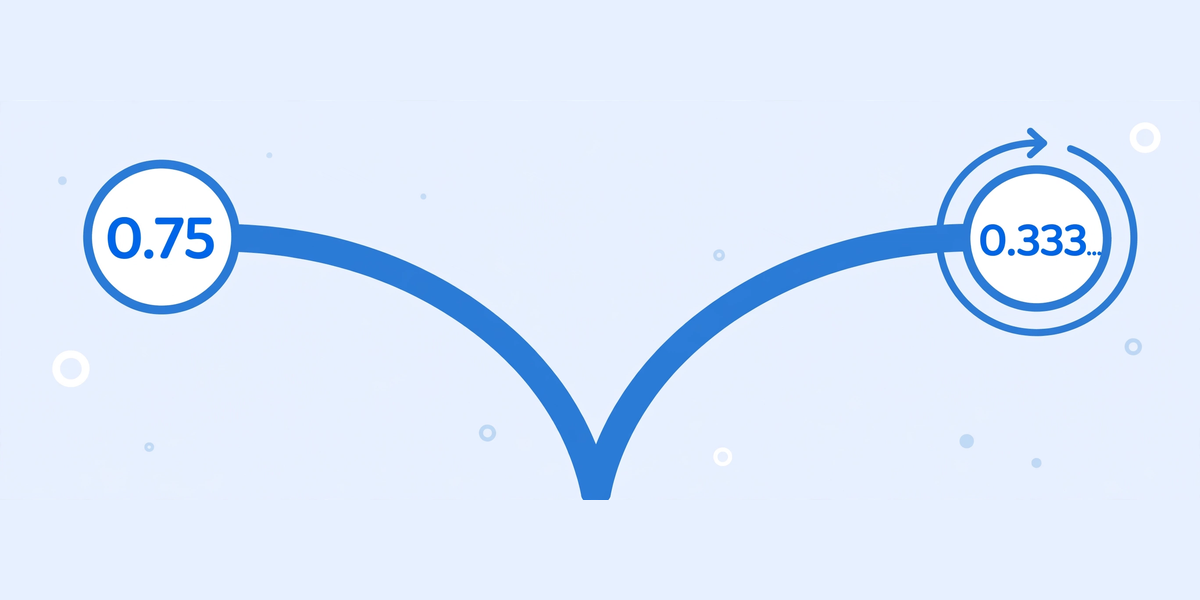
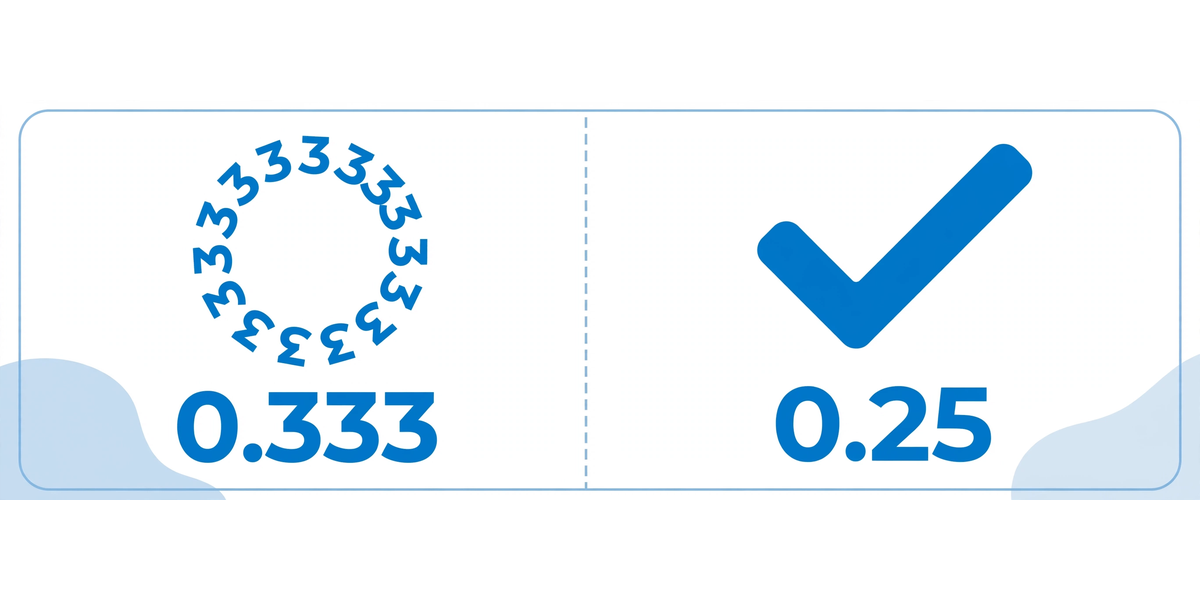
Direct answer: A terminating decimal ends after a fixed number of digits (like 1/4 = 0.25), while a repeating decimal has a digit or group of digits that cycles forever (like 1/3 = 0.333…). The difference comes from the denominator: after simplifying, denominators built only from 2s and 5s terminate, and any other prime factor causes repetition. A fraction to decimal calculator labels each result so you can see which type you have.
What Is a Terminating Decimal?
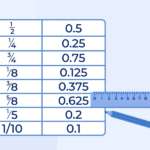
A terminating decimal stops. It has a final digit, and every digit after it is zero. Common examples include 0.5, 0.25, 0.125, and 3.6. In long division, a terminating decimal appears when the remainder finally reaches zero, so there is nothing left to divide. The fraction 3/8 terminates at 0.375 because the division ends cleanly: 8 into 30 goes 3 times (remainder 6), into 60 goes 7 times (remainder 4), into 40 goes 5 times (remainder 0). Done.
What Is a Repeating Decimal?
A repeating decimal never stops. One digit or a block of digits cycles forever. The fraction 1/3 gives 0.333…, where the 3 repeats. The fraction 1/6 gives 0.1666…, where only the 6 repeats. Longer cycles exist too: 1/7 = 0.142857142857…, where the six-digit block 142857 repeats. Mathematicians mark repeating digits with a line above them (called a vinculum), so 1/3 is written as 0.3 with a bar over the 3.
A repeating decimal is still an exact value, not an approximation. 0.999… with the 9 repeating is exactly equal to 1. The digits continue forever, but the number they describe is precise.
Why Do Some Fractions Terminate and Others Repeat?
The secret is in the denominator. Follow this test:
- Simplify the fraction completely. Reduce 6/15 to 2/5 first, because the test only works on simplified fractions.
- Factor the denominator into primes. Break it into its prime building blocks. 20 becomes 2 x 2 x 5. 12 becomes 2 x 2 x 3.
- Check the primes. If you see only 2s and 5s, the decimal terminates. If any other prime appears (3, 7, 11, and so on), the decimal repeats.
Why 2s and 5s? Because our number system is base 10, and 10 = 2 x 5. A denominator built only from 2s and 5s can always be scaled up to a power of 10, which is exactly what a terminating decimal is: 3/8 = 375/1000 = 0.375. Denominators with other primes can never become a power of 10, so the division cycles instead of ending.
Can You Predict the Outcome Before Dividing?
Yes, using the prime-factor test above. Work through these verified examples:
| Fraction (simplified) | Denominator factors | Result |
|---|---|---|
| 1/2 | 2 | 0.5, terminates |
| 3/8 | 2 x 2 x 2 | 0.375, terminates |
| 7/20 | 2 x 2 x 5 | 0.35, terminates |
| 9/25 | 5 x 5 | 0.36, terminates |
| 1/3 | 3 | 0.333…, repeats |
| 5/6 | 2 x 3 | 0.8333…, repeats |
| 2/7 | 7 | 0.285714…, repeats |
| 4/15 | 3 x 5 | 0.2666…, repeats |
Notice that 7/20 terminates even though 20 is larger than 15. Size does not matter, only the prime factors. And 4/15 repeats because of the factor 3, even though 5 is also present.
What Mistakes Do Students Make With These?
- Testing before simplifying. The fraction 6/15 looks like it should repeat (15 = 3 x 5), but simplified it is 2/5 = 0.4, which terminates. Always reduce first.
- Thinking long decimals are repeating. A decimal like 0.142857 could be a rounded repeating decimal or an exact terminating one. Only the division or the factor test tells you which.
- Rounding repeating decimals and calling them exact. Writing 1/3 = 0.33 is an approximation. The exact value needs the repeat mark: 0.333… or the bar notation.
- Assuming all fractions with prime denominators repeat. The primes 2 and 5 are the exceptions: 1/2 and 1/5 terminate.
Where Do You Meet These in Real Life?
Money math almost always terminates, because dollars divide into 100 cents (100 = 2 x 2 x 5 x 5). That is why prices never show repeating decimals. Repeating decimals appear in measurements and ratios: 1/3 of a yard is 0.333… yards, gear ratios cycle, and music tempo divisions repeat. In school, science classes round repeating values to a sensible number of digits, while math classes keep the repeat mark to stay exact.
How Are Repeating Decimals Written in Different Notations?
Mathematicians and textbooks use three common ways to show repetition. The bar notation places a line over the repeating digits: 0.333… becomes 0.3 with a bar over the 3, and 0.142857142857… becomes 0.142857 with a bar over all six digits. Some texts use dots instead: a dot over the first and last repeating digit means the same thing. The simplest style for everyday writing is the ellipsis: 0.333…. All three mean exactly the same value, so use whichever your class or style guide prefers. In computer code and calculators, you will usually see a rounded value like 0.3333333333, which is an approximation of the display, not the exact number.
Frequently Asked Questions
How can you tell if a decimal will terminate or repeat?
Simplify the fraction, factor the denominator into primes, and check. Only 2s and 5s means it terminates. Any other prime factor means it repeats.
Is 0.5 a terminating or repeating decimal?
Terminating. It equals 1/2, and the denominator 2 is one of the allowed primes, so the division ends at 0.5.
What does the bar over a digit mean in a decimal?
The bar (vinculum) marks the repeating part. 0.16 with a bar over the 6 means the 6 repeats forever: 0.1666…. A bar over multiple digits means the whole group repeats.
Can a repeating decimal equal a whole number?
Yes. 0.999… with the 9 repeating is exactly equal to 1. This is a proven result, not a rounding trick.
Why does 1/7 have such a long repeating pattern?
The length of the repeat relates to the denominator. For prime denominators like 7, the cycle can be up to one digit shorter than the denominator. 1/7 cycles through 142857, a six-digit block, before repeating.
Do calculators show repeating decimals correctly?
Most basic calculators round the display, showing 0.3333333333 for 1/3. A dedicated fraction converter marks the repeating digits explicitly so you know the value is exact and repeating.