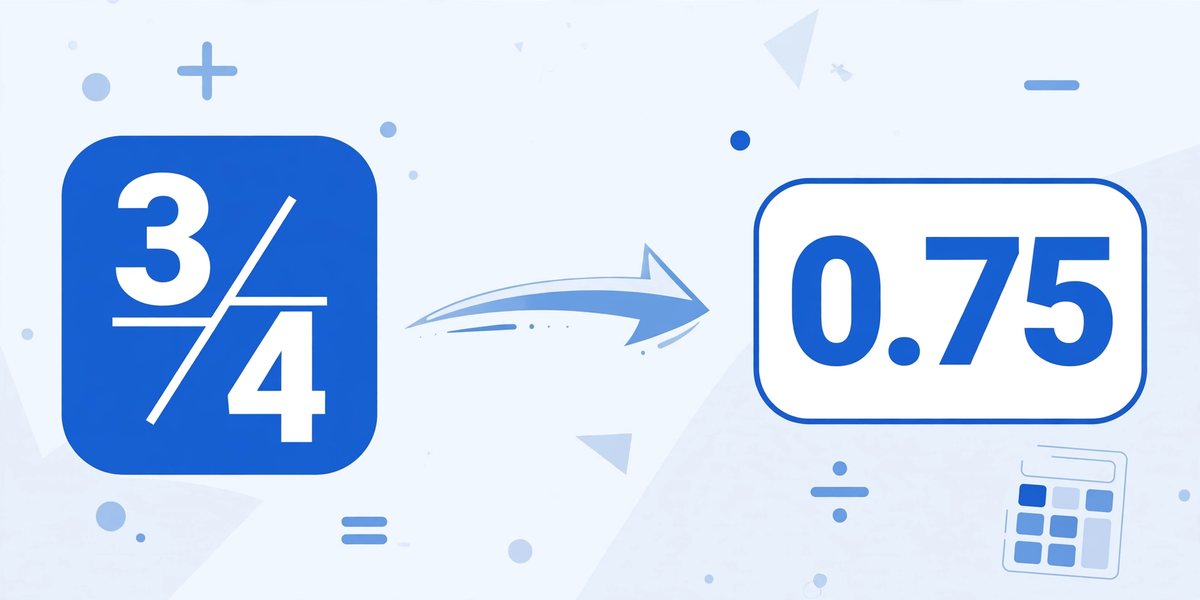
Example: 3 / 4 becomes 0.75
Example: 2 + 1 / 4 becomes 2.25
Decimal result
Step-by-step
Quick answer: A fraction to decimal calculator divides the numerator by the denominator and instantly shows the decimal result. It also tells you whether the decimal terminates or repeats, shows the simplified fraction, and walks you through the long division step by step. Enter any fraction or mixed number above to convert it in seconds.
How to Use This Calculator
- Pick a mode. Choose the "Simple Fraction" tab for fractions like 3/4, or the "Mixed Number" tab for values like 2 1/2.
- Enter your numbers. Type whole numbers into the numerator and denominator fields. The denominator cannot be zero.
- Press Calculate. The tool instantly shows the decimal result, the simplified fraction, and whether the decimal terminates or repeats.
- Review the steps. Read the step-by-step long division below the result to see exactly how the answer was found.
- Start over. Press Reset to clear every field and try a new conversion.
What Is the Math Behind the Conversion?
Converting a fraction to a decimal uses one simple rule: divide the top number (the numerator) by the bottom number (the denominator). That is the whole method. For example, to convert 3/4, you calculate 3 divided by 4, which equals 0.75.
When the denominator does not divide evenly, you keep adding zeros after a decimal point and continue the long division. This is where two different outcomes appear. Some fractions, like 1/2, divide cleanly and stop. Others, like 1/3, produce a remainder that keeps cycling, so the decimal digits repeat forever. The calculator detects this automatically by watching for a repeated remainder during the division, then marks the repeating digits with a line above them.
Mixed numbers work the same way. A mixed number like 2 1/2 is really the whole number 2 plus the fraction 1/2. The calculator converts the fraction part to a decimal (0.5) and adds the whole number, giving 2.5. Internally it first rewrites the mixed number as an improper fraction, so 2 1/2 becomes 5/2, then divides 5 by 2.
Common Fraction to Decimal Examples
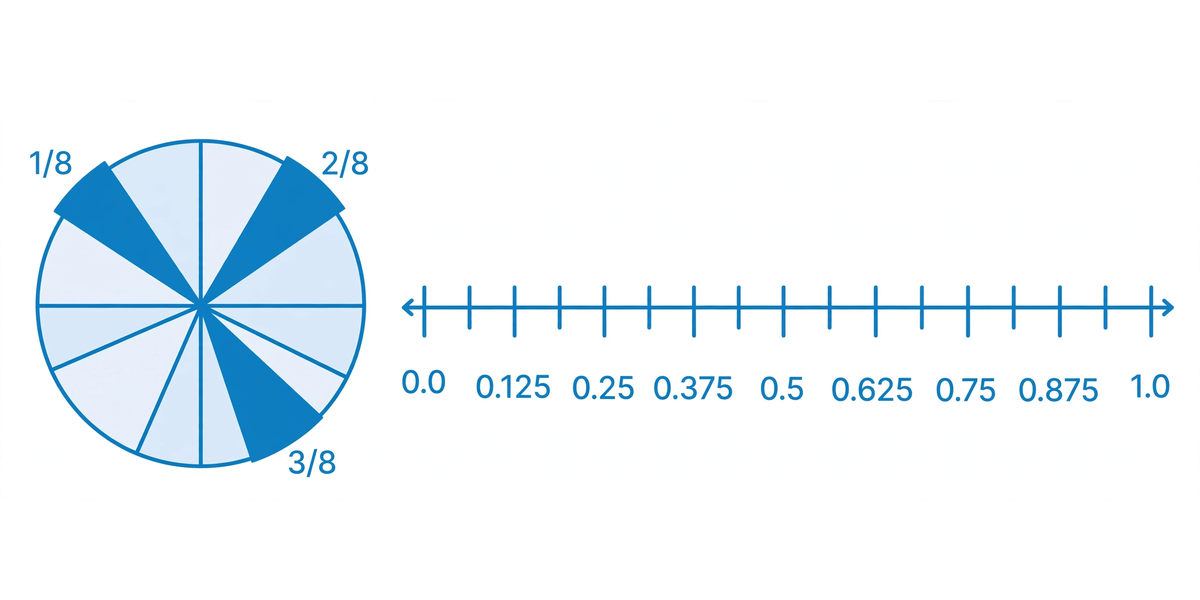
Here are conversions you will use most often, all verified by direct division:
| Fraction | Decimal | Type |
|---|---|---|
| 1/2 | 0.5 | Terminating |
| 1/4 | 0.25 | Terminating |
| 3/4 | 0.75 | Terminating |
| 1/3 | 0.333... | Repeating |
| 2/3 | 0.666... | Repeating |
| 1/5 | 0.2 | Terminating |
| 2/5 | 0.4 | Terminating |
| 3/5 | 0.6 | Terminating |
| 4/5 | 0.8 | Terminating |
| 1/8 | 0.125 | Terminating |
| 3/8 | 0.375 | Terminating |
| 5/8 | 0.625 | Terminating |
| 7/8 | 0.875 | Terminating |
| 1/10 | 0.1 | Terminating |
Terminating vs Repeating: Why Do Some Decimals Never End?
Whether a decimal ends depends only on the denominator after the fraction is fully simplified. If the simplified denominator is made only of 2s and 5s (for example 4 = 2 x 2, or 20 = 2 x 2 x 5), the decimal terminates. If the simplified denominator contains any other prime factor, such as 3 or 7, the decimal repeats forever. That is why 1/4 = 0.25 stops but 1/3 = 0.333... never does. The calculator flags each result as terminating or repeating so you never have to guess.
When Is This Calculator Useful?
- Homework and tests: check your fraction conversions and see the full working, not just the answer.
- Cooking and recipes: convert 1/3 cup or 3/4 teaspoon into decimal amounts for kitchen scales.
- Shopping and discounts: turn fraction-based discounts into decimals before calculating prices.
- DIY and measurements: convert tape-measure fractions like 5/16 inch into decimals for calculators.
Learn More
Want to understand the details behind each conversion? These guides explain every part of the process:
- How to Convert a Fraction to a Decimal - the full manual method with worked examples.
- Terminating vs Repeating Decimals Explained - why some decimals end and others repeat forever.
- Fraction to Decimal Chart: Common Conversions - a quick reference table of the most-used conversions.
- How to Convert a Mixed Number to a Decimal - step-by-step help for values like 3 2/5.
- How to Convert a Decimal to a Fraction - go the other direction, from decimals back to fractions.
Frequently Asked Questions
How do you convert a fraction to a decimal?
Divide the numerator by the denominator. For 5/8, calculate 5 divided by 8 to get 0.625. The calculator above does this instantly and shows the long division steps.
What is 1/3 as a decimal?
1/3 equals 0.333..., with the 3 repeating forever. The denominator 3 cannot divide evenly, so the remainder cycles and the digit never changes. The calculator marks this with a line over the repeating 3.
Can a fraction with a zero denominator be converted?
No. Division by zero is undefined in math, so a fraction like 5/0 has no decimal value. The calculator shows a friendly error message if you try.
Do I need to simplify the fraction first?
No. The calculator accepts any fraction, such as 6/8, and simplifies it for you (6/8 becomes 3/4) before showing the decimal 0.75.
How do mixed numbers convert to decimals?
Convert the fraction part to a decimal and add the whole number. For 2 3/4, the fraction 3/4 equals 0.75, so the answer is 2.75. Use the Mixed Number tab above to do this automatically.
Why does the calculator show a line over some digits?
The line marks repeating digits. For example, 1/6 = 0.1666..., so the calculator shows 0.1 with a line over the 6, meaning only the 6 repeats. This is the standard math notation for repeating decimals.