Quick Answer
To estimate acrylic pour paint accurately: multiply canvas area (length × width) by 0.1 for ounces. Then adjust by technique (+10–20% for flip cup/dirty pour), divide by number of colors, and add a 20% buffer. A 16×20 canvas needs approximately 38–40 oz total.
Why Estimation Is a Core Skill for Acrylic Pouring
Every successful acrylic pour starts with a reliable paint estimate. Too little paint and your colors fail to merge naturally or leave bare canvas showing through. Too much and you are wasting potentially expensive fluid acrylics or custom-mixed colors that cannot be recreated exactly.
A proper acrylic pour paint estimator approach — whether a formula, a reference chart, or a tracking system — removes the guesswork and lets you focus entirely on the creative process.
The Estimator Formula Explained
The standard estimation formula used across the fluid art community is:
Total Paint (oz) = Canvas Length × Canvas Width × 0.1
The 0.1 multiplier represents the average paint depth needed to cover a primed canvas with standard-consistency acrylic pouring paint. It assumes paint mixed with pouring medium at roughly a 2:1 medium-to-paint ratio.
This is your acrylic pouring paint estimator baseline. From here, you refine based on variables unique to your project.
Variable Adjustments to Your Paint Estimate
Technique Multipliers
| Technique | Adjustment | Reason |
| Puddle Pour | 0% | Standard coverage, no extra needed |
| Dirty Pour | +15% | All colors in one cup, need full coverage |
| Flip Cup | +15–20% | Must cover entire canvas on flip |
| Dutch Pour | -5–10% | Air spreads paint thinner and farther |
| Tree Ring | 0% | Precise layering, base estimate sufficient |
| String Pull | -10% | Minimal volume, small contact area |
| Swipe | +10% | Needs coverage plus extra to swipe through |
Consistency Adjustments
Paint consistency directly affects coverage per ounce:
- Very thin (flows like water): reduce estimate by 15%
- Standard (warm honey flow): use base estimate as-is
- Thick (slow drip off stick): increase estimate by 15%
- Very thick (almost gel): increase estimate by 20–25%
Surface Type Adjustments
The surface you pour on changes how much paint you need:
- Primed canvas (gesso): use base estimate — recommended starting point
- Unprimed canvas: increase by 20–30% due to absorption
- Wood panel: increase by 10% — less flexible, paint may pool at edges
- Tile or ceramic: decrease by 10% — non-porous surface, excellent flow
- Glass: decrease by 15% — very non-porous, paint flows freely
Complete Acrylic Pouring Paint Estimator: Step-by-Step
Step 1: Measure Your Surface
Measure length and width of your canvas in inches. For non-rectangular shapes, calculate approximate area. A 12-inch circle has an area of about 113 square inches (π × 6²).
Step 2: Calculate Base Amount
Multiply length × width × 0.1. Write this number down as your starting point.
Step 3: Apply Technique Adjustment
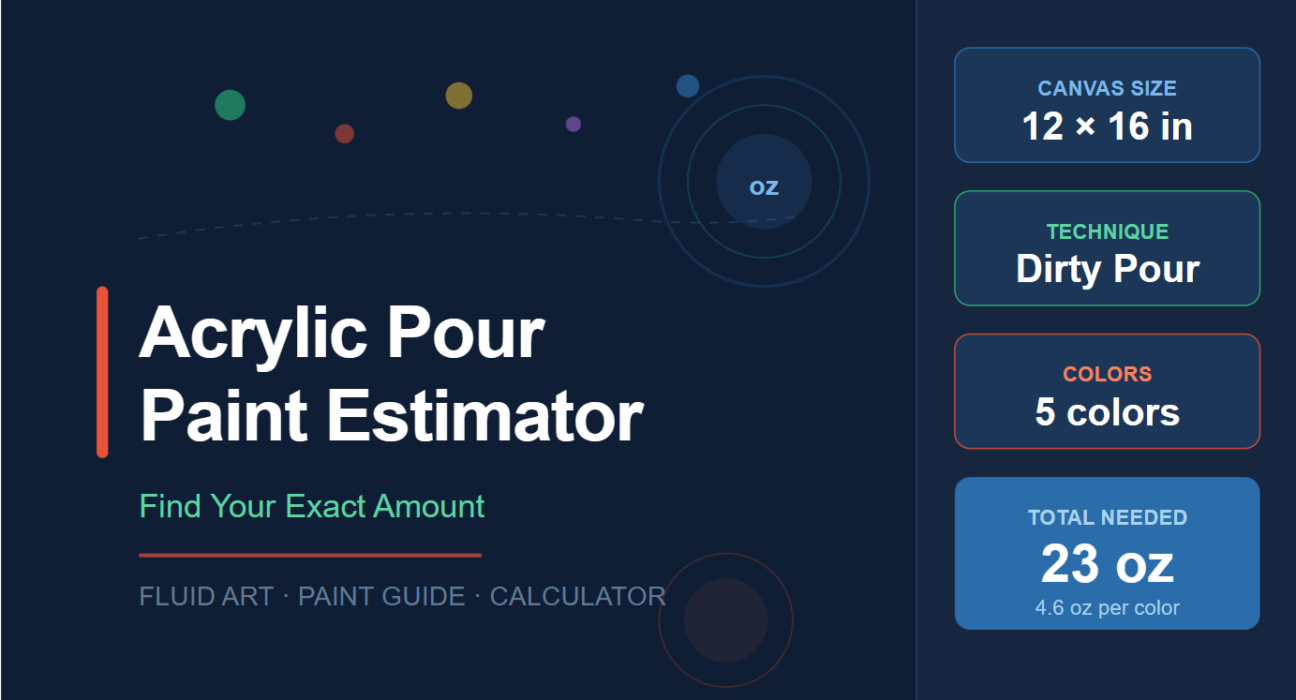
Refer to the technique multiplier table above. For flip cup on a 12×12 canvas (base = 14.4 oz), add 15–20% to get 16.5–17.3 oz.
Step 4: Apply Surface Adjustment
If pouring on unprimed canvas, multiply your adjusted figure by 1.25.
Step 5: Add Safety Buffer
Always add 15–20% to your final number. Running short in the middle of a pour is more costly than wasting a small amount.
Step 6: Divide by Colors
Divide your total evenly — or by proportion — across your chosen colors. Decide which colors will be dominant and which are accents, and allocate accordingly.
Paint Estimator Reference: Common Canvas Sizes
| Canvas | Base (oz) | +20% Buffer | 4 Colors (oz ea) | 6 Colors (oz ea) |
| 6 × 6 | 3.6 | 4.3 | 1.1 | 0.7 |
| 8 × 10 | 8.0 | 9.6 | 2.4 | 1.6 |
| 11 × 14 | 15.4 | 18.5 | 4.6 | 3.1 |
| 12 × 12 | 14.4 | 17.3 | 4.3 | 2.9 |
| 16 × 20 | 32.0 | 38.4 | 9.6 | 6.4 |
| 18 × 24 | 43.2 | 51.8 | 13.0 | 8.6 |
| 24 × 24 | 57.6 | 69.1 | 17.3 | 11.5 |
| 24 × 36 | 86.4 | 103.7 | 25.9 | 17.3 |
How to Measure Paint for Acrylic Pouring Without a Scale
Not everyone has a kitchen scale when starting out. Here are reliable alternatives:
- Use measuring cups: 1 fluid oz = 2 tablespoons = 6 teaspoons
- Mark a popsicle stick with measurements for a quick dip gauge
- Use shot glasses: a standard shot glass holds 1.5 oz
- Buy graduated medicine cups from a pharmacy for small precise amounts
A kitchen scale in grams is the most accurate method and highly recommended once you are doing regular pours. It allows you to track exact ratios and replicate successful mixes.
Estimating Paint for Series Work and Repeat Pours
If you are creating a series of paintings with the same color palette on the same canvas size, keep a pour journal. Record:
- Canvas size and type (primed/unprimed)
- Technique used
- Total paint volume prepared and amount left over
- Consistency notes (how much pouring medium per color)
- Weather conditions (humidity affects drying and flow)
After 5–10 pours in the same format, you will have a personal reference chart more accurate than any general formula because it reflects your specific materials and technique.
The Pouring Medium Estimate
Pouring medium must be factored into your total volume calculation. It is not paint, but it makes up the majority of each color cup. Standard ratios:
- Floetrol: 2 parts Floetrol to 1 part paint
- Liquitex Pouring Medium: 1.5–2 parts medium to 1 part paint
- GAC 800: 3 parts GAC to 1 part paint (produces cells without silicone)
For your acrylic pour paint estimator, always separate the paint volume from the medium volume. If your total pour needs 15 oz of material and you use a 2:1 ratio, that means 10 oz of medium and 5 oz of paint across all colors.
Frequently Asked Questions
How do I estimate paint for an acrylic pour on a large canvas?
Use the same formula: length × width × 0.1. For very large canvases (24×36 and above), increase your buffer to 25–30% because large pours are harder to top up mid-process if you run short.
What is the best tool to measure acrylic pour paint?
A digital kitchen scale measuring in grams is the most precise and affordable tool. It allows you to measure small amounts accurately and record exact ratios for future reference.
Can I use the same estimate for silicone cell pours?
Yes, the volume estimate stays the same. Silicone affects cell formation but not the total paint volume required to cover your canvas.
How many ounces of paint do I need for a 16×20 canvas?
Base estimate: 16 × 20 × 0.1 = 32 oz. With a 20% buffer, prepare approximately 38–40 oz total across all your colors.
Key Takeaways
- Use length × width × 0.1 as your acrylic pour paint estimator baseline
- Adjust for technique: flip cup and dirty pour need 15–20% more
- Surface type changes your needs — always prime canvas before pouring
- Keep a pour journal to build a personal reference over time
- Measure medium separately from paint when planning your ratios