In an age dominated by smartphones and digital calculators, the ability to calculate a square root by hand has become a rare and undervalued skill. Yet, understanding how to compute a square root manually — without any electronic aid — is crucial for passing exams where calculators are banned, strengthening your mathematical reasoning, and truly understanding the structure of numbers. This in-depth guide covers multiple proven methods to calculate a square root without a calculator, complete with technical explanations and worked examples.
Why Learn to Calculate Square Roots Without a Calculator?
Beyond exam preparation, manual square root calculation develops important cognitive skills:
- Number sense: Understanding where a number sits in relation to perfect squares improves estimation ability.
- Algorithmic thinking: Step-by-step methods mirror the logic of computer algorithms.
- Mental math: Repeated practice sharpens overall numerical fluency.
- Problem-solving confidence: Being able to derive an answer from scratch builds self-reliance in mathematical contexts.
Method 1: Estimation by Bracketing
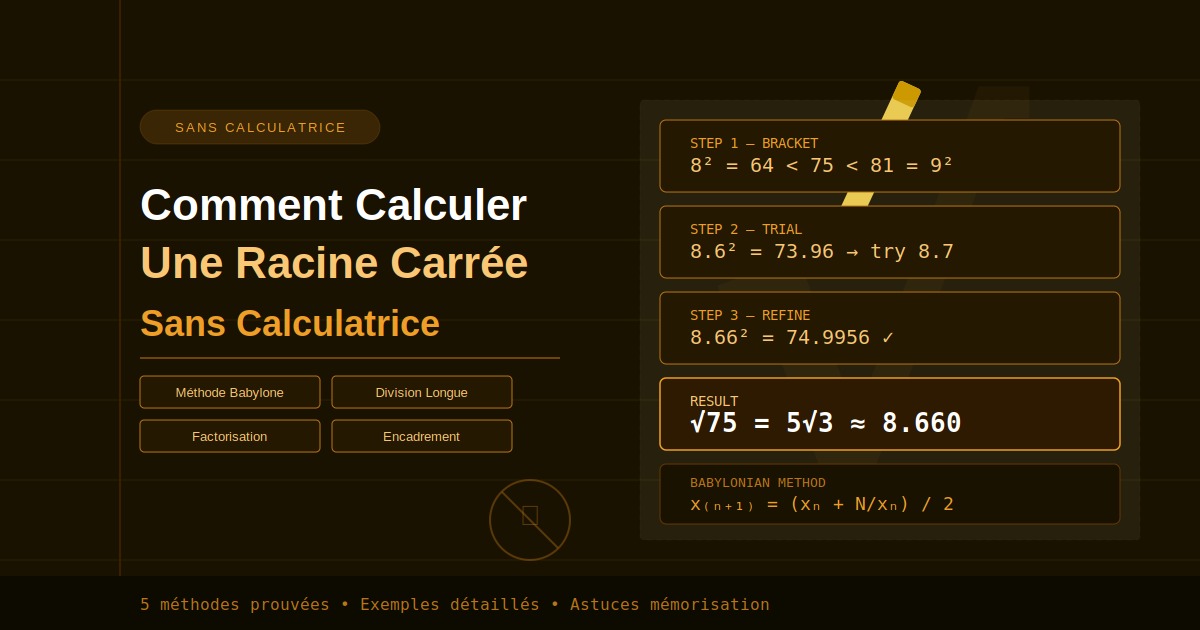
This is the most accessible method for beginners. It involves identifying two consecutive integers whose squares bracket the target number, then narrowing down the result.
Step-by-Step Example: Calculate √85
1. Find the nearest perfect squares: 9² = 81 and 10² = 100. So 9 < √85 < 10.
2. Since 85 is closer to 81 than to 100, the answer is closer to 9. Try 9.2: 9.2² = 84.64.
3. Try 9.22: 9.22² = 85.0084. Very close!
4. Try 9.219: 9.219² = 84.99… ≈ 85. Therefore, √85 ≈ 9.22.
This method requires no special formulas — just patience and careful squaring of trial values.
Method 2: The Babylonian (Heron’s) Algorithm
This ancient method is one of the fastest manual algorithms for computing square roots. It uses successive approximations that converge rapidly to the true value.
Formula
x_{n+1} = (x_n + S / x_n) / 2
Where S is the number whose square root you want, and x₀ is your initial guess.
Example: Calculate √30
5. Initial guess: x₀ = 5 (since 5² = 25 and 6² = 36, 5 is reasonable).
6. x₁ = (5 + 30/5) / 2 = (5 + 6) / 2 = 5.5
7. x₂ = (5.5 + 30/5.5) / 2 = (5.5 + 5.4545) / 2 = 5.4772
8. x₃ = (5.4772 + 30/5.4772) / 2 ≈ (5.4772 + 5.4772) / 2 = 5.4772
The algorithm has converged: √30 ≈ 5.477. The true value is 5.47722…, confirming the precision of this method after just 3 iterations.
Method 3: Long Division Method for Square Roots
The long division method is the most systematic approach and produces as many decimal places as desired. It is the manual equivalent of the algorithm used in early electronic calculators.
Steps for √1764
9. Group digits in pairs from the decimal point: 17 | 64.
10. Find the largest integer whose square is ≤ 17. That is 4, since 4² = 16. Write 4 as the first digit of the answer.
11. Subtract: 17 – 16 = 1. Bring down the next pair: 164.
12. Double the current answer (4 × 2 = 8). Find digit d such that (80 + d) × d ≤ 164. Try d=2: 82 × 2 = 164. Perfect.
13. Answer so far: 42. Remainder: 164 – 164 = 0. Therefore √1764 = 42 exactly.
For irrational results, you simply continue the process by appending pairs of zeros after the decimal point, generating as many decimal digits as needed.
Method 4: Using Logarithms
If you have access to a logarithm table (or have memorized key log values), you can calculate square roots using the identity:
√x = 10^(log₁₀(x) / 2)
Example: Calculate √500
14. log₁₀(500) = log₁₀(5 × 100) = log₁₀(5) + 2 ≈ 0.69897 + 2 = 2.69897
15. Divide by 2: 2.69897 / 2 = 1.34948
16. Find the antilog: 10^1.34948 ≈ 22.36
This method is particularly useful in scientific contexts and when a slide rule or log table is available.
Method 5: The Prime Factorization Method (For Perfect Squares)
When the number is a perfect square, prime factorization gives an exact result efficiently.
Example: Calculate √3600
17. Factorize: 3600 = 2⁴ × 3² × 5²
18. Take the square root of each factor: √(2⁴) × √(3²) × √(5²) = 2² × 3 × 5
19. Result: 4 × 3 × 5 = 60. Therefore √3600 = 60.
This method works only for perfect squares but delivers exact, error-free results.
Tips for Faster Mental Calculation
• Memorize squares up to 25: Knowing that 22² = 484 and 23² = 529 gives you an immediate bracket for any number between 484 and 529.
• Use the identity √(a²×b) = a√b to simplify: √200 = √(100×2) = 10√2 ≈ 14.14.
• Remember key irrational values: √2 ≈ 1.414, √3 ≈ 1.732, √5 ≈ 2.236, √6 ≈ 2.449, √7 ≈ 2.646.
Conclusion
Calculating a square root without a calculator is a learnable skill that deepens your mathematical understanding significantly. The bracketing method works for quick estimates, the Babylonian algorithm delivers fast convergence, the long division method gives unlimited precision, and prime factorization handles perfect squares exactly. Master these techniques and you will be equipped to handle square root problems in any setting — with or without technology.