
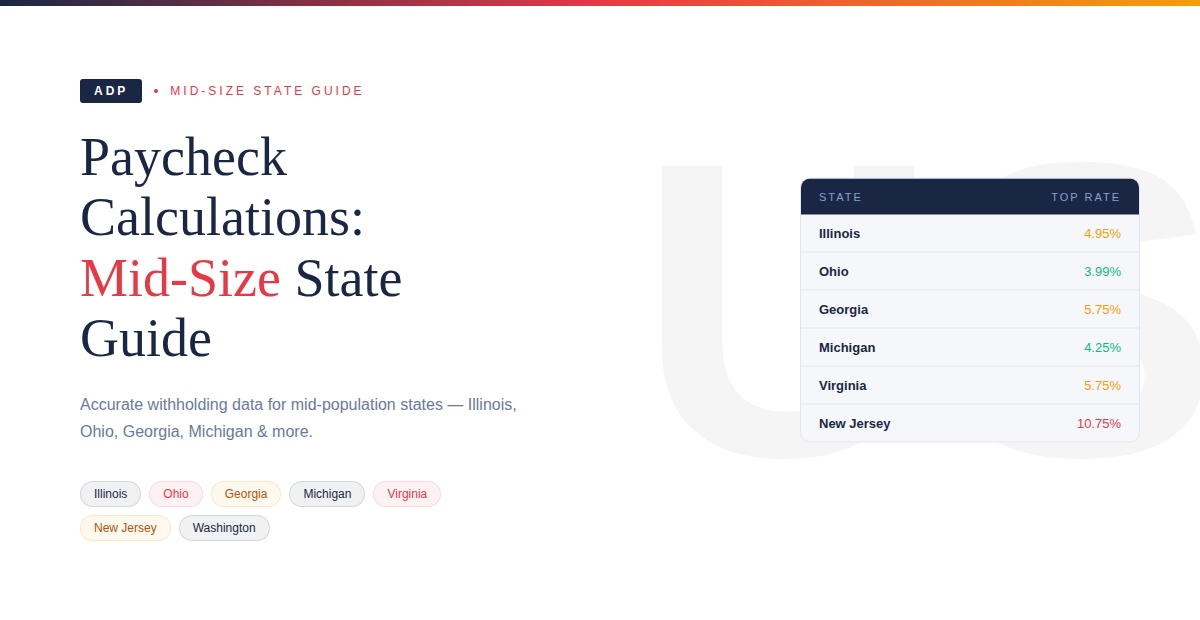
Mid-size states are where most of the paycheck complexity lives. States like Ohio, Indiana, Colorado, Virginia, Tennessee, and Oregon are home to tens of millions of workers — each with their own state tax rules, local tax structures, and withholding quirks.
If you work in one of these states, this guide will help you understand how your paycheck is calculated, what to look for on your pay stub, and why two employees at the same company earning the same salary can take home different amounts based purely on where they live.
The mid-size state paycheck landscape
Mid-size states — roughly those with populations between 3 million and 10 million — tend to have more complex tax structures than very small states. Many have progressive income tax brackets. Several have local taxes layered on top of state taxes. And a few, like Tennessee, have moved away from income tax entirely.
| State | Tax Structure | Top Rate | Local Tax? |
| Tennessee | No income tax | 0% | No |
| Indiana | Flat rate | 3.15% | Yes — county level |
| Colorado | Flat rate | 4.4% | Yes — some cities |
| Virginia | Progressive | 5.75% | No |
| Oregon | Progressive | 9.9% | Yes — some areas |
| Ohio | Progressive | 3.99% | Yes — extensive |
| Washington | No income tax | 0% | No |
| Connecticut | Progressive | 6.99% | No |
| South Carolina | Progressive | 6.5% | No |
| Oklahoma | Progressive | 4.75% | No |
Flat-rate mid-size states: simple and predictable
Indiana
Indiana uses a flat 3.15% state income tax rate — one of the lower flat rates in the country. However, Indiana is unique because it also has county-level income taxes. Every county in Indiana has its own rate, ranging from under 1% to over 3%.
This means your Indiana paycheck depends not just on your state withholding, but on which county you live in. An employee in Marion County (Indianapolis) pays a different county tax than an employee in Hamilton County — even with the same salary and same state rate.
Colorado
Colorado has a flat 4.4% state income tax. It is simple, predictable, and easy to verify on your pay stub. Some cities in Colorado — most notably Denver — also charge a flat local occupational privilege tax. Denver’s version is a fixed dollar amount per month rather than a percentage, which is unusual and worth knowing.
Progressive-rate mid-size states: more variables
Virginia
Virginia uses four income tax brackets ranging from 2% to 5.75%. The top rate kicks in at a relatively low threshold — just $17,000 of taxable income — which means most Virginia workers are paying at or near the top state rate.
Virginia also has one of the simpler withholding systems among progressive-rate states, making it relatively straightforward to verify your state tax withholding using any standard paycheck calculator.
Ohio
Ohio is one of the most complex paycheck states in the country for mid-size states. The state has reduced and simplified its income tax brackets in recent years — with a top rate of 3.99% — but what makes Ohio genuinely complicated is its municipal income tax system.
Ohio has over 600 municipalities that each levy their own income tax. Rates vary by city. Columbus, Cleveland, and Cincinnati all have their own local rates. And unlike many states, Ohio workers can owe municipal taxes both where they live and where they work — though credits usually prevent full double taxation.
Oregon
Oregon has one of the highest top income tax rates among mid-size states at 9.9%. It applies to income over $125,000 for single filers. However, Oregon has no sales tax — so residents often offset some of that income tax burden in their daily spending.
Portland and Lane County have additional local taxes related to specific programs — Metro tax, Multnomah County tax — that can add several percentage points for higher earners in those areas. Oregon is a state where a general paycheck calculator often underestimates actual local withholding.
No-income-tax mid-size states
Two commonly considered mid-size states have no state income tax at all:
- Tennessee eliminated its income tax on wages. There is no state withholding on regular employment income. This makes Tennessee paychecks straightforward to calculate.
- Washington State has no personal income tax. However, Washington does have a capital gains tax on high earners and a paid family and medical leave deduction that shows up on paychecks.
Local taxes: the hidden variable in mid-size states
Local income taxes are far more common in mid-size states than most employees realize. They typically do not show up in standard paycheck calculators unless you specifically account for them. Here are the most common patterns:
- Ohio: over 600 municipalities with rates typically between 1% and 3%
- Indiana: 92 counties each with their own rate applied on top of state withholding
- Kentucky: many cities have occupational taxes — Louisville, Lexington, and others
- Colorado: Denver’s occupational privilege tax ($5.75/month employee portion)
- Oregon: Metro and Multnomah County taxes for Portland-area workers
The practical takeaway: if you work in a mid-size state with known local taxes, always add those separately when reviewing your paycheck estimate.
Reciprocity agreements in mid-size states
Many mid-size states have reciprocity agreements with neighboring states. These agreements let employees who live in one state but work in another pay income tax only in their home state.
Virginia has reciprocity agreements with West Virginia, Maryland, Pennsylvania, Kentucky, and Washington DC. Ohio has agreements with Indiana, Kentucky, Michigan, Pennsylvania, and West Virginia. Indiana has agreements with Kentucky, Michigan, Ohio, Pennsylvania, and Wisconsin.
These agreements can significantly simplify your tax situation — but they require filing the correct paperwork with your employer. If your employer is not aware of an applicable agreement, you may be having the wrong state’s taxes withheld.
Our main ADP Paycheck Calculator covers all 50 states. Select your mid-size state to get a full breakdown including state and where applicable local tax estimates.
Tips for mid-size state employees
- Confirm your county or city tax rate with your employer — state alone is not enough in Ohio and Indiana
- Check for reciprocity agreements if you live in one state and work in another
- Verify Washington State’s paid family leave deduction amount each year — it changes annually
- Oregon workers in the Portland metro area should ask HR to confirm all local withholding
- Run a fresh paycheck calculation at the start of each year when new tax rates take effect
Tax rates and local ordinances change regularly. This guide reflects general structures and not specific 2025 rates for every municipality. Always verify with your state’s department of revenue.