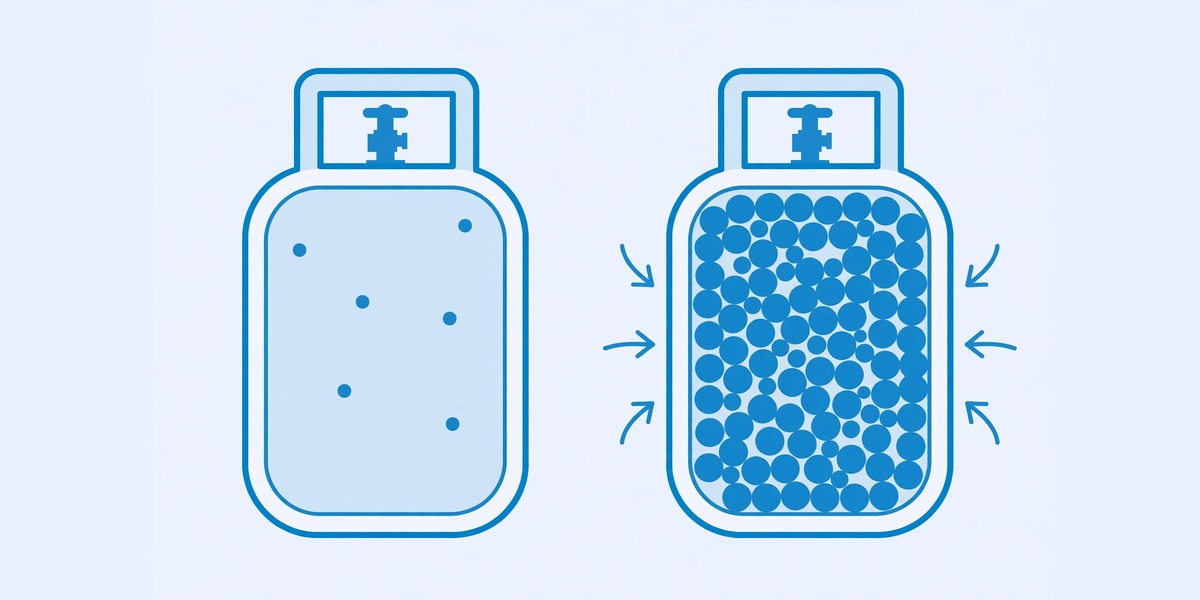
An ideal gas is a theoretical model: point particles with no volume and no intermolecular forces, obeying PV = nRT exactly. A real gas has particle volume and attractions, so it deviates, especially at high pressure or low temperature. At everyday conditions like 1 atm and room temperature, most gases behave nearly ideally.
The Ideal Gas Model: Five Assumptions
The ideal gas is a useful fiction. It imagines particles that follow five rules:
- Zero particle volume. Each molecule is treated as a mathematical point. All of the container volume is free space.
- No intermolecular forces. Particles neither attract nor repel. They travel in straight lines between collisions.
- Perfectly elastic collisions. Bounces lose no kinetic energy, so pressure never fades on its own.
- Constant random motion. Particles move in all directions at a spread of speeds.
- Kinetic energy proportional to temperature. Double the kelvin temperature and the average molecular energy doubles.
Under these rules, PV = nRT holds exactly, for every gas, at every condition. The model is simple enough to solve on paper and accurate enough to run chemistry labs, weather models, and engine designs.
Real Gases Break Two Assumptions
Real molecules are not points, and they are not indifferent to each other. Two corrections matter:
- Particles have real volume. At high pressure, molecules are packed tightly enough that their own bulk eats a meaningful share of the container. The free space is smaller than V, so the measured pressure runs higher than PV = nRT predicts.
- Particles attract each other. At low temperature, molecules move slowly enough that weak attractions pull them together, reducing the force of wall collisions. The measured pressure runs lower than ideal.
These effects fight each other: volume exclusion pushes pressure up, attractions pull it down. At moderate conditions they nearly cancel, which is why the ideal law works so well in daily life. Push to extremes and one side wins.
Ideal vs Real Gas: Side-by-Side
| Feature | Ideal gas | Real gas |
|---|---|---|
| Particle volume | Zero | Small but nonzero |
| Intermolecular forces | None | Weak attractions (and repulsions at very short range) |
| Obeys PV = nRT | Exactly, always | Approximately, at low P and high T |
| Can liquefy | Never | Yes, when cooled or compressed enough |
| Behavior at high pressure | Unchanged | Pressure higher than ideal (volume exclusion wins) |
| Behavior at low temperature | Unchanged | Pressure lower than ideal (attractions win) |
When Can You Treat a Real Gas as Ideal?
Three conditions keep a real gas inside the ideal comfort zone:
- Low pressure. Near 1 atm, molecules are far apart and their own volume is negligible. Nitrogen at 1 atm and 298 K has a compressibility factor of about 1.00, meaning ideal math is essentially exact.
- High temperature. Well above the boiling point, molecules move too fast for attractions to grab hold. Room temperature is “high” for nitrogen (boils at 77 K) and oxygen (boils at 90 K).
- Nonpolar, light molecules. Helium, hydrogen, nitrogen, and oxygen have weak attractions and follow the ideal law closely. Heavy polar molecules like water vapor and ammonia deviate sooner.
Classroom problems, atmospheric science, HVAC design, and most industrial gas handling all live in this zone. If your problem states “assume ideal behavior,” it is telling you these conditions hold.
Measuring Deviation: The Compressibility Factor
Chemists quantify non-ideality with Z, the compressibility factor: Z = PV / nRT. For a perfect ideal gas, Z equals exactly 1. For real gases, Z drifts above or below 1 as conditions get extreme.
Take 1 mol of nitrogen at 100 atm and 298 K. Ideal math predicts V = nRT / P = (1 x 0.08206 x 298) / 100 = 0.245 L. But measured Z for nitrogen there is about 1.07, so the real volume is 1.07 x 0.245 = 0.262 L, roughly 7 percent larger than ideal. At 1 atm, Z is about 1.00 and the two answers are indistinguishable.
That 7 percent is the entire story of this article in one number: the ideal law is superb at ordinary pressure and merely approximate at one hundred atmospheres. Run the ideal numbers through an ideal gas law calculator, then multiply by Z from a data table when your conditions demand real-gas accuracy.
The van der Waals Upgrade
When you need better than ideal, the classic fix is the van der Waals equation:
(P + a(n/V)^2) x (V – nb) = nRT
It patches exactly the two broken assumptions. The constant a corrects for intermolecular attractions (added to pressure), and b corrects for particle volume (subtracted from volume). Each gas gets its own a and b from experimental data; larger, more polarizable molecules get larger values.
At low pressure, the correction terms shrink to nothing and van der Waals melts back into PV = nRT. That is a good equation: it contains the simple law as a special case and extends it where the simple law fails.
Frequently Asked Questions
What is the difference between an ideal gas and a real gas?
An ideal gas is a model of point particles with no forces between them, obeying PV = nRT exactly. A real gas has molecular volume and attractions, so it deviates from PV = nRT at high pressure or low temperature.
Do ideal gases exist in real life?
No. Every real gas deviates under extreme conditions. But at low pressure and high temperature, gases like helium and nitrogen behave so close to ideal that the model is effectively true.
When do real gases behave most like ideal gases?
At low pressure, high temperature, and with small nonpolar molecules. Under those conditions particles are far apart and moving fast, so volume and attraction effects nearly vanish.
What is the compressibility factor Z?
Z = PV / nRT measures how far a real gas strays from ideal behavior. Z = 1 means ideal. Z above 1 means the gas resists compression more than ideal (particle volume dominates); below 1 means attractions dominate.
What is the van der Waals equation?
It is the ideal gas law with two corrections: (P + a(n/V)^2)(V – nb) = nRT. The constant a accounts for attractions and b for particle volume, with values fitted per gas from experiments.
Why does high pressure cause deviation from the ideal gas law?
Compression packs molecules close together until their own volume becomes a real fraction of the container. Less free space means more wall collisions, so measured pressure exceeds the ideal prediction.