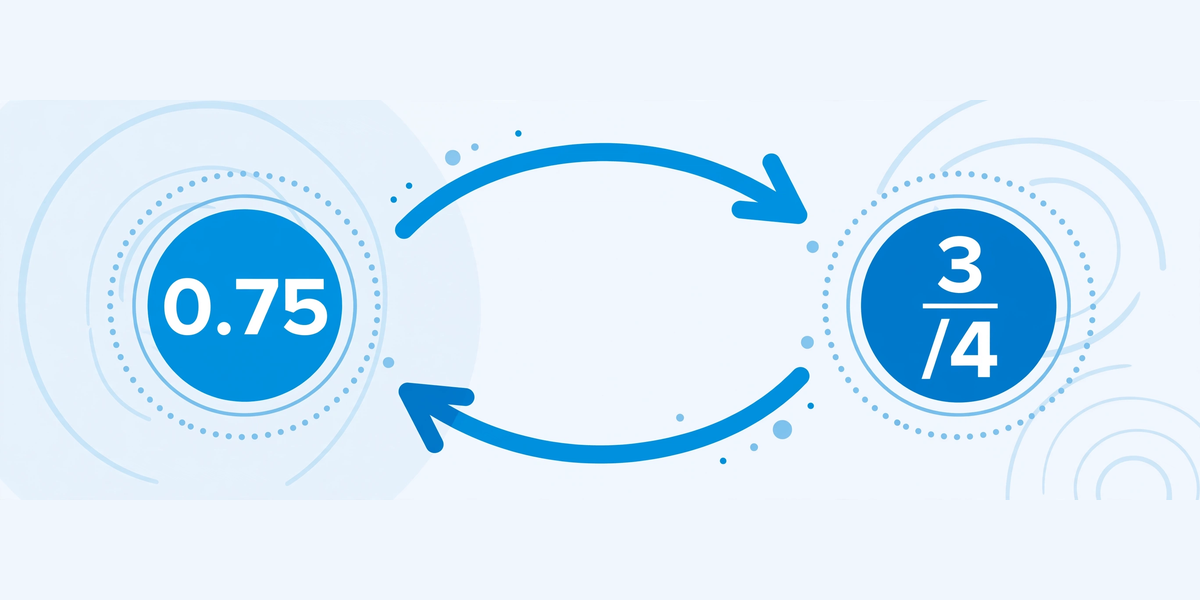
Direct answer: To convert a decimal to a fraction, write the decimal over a power of 10 that matches its decimal places, then simplify. For example, 0.75 becomes 75/100, which simplifies to 3/4. Repeating decimals need an algebra trick instead. If you need the reverse conversion, a fraction to decimal calculator checks your work instantly.
How Do You Convert a Terminating Decimal to a Fraction?
Follow these steps for any decimal that ends:
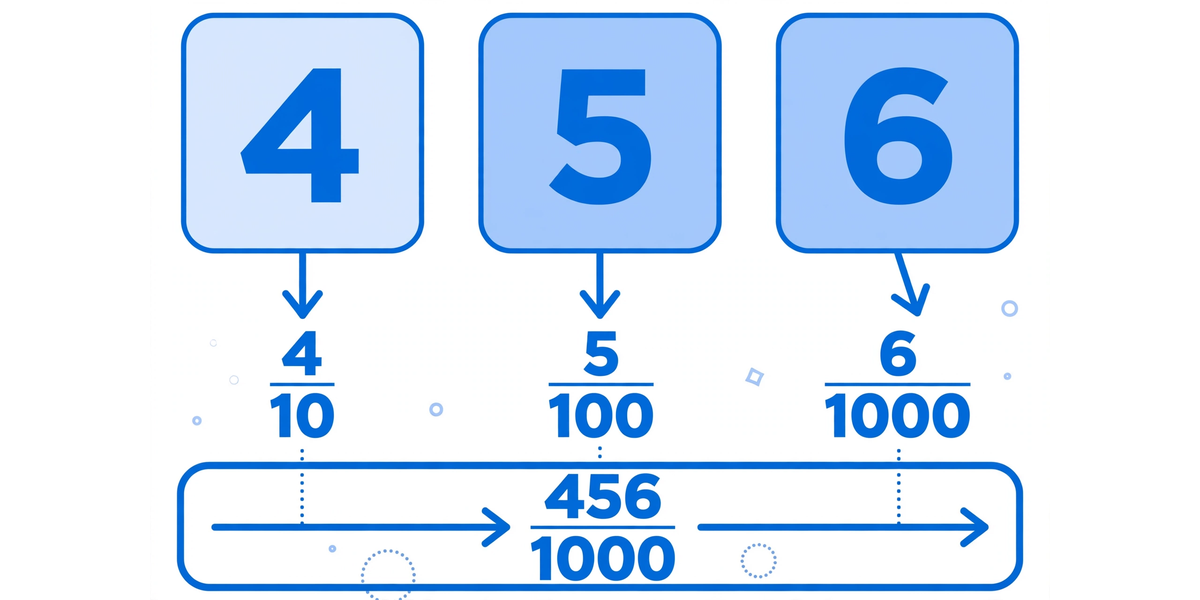
- Count the decimal places. For 0.375, there are three digits after the point.
- Write it over the matching power of 10. One place means tenths (10), two places mean hundredths (100), three places mean thousandths (1000). So 0.375 becomes 375/1000.
- Simplify the fraction. Divide the top and bottom by their greatest common divisor. For 375/1000, the GCD is 125, giving 3/8.
More verified examples: 0.5 = 5/10 = 1/2. 0.25 = 25/100 = 1/4. 0.6 = 6/10 = 3/5. 0.125 = 125/1000 = 1/8. 2.75 = 275/100 = 11/4, which as a mixed number is 2 3/4.
How Do You Simplify Quickly?
Simplifying means dividing the numerator and denominator by the same number until no common divisor remains except 1. The fastest route is the greatest common divisor (GCD). For 375/1000:
- Both end in 5 or 0, so divide by 5: 75/200.
- Again by 5: 15/40.
- Again by 5: 3/8.
- 3 and 8 share no divisor, so 3/8 is final.
Using the GCD directly (125) skips the intermediate steps. Either path reaches 3/8. A shortcut for common decimals: 0.5 = 1/2, 0.25 = 1/4, 0.75 = 3/4, 0.2 = 1/5, 0.125 = 1/8. Memorizing these saves the simplifying step.
How Do You Convert a Repeating Decimal to a Fraction?
Repeating decimals cannot go over a power of 10, so they need algebra. Here is the method for 0.333…:
- Let x equal the decimal. x = 0.333…
- Multiply by 10. 10x = 3.333…
- Subtract the original. 10x – x = 3.333… – 0.333…, which gives 9x = 3.
- Solve. x = 3/9 = 1/3.
For a two-digit repeat like 0.272727…, multiply by 100 instead: x = 0.272727…, 100x = 27.272727…, 99x = 27, so x = 27/99 = 3/11. The rule: multiply by 10 raised to the number of repeating digits, subtract, and solve.
For a mixed repeater like 0.1666…, handle the non-repeating part first. Let x = 0.1666…. Then 10x = 1.666… and 100x = 16.666…. Subtract: 90x = 15, so x = 15/90 = 1/6. Verified: 1/6 = 0.1666….
What About Decimals Greater Than 1?
Split off the whole number first. For 3.6, the whole part is 3 and 0.6 = 6/10 = 3/5, giving the mixed number 3 3/5. As an improper fraction, that is 18/5. Check: 18 divided by 5 equals 3.6. For 1.25: the whole part is 1, 0.25 = 1/4, so the answer is 1 1/4, or 5/4 as an improper fraction.
What Mistakes Should You Avoid?
- Using the wrong power of 10. 0.375 has three decimal places, so it goes over 1000, not 100. Count the digits carefully.
- Forgetting to simplify. 75/100 is correct but unfinished; the expected answer is 3/4.
- Treating a repeating decimal like a terminating one. 0.333… is not 33/100. The algebra method is required for repeats.
- Misplacing the whole number. 2.75 is 2 3/4, not 275/10. Keep the whole part separate from the fraction conversion.
When Do You Need Decimals as Fractions?
Fractions are exact while decimals often round. In carpentry, 0.333 inches is vague but 1/3 inch is exact. In recipes, 0.25 cups is 1/4 cup, a standard measuring cup. In math class, answers are usually expected as simplified fractions. Test scores, probabilities, and financial ratios all read more clearly as fractions: 0.875 becomes 7/8, which is easier to picture than eight hundred seventy-five thousandths.
How Do You Convert a Percent to a Fraction?
Percents convert through decimals. A percent is a number over 100, so 45 percent equals 45/100. Simplify by dividing top and bottom by 5 to get 9/20. Verify: 9 divided by 20 equals 0.45, which is 45 percent.
The steps are: drop the percent sign, write the number over 100, and simplify. More examples: 25 percent = 25/100 = 1/4. 60 percent = 60/100 = 3/5. 12.5 percent = 12.5/100 = 125/1000 = 1/8. For 12.5 percent, moving the decimal gives 125/1000, and dividing by 125 gives 1/8. This is why an eighth of anything is 12.5 percent.
How Do You Handle Decimals With Many Places?
Long decimals follow the same rules, just with bigger numbers. For 0.142857, write it over 1,000,000 to get 142857/1000000, then simplify. The GCD of 142857 and 1000000 is 1, so it stays as is, but notice this is the rounded form of 1/7 = 0.142857142857…. When a decimal looks like the start of a known repeating cycle, convert the repeating form instead for an exact answer.
A practical trick for messy decimals is to round to two or three places first, then convert. The decimal 0.6667 becomes 6667/10000, which does not simplify nicely. Recognizing it as approximately 2/3 is more useful. Always ask whether the problem wants an exact fraction or a rounded one before you start simplifying.
Frequently Asked Questions
How do you turn 0.75 into a fraction?
Write 0.75 as 75/100, then simplify by dividing by 25 to get 3/4. Verify: 3 divided by 4 equals 0.75.
What is 0.125 as a fraction?
1/8. Write 0.125 as 125/1000 and simplify by dividing by 125.
How do you convert 0.666… to a fraction?
Use the algebra method: x = 0.666…, 10x = 6.666…, 9x = 6, so x = 6/9 = 2/3.
What is 1.6 as a fraction?
1 3/5 as a mixed number, or 8/5 as an improper fraction. The decimal part 0.6 equals 6/10 = 3/5, and 1 + 3/5 = 8/5.
Can every decimal become a fraction?
Every terminating and repeating decimal equals some fraction. Decimals that never terminate and never repeat, like pi (3.14159…), cannot be written as fractions. Those are called irrational numbers.
How do you simplify 48/100?
Divide both numbers by their GCD, which is 4, giving 12/25. Check: 12 divided by 25 equals 0.48.