Direct answer: To convert a mixed number to a decimal, convert the fraction part to a decimal by dividing its numerator by its denominator, then add the whole number. For example, 3 2/5 becomes 3.4 because 2/5 = 0.4 and 3 + 0.4 = 3.4. You can also rewrite the mixed number as an improper fraction first. A fraction to decimal calculator with a mixed number mode does this instantly.
What Is a Mixed Number?
A mixed number combines a whole number with a fraction, like 2 1/2 or 5 3/4. It represents a value between whole numbers: 2 1/2 sits halfway between 2 and 3. Mixed numbers appear in recipes (2 1/2 cups), measurements (5 3/4 inches), and everyday quantities. Converting one to a decimal gives a single number, like 2.5, that works in calculators and spreadsheets.
What Is the Two-Step Method?
The simplest method keeps the whole number and the fraction separate:
- Convert the fraction part. Divide the numerator by the denominator. For 4 3/8, calculate 3 divided by 8, which equals 0.375.
- Add the whole number. 4 + 0.375 = 4.375. That is the answer.
This works because a mixed number is really an addition problem: 4 3/8 means 4 + 3/8. Try it with 1 1/4: the fraction 1/4 equals 0.25, and 1 + 0.25 = 1.25. With 7 2/3: the fraction 2/3 equals 0.666…, so the answer is 7.666….
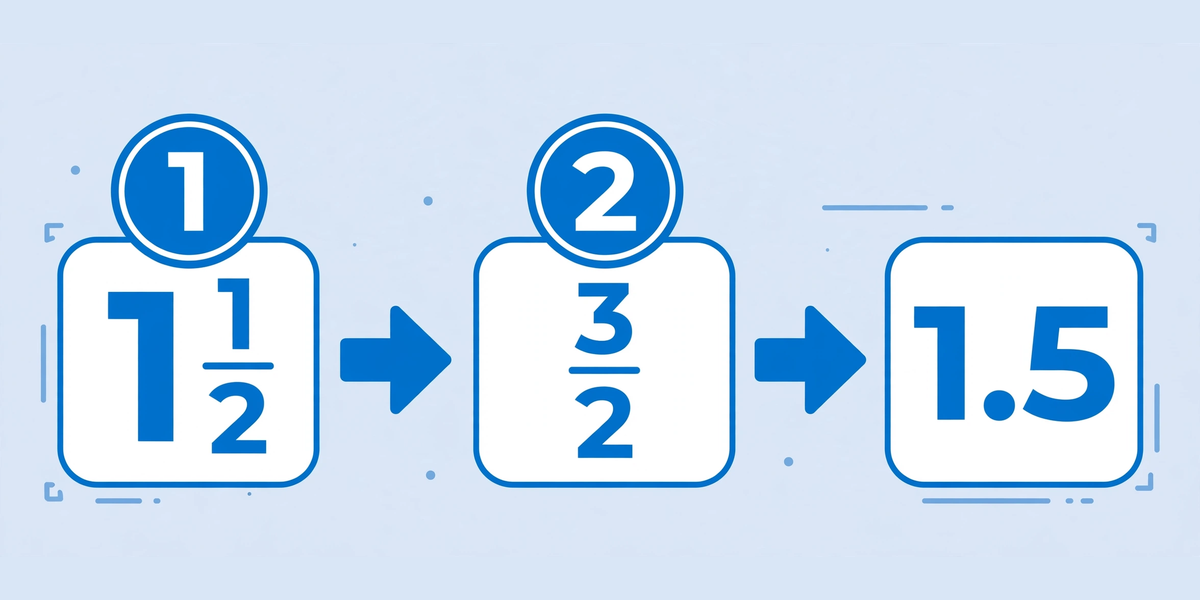
How Does the Improper Fraction Method Work?
The second method rewrites the mixed number as a single fraction first:
- Multiply the whole number by the denominator. For 4 3/8: 4 x 8 = 32.
- Add the numerator. 32 + 3 = 35. The improper fraction is 35/8.
- Divide. 35 divided by 8 equals 4.375.
Both methods always agree. The two-step method is faster for mental math, while the improper fraction method is useful when you need a single fraction for further calculation. Verify with another example: 2 5/6 becomes (2 x 6 + 5)/6 = 17/6, and 17 divided by 6 equals 2.8333…. The two-step check: 5/6 = 0.8333…, plus 2 = 2.8333…. Same result.
What About Negative Mixed Numbers?
A negative mixed number like -2 1/2 means -(2 + 1/2), which equals -2.5. The negative sign applies to the whole value, not just the whole number part. A common mistake is writing -2 + 0.5 = -1.5, which is wrong. Keep the sign on the entire quantity: convert 2 1/2 to 2.5 first, then apply the negative sign to get -2.5.
Can You Do These Mentally?
Yes, for common fractions. Memorize the easy conversions and add the whole number:
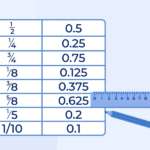
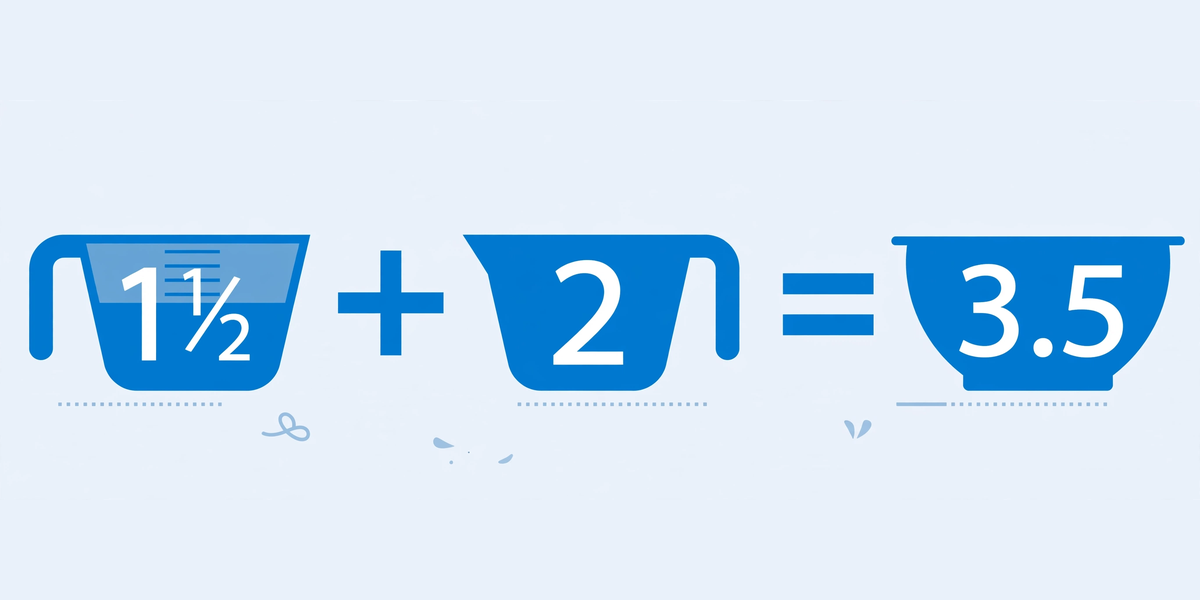
- 3 1/2 = 3.5 (1/2 = 0.5)
- 5 1/4 = 5.25 (1/4 = 0.25)
- 2 3/4 = 2.75 (3/4 = 0.75)
- 6 1/8 = 6.125 (1/8 = 0.125)
- 4 3/5 = 4.6 (3/5 = 0.6)
- 1 7/10 = 1.7 (7/10 = 0.7)
For trickier fractions like 3 5/12, do the division: 5 divided by 12 equals 0.41666…, so the answer is 3.41666…. When the fraction part repeats, the whole decimal repeats too.
What Mistakes Should You Avoid?
- Multiplying instead of adding. 2 1/2 is 2 + 0.5 = 2.5, not 2 x 0.5 = 1. The space in a mixed number means plus.
- Forgetting to convert the fraction. Writing 3 3/4 as 3.34 is wrong. The fraction 3/4 is 0.75, so the answer is 3.75.
- Mishandling the improper fraction. 2 3/8 becomes (2 x 8 + 3)/8 = 19/8, not (2 + 3)/8. Multiply the whole number by the denominator first.
- Dropping the negative sign. -1 3/4 equals -1.75, with the sign covering the entire value.
Where Do Mixed Number Decimals Appear in Real Life?
Construction uses them constantly: a board cut to 7 5/8 inches is 7.625 inches on a digital caliper. Recipes scale with them: doubling 1 1/2 cups gives 3 cups, but tripling needs 4.5 cups. Running distances, fuel economy, and fabric measurements all switch between mixed numbers and decimals. In each case, the decimal form makes multiplication and comparison easier.
How Do You Convert Large or Awkward Mixed Numbers?
The methods work the same at any size. For 25 7/16: the fraction 7/16 equals 0.4375, so the answer is 25.4375. For 12 5/12: the fraction 5/12 equals 0.41666…, so the answer is 12.41666…. When the fraction part has a large denominator, the improper fraction method keeps things organized: 25 7/16 becomes (25 x 16 + 7)/16 = 407/16, and 407 divided by 16 equals 25.4375.
If a problem asks you to round, convert first and then round. Round 8 2/3 to two decimal places: 2/3 = 0.666…, so the value is 8.666…, which rounds to 8.67. Never round the fraction before converting, because early rounding introduces error that grows in later steps.
Frequently Asked Questions
How do you convert 2 3/4 to a decimal?
Convert 3/4 to 0.75 and add 2, giving 2.75. Using the improper fraction method: (2 x 4 + 3)/4 = 11/4, and 11 divided by 4 equals 2.75.
What is 5 1/8 as a decimal?
5.125. The fraction 1/8 equals 0.125, and 5 + 0.125 = 5.125.
How do you convert a mixed number with a repeating fraction?
Convert the fraction part normally and keep the repeat mark. 2 1/3 = 2.333… because 1/3 = 0.333…. The whole number does not affect the repeating part.
Is 3.5 the same as 3 1/2?
Yes. 3.5 and 3 1/2 are two ways of writing the same value. The decimal 0.5 equals the fraction 1/2.
How do you convert a decimal back to a mixed number?
Split the decimal at the point. For 4.375, the whole number is 4 and 0.375 converts to 3/8, giving 4 3/8. A decimal-to-fraction guide walks through this reverse process.
What is -2 2/5 as a decimal?
-2.4. Convert 2 2/5 to 2.4 first (2/5 = 0.4), then apply the negative sign to the whole value.