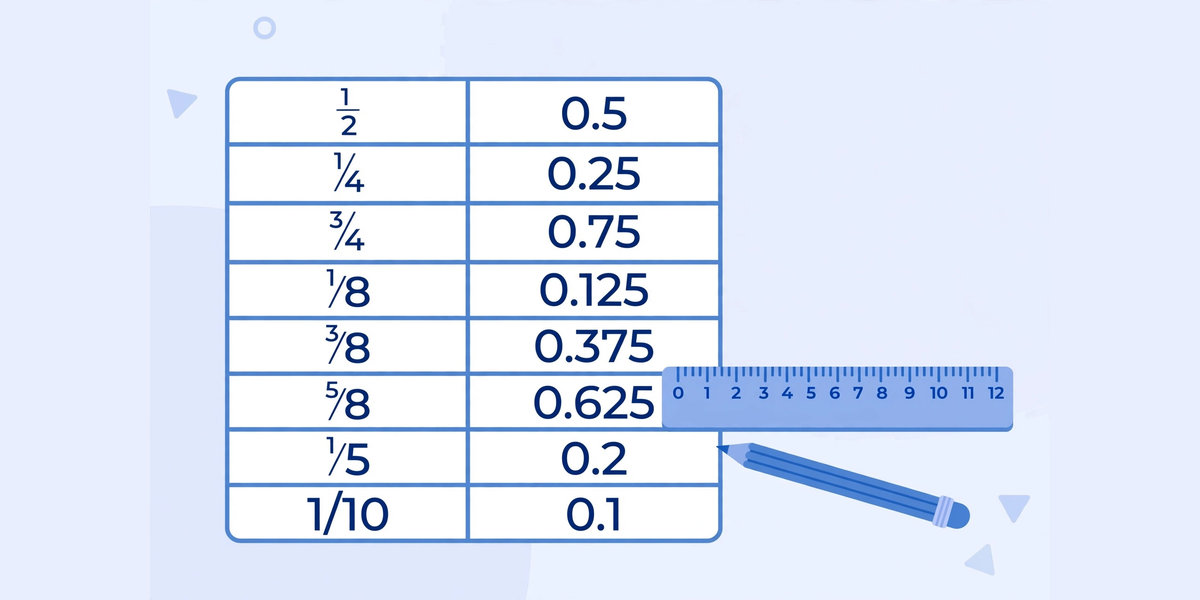
Direct answer: A fraction to decimal chart lists common fractions next to their decimal equivalents so you can look up values like 1/2 = 0.5 or 3/8 = 0.375 instantly. Use the reference table below for halves, thirds, quarters, fifths, eighths, sixteenths, and tenths. For any fraction not on the chart, a fraction to decimal calculator gives the exact value in seconds.
Why Use a Conversion Chart?
Charts save time. When you cook, build, or do homework, you meet the same fractions again and again: halves, quarters, eighths. Memorizing or bookmarking their decimal values means you skip the division entirely. A chart also builds number sense: after seeing that 3/8 = 0.375 a few times, you start to recognize the pattern without looking it up.
How Do You Read the Chart?
Find your fraction in the left column and read across to its decimal in the right column. Fractions are grouped by denominator so you can scan quickly. Values marked “repeats” continue forever; the digits shown are the start of the cycle. Every value below was verified by direct division.
Halves, Thirds, and Quarters
| Fraction | Decimal |
|---|---|
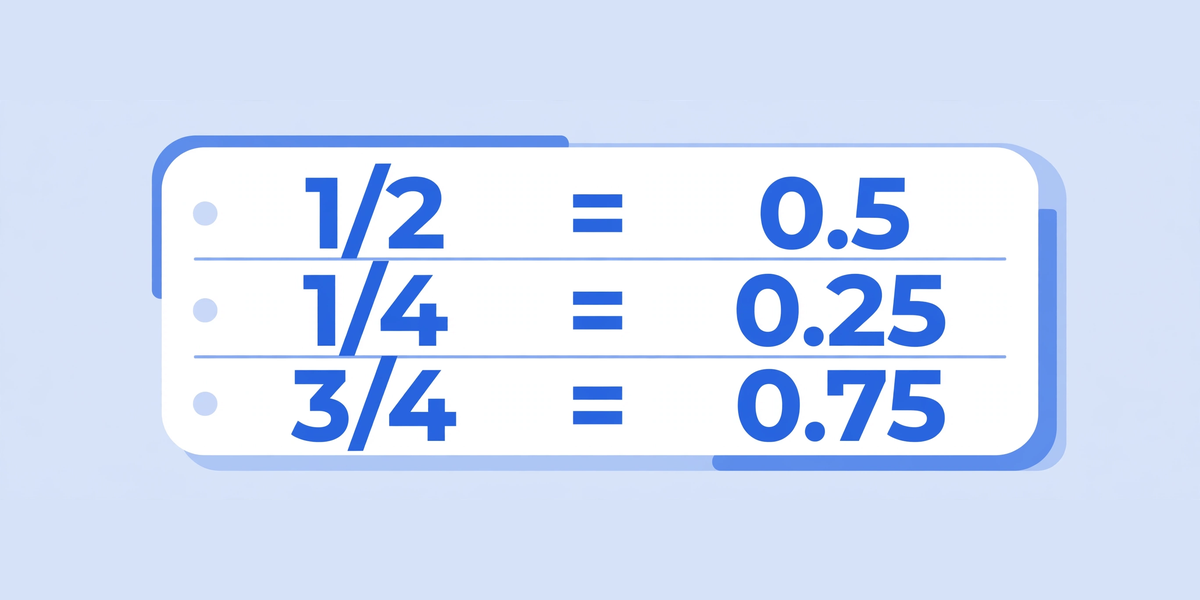
| 1/2 | 0.5 |
| 1/3 | 0.333… (repeats) |
| 2/3 | 0.666… (repeats) |
| 1/4 | 0.25 |
| 3/4 | 0.75 |
Fifths and Sixths
| Fraction | Decimal |
|---|---|
| 1/5 | 0.2 |
| 2/5 | 0.4 |
| 3/5 | 0.6 |
| 4/5 | 0.8 |
| 1/6 | 0.1666… (repeats) |
| 5/6 | 0.8333… (repeats) |
Sevenths and Eighths
| Fraction | Decimal |
|---|---|
| 1/7 | 0.142857… (repeats) |
| 1/8 | 0.125 |
| 3/8 | 0.375 |
| 5/8 | 0.625 |
| 7/8 | 0.875 |
Ninths, Tenths, and Sixteenths
| Fraction | Decimal |
|---|---|
| 1/9 | 0.111… (repeats) |
| 2/9 | 0.222… (repeats) |
| 1/10 | 0.1 |
| 3/10 | 0.3 |
| 7/10 | 0.7 |
| 9/10 | 0.9 |
| 1/16 | 0.0625 |
| 3/16 | 0.1875 |
| 5/16 | 0.3125 |
| 7/16 | 0.4375 |
| 9/16 | 0.5625 |
| 11/16 | 0.6875 |
| 13/16 | 0.8125 |
| 15/16 | 0.9375 |
How Can You Memorize the Most Useful Ones?
Start with the eighths, because they follow a neat pattern: 0.125, 0.25, 0.375, 0.5, 0.625, 0.75, 0.875. Each step up adds 0.125. Once you know 1/8 = 0.125, you can count upward: 3/8 is three steps, so 0.375. The sixteenths work the same way with steps of 0.0625.
For everyday use, these ten cover most situations: 1/2 = 0.5, 1/4 = 0.25, 3/4 = 0.75, 1/3 = 0.333…, 2/3 = 0.666…, 1/5 = 0.2, 1/8 = 0.125, 3/8 = 0.375, 5/8 = 0.625, 7/8 = 0.875. Learn these and you will rarely need to divide.
What If Your Fraction Is Not on the Chart?
No chart can list every fraction, so for values like 7/13 or 5/12, divide the numerator by the denominator or use an online converter. A quick check: 5/12 = 0.41666… (repeats), because 12 = 2 x 2 x 3 and the factor 3 causes repetition. The chart handles the common cases; division handles everything else.
How Do Teachers and Students Use This Chart?
Teachers print the chart as a classroom reference so students can check their long division work. Students use it to verify homework answers and to build speed on timed tests. A good study habit is to cover the decimal column, quiz yourself on each fraction, and reveal the answers to check. Flashcards made from the ten most common conversions work well for this.
How Do You Use This Chart for Homework?
Use the chart as a checker, not a shortcut around learning. First solve the conversion yourself with long division, then find the fraction in the table and compare. If your answer matches, move on. If it does not match, redo the division and look for the step where you went wrong. This habit builds both speed and accuracy.
For word problems, the chart helps you translate measurements fast. If a recipe calls for 3/4 cup and you are scaling it by 1.5, the chart gives you 0.75 right away, and 0.75 x 1.5 = 1.125 cups. If a woodworking plan lists 11/16 inch and your digital caliper reads decimals, the chart shows 0.6875 instantly. Keep the page bookmarked on your phone for the workshop or kitchen.
How Can You Extend the Chart Yourself?
You can add any fraction with one division. To extend the sixteenths, keep adding 0.0625: 15/16 = 0.9375 was the last entry, and whole sixteenths end there. For thirty-seconds, start from 1/32 = 0.03125 and add 0.03125 per step: 3/32 = 0.09375, 5/32 = 0.15625, 7/32 = 0.21875, 9/32 = 0.28125, 11/32 = 0.34375, 13/32 = 0.40625, 15/32 = 0.46875. Tape measures in the US commonly use thirty-seconds, so this extension is handy for precise work. Verify each by division: 13 divided by 32 equals 0.40625.
For twelfths, note that they repeat: 1/12 = 0.08333…, 5/12 = 0.41666…, 7/12 = 0.58333…, 11/12 = 0.91666…. The denominator 12 factors into 2 x 2 x 3, and the factor 3 causes the repetition. Mark these clearly if you add them to a printed chart.
Frequently Asked Questions
What is 5/8 as a decimal?
5/8 equals 0.625. Five steps of 0.125 (the value of 1/8) give 0.625, and long division confirms it: 8 into 50 goes 6 times (remainder 2), into 20 goes 2 times (remainder 4), into 40 goes 5 times exactly.
What is 7/16 as a decimal?
7/16 equals 0.4375. Seven steps of 0.0625 (the value of 1/16) give 0.4375.
Which fractions on the chart repeat?
The thirds (1/3, 2/3), 1/6, 5/6, 1/7, 1/9, and 2/9 repeat. Their denominators contain prime factors other than 2 and 5, so the division never ends.
How accurate are the repeating values shown here?
The digits shown are the start of an exact repeating cycle, not rounded approximations. 1/3 = 0.333… means the 3 continues forever. For calculations, keep the fraction form to stay exact.
Is there a printable version of this chart?
You can bookmark this page or print it from your browser for a desk reference. The tables above are organized by denominator so the values are easy to find on paper too.
What is the decimal for 11/16?
11/16 equals 0.6875. Eleven steps of 0.0625 give 0.6875, which sits between 5/8 (0.625) and 3/4 (0.75).